Unlocking the Visual Rhythm: An Exploration of Victor Vasarely’s *Tavoll-Rouge*
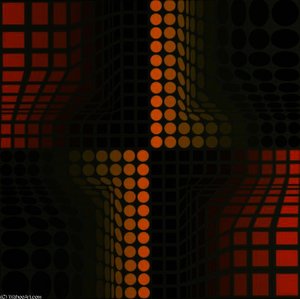
Victor Vasarely's Tavoll-Rouge is more than just an abstract painting; it’s a meticulously crafted invitation to experience perception itself. Created in the vibrant hues of red, purple, and orange, this Op Art masterpiece, executed with oil on canvas, embodies the revolutionary spirit of the mid-20th century. The artwork's intricate composition – a dense network of circles and squares – immediately draws the viewer into its dynamic surface, challenging conventional notions of space and form. Vasarely, born Károly Vaszary in 1906 in Pécs, Croatia, was a pivotal figure in the development of Op Art, a movement that sought to evoke optical illusions through precise geometric arrangements. His journey began with an initial interest in medicine, but a profound fascination with visual expression led him to painting, ultimately shaping his groundbreaking approach to art.
The Genesis of Kinetic Illusion
Vasarely’s artistic trajectory was profoundly influenced by the Bauhaus movement and Sándor Bortnyik's “Műhely” workshop. This environment fostered a deep understanding of functional design and geometric abstraction – principles that would become the bedrock of his style. He wasn't simply creating pretty pictures; he was investigating how our eyes and brains process visual information. The seemingly random arrangement of circles and squares in Tavoll-Rouge is, in fact, a carefully calculated system designed to manipulate the viewer’s perception of depth and movement. This technique, central to Op Art, aims to create an illusion of kinetic energy, as if the painting were subtly shifting and changing before your eyes.
Decoding the Color Language
The deliberate use of color in Tavoll-Rouge is crucial to its impact. The dominant reds, purples, and oranges aren’t merely decorative; they are strategically deployed to heighten the optical illusion. These warm tones intensify the sense of movement and create a visually stimulating experience. Vasarely's mastery lies in his ability to harness color psychology, using it not just to represent reality but to actively engage with the viewer’s visual system. The layering of shapes and colors creates a complex interplay that demands attention and rewards careful observation.
A Legacy of Geometric Abstraction
Tavoll-Rouge stands as a testament to Vasarely's pioneering work in geometric abstraction, solidifying his place as one of the most influential artists of the 20th century. His influence extends beyond Op Art, impacting fields like graphic design and architecture. Reproductions of this artwork offer an accessible entry point into Vasarely’s world, allowing collectors and interior designers to incorporate a piece of art history into their spaces – a visual echo of a revolutionary approach to perception and form.



 In echtem Maßstab anzeigen
 Zum Druck wechseln
 Versenden als Grußkarte
 Teilen
 Details anzeigen

 Herunterladen
 Ähnliche Objekte
 Röntgenaufnahme
 Diashow
 Besucherstatistiken

 Mehr anzeigen






































 Die Glasoption ist nur für Größen unter 110 cm verfügbar.