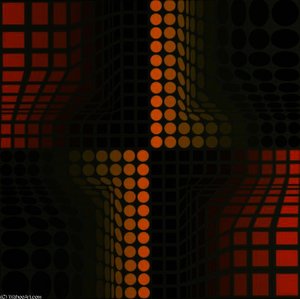
A Symphony in Geometric Precision: Exploring Victor Vasarely’s “Sikra”
Victor Vasarely's "Sikra," painted in 1966, is more than just a colorful composition; it’s a meticulously crafted portal into the heart of Op Art and a testament to the revolutionary approach Vasarely took to visual perception. Born Károly Vaszary in 1906 in Pécs, Croatia – then part of Austria-Hungary – his artistic trajectory began unexpectedly with medical studies before he was drawn to the expressive power of painting. This shift, fueled by influences from the Bauhaus movement and Sándor Bortnyik’s “Műhely” workshop, led him to a singular focus: exploring how our eyes perceive depth and movement through geometric abstraction. "Sikra" exemplifies this pursuit with breathtaking clarity.
- Subject Matter: The artwork eschews traditional representational imagery entirely. Instead, it presents a dynamic arrangement of shapes – squares, circles, triangles, and more – each rendered with an almost obsessive attention to detail.
- Style & Technique: This piece is a quintessential example of Op Art, a movement that emerged in the 1960s aiming to create optical illusions through precise geometric patterns. Vasarely’s technique involved meticulous layering of paint and careful consideration of color relationships to generate an illusion of movement and depth without any actual change in the artwork itself.
The Genesis of Optical Illusions: Op Art and its Pioneers
“Sikra” belongs to a pivotal moment in art history – the rise of Op Art, spearheaded by artists like Vasarely, Bridget Riley, and Kenneth Noland. This movement challenged conventional notions of representation, arguing that art could be experienced primarily through visual perception rather than traditional subject matter. Vasarely’s work was deeply influenced by kinetic art and his interest in the scientific study of optics. He sought to translate mathematical principles – specifically, the way our eyes perceive motion and depth – into a purely visual language. The vibrant colors employed aren't merely decorative; they are strategically chosen to heighten the optical effect, manipulating the viewer’s perception of space.
Decoding the Visual Language: Symbolism and Perception
While seemingly abstract, “Sikra” invites contemplation about the nature of perception itself. The overlapping shapes create a sense of infinite depth, drawing the eye into a complex interplay of forms. Vasarely wasn’t simply arranging shapes; he was creating a visual puzzle for the viewer to solve – a meditation on how our brains actively construct reality. The sheer precision and scale of these geometric elements suggest an underlying order, reflecting Vasarely's fascination with mathematical harmony and his belief that art could reveal fundamental truths about the universe.
A Legacy in Color and Form
Painted in 1966, “Sikra” stands as a powerful example of Victor Vasarely’s enduring contribution to modern art. His pioneering work with Op Art continues to influence artists and designers today, demonstrating the profound impact of exploring the relationship between perception and form. A hand-painted reproduction of "Sikra" offers an exceptional opportunity to bring this iconic artwork into your space, allowing you to experience firsthand the captivating illusion and intellectual depth that define Vasarely’s legacy.



 In echtem Maßstab anzeigen
 Handgemalte Reproduktion kaufen
 Versenden als Grußkarte
 Teilen
 Details anzeigen
 Leitfaden

 Herunterladen
 Ähnliche Objekte
 Röntgenaufnahme
 Diashow
 Besucherstatistiken

 Mehr anzeigen






































 Die Glasoption ist nur für Größen unter 110 cm verfügbar.