Victor Vasarely’s *Okta-Sarga*: A Journey Into Geometric Perception
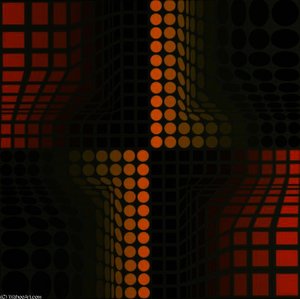
Victor Vasarely's *Okta-Sarga*, created around 1968, stands as a monumental achievement in the realm of Op Art and a testament to his lifelong fascination with the relationship between mathematics, perception, and visual experience. This striking artwork, dominated by meticulously arranged hexagonal shapes, immediately captivates with its dynamic sense of depth and perspective – an illusion expertly crafted through carefully calibrated color gradients and receding lines. It’s not merely a decorative piece; it's an invitation to contemplate the very nature of how we see and interpret the world around us.
- A Pioneer of Op Art: Vasarely was at the forefront of the Op Art movement, which emerged in the 1960s as a reaction against representational art. This style sought to stimulate optical illusions through precise patterns and controlled visual effects, challenging viewers’ perceptions of space and form.
- Geometric Precision: The artwork's core is built upon a rigorously geometric foundation – hexagons, squares, and triangles layered to create an illusion of infinite depth. This deliberate use of basic shapes speaks to Vasarely’s belief in the fundamental role of geometry in shaping our visual experience.
Technique and Materials: Digital Rendering of a Master's Vision
*Okta-Sarga* exemplifies Vasarely’s innovative approach to artmaking, utilizing digital rendering techniques that were at the cutting edge of his time. The artwork was likely created using computer-generated imagery, employing precise pixel manipulation and sophisticated color gradients to achieve its remarkable visual impact. The smooth texture, achieved through layering and digital precision, belies the complex mathematical calculations underpinning the composition. Unlike traditional painting methods, this piece relies on the controlled manipulation of data – a reflection of Vasarely’s embrace of modern technology as a tool for artistic exploration.
- Digital Precision: The artwork's creation involved meticulous control over color and shape using digital rendering software.
- Layered Complexity: Subtle variations in tone and hue, achieved through layering, create a sense of volume and depth within the seemingly flat composition.
Symbolism and Emotional Impact
Beyond its purely visual impact, *Okta-Sarga* resonates with deeper symbolic meanings. The repetition of hexagonal shapes evokes associations with order, structure, and potentially infinity – concepts central to Vasarely’s philosophical inquiries. The radial arrangement creates a sense of vortex or tunnel, drawing the viewer's eye into the heart of the composition and suggesting an exploration of inner space. The artwork’s effect is profoundly calming yet stimulating; it invites contemplation and offers a momentary escape from the everyday world. It’s a piece that rewards repeated viewing, revealing new nuances with each observation.
Historical Context and Legacy
Created in 1968, *Okta-Sarga* reflects the broader artistic and intellectual currents of its time – the rise of Op Art, the influence of the Bauhaus movement, and a growing interest in scientific theories related to perception. Victor Vasarely’s work continues to inspire artists and designers today, demonstrating the enduring power of geometric abstraction and its ability to challenge our understanding of reality. A hand-painted reproduction of *Okta-Sarga* offers a unique opportunity to experience this iconic artwork firsthand, bringing its captivating visual effects into your home or office.



 Handgemalte Reproduktion kaufen
 Versenden als Grußkarte
 Teilen
 Details anzeigen
 Leitfaden

 Herunterladen
 Ähnliche Objekte
 Diashow
 Besucherstatistiken

 Mehr anzeigen






































 Die Glasoption ist nur für Größen unter 110 cm verfügbar.