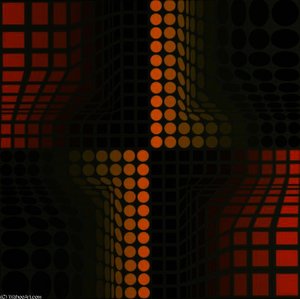
A Symphony in Squares: Exploring Victor Vasarely’s *Folkokta*
Victor Vasarely's Folkokta is more than just a colorful arrangement of squares; it’s a meticulously crafted portal into the heart of Op Art and a testament to the revolutionary ideas that shaped 20th-century art. Born in 1906 in Pécs, Croatia – then part of Austria-Hungary – Vasarely's artistic trajectory began unexpectedly, with an initial pursuit of medicine before he was captivated by the possibilities of visual expression. This shift led him to the Podolini-Volkmann Academy and, crucially, to Sándor Bortnyik’s “Műhely,” a workshop deeply rooted in the principles of Bauhaus functional design and geometric abstraction. It was within this environment that Vasarely's unique vision began to coalesce – a fascination with how our perception is manipulated by visual stimuli, particularly movement and vibration.
The Genesis of Kinetic Art
Folkokta exemplifies Vasarely’s pioneering work in kinetic art, a field he largely defined. He wasn't simply painting shapes; he was exploring the *illusion* of movement through static forms. The seemingly random arrangement of squares is, in fact, a carefully calculated orchestration designed to trick the eye and create an optical illusion. This technique, central to Op Art, aimed to stimulate sensory perception directly, bypassing conscious thought and engaging the viewer on a visceral level. The artist meticulously controlled color relationships and spatial variations to generate this dynamic effect – a subtle but powerful demonstration of how our brains interpret visual information.
Color as a Catalyst for Perception
Vasarely’s masterful use of color is integral to the artwork's impact. The vibrant palette—a rich tapestry of reds, greens, blues, yellows, and purples—isn't chosen arbitrarily. Each hue was carefully selected to amplify the optical illusion, creating areas of simultaneous contrast and visual tension. The overlapping squares generate a sense of depth and movement, drawing the eye across the composition in a seemingly endless dance. This deliberate manipulation of color is a hallmark of Vasarely’s approach, reflecting his belief that art could directly influence our emotional and psychological states.
A Legacy of Geometric Abstraction
Folkokta stands as a significant piece within Victor Vasarely's extensive body of work. It represents the culmination of his lifelong exploration into geometric abstraction, influenced by the Bauhaus movement’s emphasis on functionality and clarity. His influence extended far beyond the art world, impacting graphic design, architecture, and even industrial product development. Today, reproductions like this offer a window into a pivotal moment in artistic history – a time when artists began to actively investigate the very nature of perception itself. This artwork is not just decoration; it’s an intellectual exercise rendered visually, inviting contemplation on the relationship between art, science, and human experience.



 Vorschau anzeigen
 Zu Druck wechseln
 Versenden
 Teilen
 Details anzeigen

 Herunterladen
 Ähnliche Objekte
 Röntgenaufnahme
 Diashow
 Statistiken

 Weiterlesen






































 Die Glasoption ist nur für Größen unter 110 cm verfügbar.