Eridan: A Symphony in Geometric Abstraction
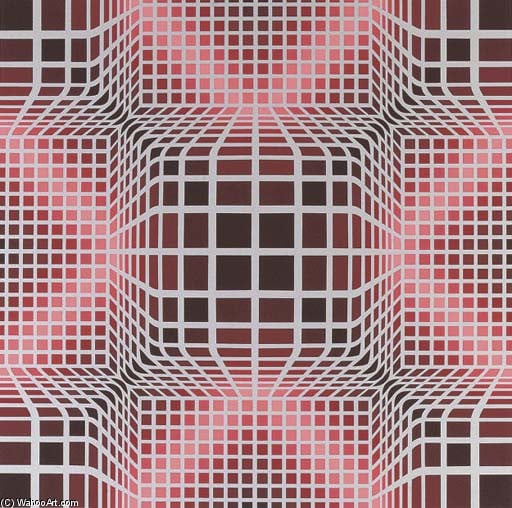
WahooArt.com presents an exquisite hand-painted reproduction of Victor Vasarely’s “Eridan,” a captivating exploration of visual perception and the fundamental building blocks of form. This artwork, reminiscent of Vasarely's groundbreaking Op Art movement, invites viewers into a world where color and geometry coalesce to create a dynamic and intensely engaging experience. The image itself – a close-up photograph of the original painting – immediately draws the eye to its meticulously crafted design: a vibrant interplay of red and pink hues arranged in a striking checkered pattern. It’s an invitation to deconstruct and reconstruct visual reality, mirroring Vasarely's own relentless pursuit of understanding how our eyes perceive depth and movement.
The Legacy of Victor Vasarely and Op Art
Born Károly Vaszary in 1906 in Pécs, Croatia, Victor Vasarely’s artistic journey began with a surprising detour – medical studies at Eötvös Loránd University. However, his fascination with visual expression led him to abandon this path and embrace the burgeoning world of modern art. Influenced profoundly by the Bauhaus movement and Sándor Bortnyik's “Műhely” workshop, Vasarely developed his signature style: a rigorous exploration of geometric abstraction. “Eridan,” like much of his work, exemplifies Op Art – Optical Art – a movement that emerged in the mid-20th century, challenging traditional notions of representation and focusing instead on the optical effects created by precise patterns and color relationships. Vasarely’s meticulous approach, honed through years of experimentation with color fields and geometric forms, resulted in artworks that seem to shimmer and vibrate before the viewer's eyes.
Decoding the Composition: Color and Geometry
The composition of “Eridan” is deliberately unsettling yet profoundly harmonious. The dominant red and pink hues are not simply applied randomly; they’re strategically arranged within a checkered pattern, creating an illusion of movement and depth. This technique, central to Vasarely's practice, exploits the way our eyes perceive spatial relationships. The seemingly static arrangement generates a dynamic visual experience, prompting the viewer to actively engage with the artwork. The precision of the design – a hallmark of Vasarely’s work – suggests a deep understanding of mathematical principles and their application in artistic creation. It's a testament to his belief that art could be both intellectually stimulating and emotionally resonant.
Symbolism and Emotional Impact
"Eridan," despite its abstract nature, evokes a sense of dynamism and energy. The vibrant colors and geometric patterns stimulate the senses, creating an immersive experience for the viewer. Vasarely’s work transcends mere decoration; it's a meditation on perception itself. The artwork invites contemplation about how we interpret the world around us – how our brains actively construct reality from visual information. This reproduction offers a unique opportunity to bring this powerful piece of modern art into your home or office, adding a touch of intellectual sophistication and visual excitement to any space.


 In echtem Maßstab anzeigen
 Zum Druck wechseln
 Versenden als Grußkarte
 Teilen
 Details anzeigen
 Leitfaden

 Herunterladen
 Ähnliche Objekte
 Röntgenaufnahme
 Diashow
 Besucherstatistiken

 Mehr anzeigen






































 Die Glasoption ist nur für Größen unter 110 cm verfügbar.