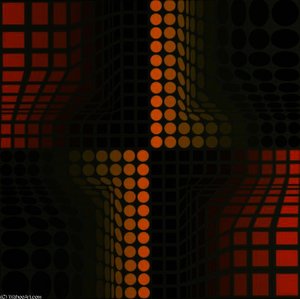
A Geometric Void: Exploring Victor Vasarely’s *Axo-11*
Victor Vasarely's Axo-11 is not merely a painting; it’s an invitation to contemplate the very nature of perception. Created by one of the foremost figures in Op Art, this striking black and white composition immediately commands attention with its deceptively simple arrangement: a meticulously checkered square punctuated by a startlingly vibrant blue void. The image, a photographic representation of Vasarely's original work, captures the essence of his groundbreaking approach – a systematic exploration of optical illusions and the dynamic effects created through geometric abstraction.
The Birth of Op Art and Kinetic Vision
Born in 1906 in Pécs, Croatia (then part of Austria-Hungary), Károly Vaszary, as he was initially known, embarked on a remarkable artistic journey. Initially drawn to medicine, his passion shifted dramatically upon enrolling at the Podolini-Volkmann Academy and later Sándor Bortnyik’s influential “Műhely” workshop – a direct descendant of the Bauhaus movement. This immersion in functional design and geometric abstraction proved transformative. Vasarely wasn't simply painting; he was meticulously constructing visual experiences, anticipating the rise of Op Art with his focus on manipulating perception through controlled patterns and color variations. His work reflects a deep engagement with the theories of Gestalt psychology, particularly the principles of figure-ground relationships – the inherent human tendency to organize visual elements into meaningful wholes.
Technique and Composition: A Calculated Illusion
The creation of Axo-11 exemplifies Vasarely’s precise technique. The black and white checkered pattern, achieved through meticulous layering and control of pigment density, generates a subtle but powerful sense of movement. This is not accidental; it's the deliberate orchestration of visual elements designed to trick the eye. The blue void, strategically placed at the center, acts as a focal point, intensifying the illusion of depth and creating an unsettling yet captivating dynamic. Vasarely’s process involved painstaking hand-painting, ensuring each element contributed to the overall effect – a testament to his dedication to precision and control. The seemingly static image is, in fact, a carefully constructed illusion, demanding active engagement from the viewer.
Symbolism and Emotional Resonance
Beyond its purely optical properties, Axo-11 carries symbolic weight. The square, a fundamental geometric form, represents stability and order – yet this is immediately disrupted by the void, suggesting emptiness, uncertainty, or perhaps even the subconscious. The blue color itself, often associated with tranquility and spirituality, introduces an element of contrast and intrigue. Vasarely’s work isn't about depicting reality; it’s about exploring the subjective experience of seeing. The piece evokes a sense of both fascination and unease, prompting viewers to question their own perceptions and the way they interpret visual information. It’s a powerful reminder that our understanding of the world is inherently constructed.



 Vorschau anzeigen
 Handgemalte Reproduktion bestellen
 Versenden
 Teilen
 Details anzeigen

 Herunterladen
 Ähnliche Objekte
 Röntgenaufnahme
 Diashow
 Stats
Stats

 Weiterlesen






































 Die Glasoption ist nur für Größen unter 110 cm verfügbar.