Victor Vasarely – Atelier Arcay: A Dance of Geometry and Perception
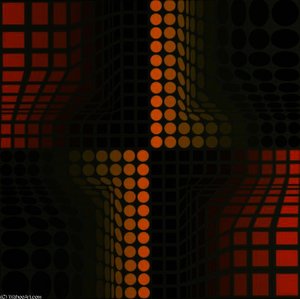
The artwork “Atelier Arcay” by Victor Vasarely is more than simply a visual composition; it’s an invitation to engage with the very nature of perception. Created in the heart of the Op Art movement, this vibrant piece, likely produced as a screenprint around 1960, embodies Vasarely's lifelong fascination with how our eyes and brains interpret form and space. It’s a testament to his pioneering work in exploring optical illusions and creating dynamic visual experiences – a world where flat surfaces seem to shimmer with depth and movement.
Vasarely, born Károly Vásárhelyi in Pécs, Croatia (now part of Hungary) in 1906, initially pursued medicine before dedicating himself fully to art. His early training at the Podolini-Volkmann Academy in Budapest exposed him to the principles of functional design and geometric abstraction – concepts that would become the bedrock of his unique style. The influence of the Bauhaus movement is palpable, emphasizing clarity, order, and a deliberate rejection of traditional representational techniques. This shift towards abstraction wasn’t arbitrary; Vasarely sought to strip away the superfluous, focusing instead on the fundamental elements of visual perception.
A Symphony of Shapes: Composition and Technique
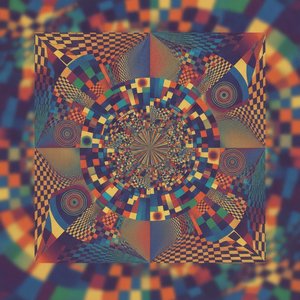
The composition of “Atelier Arcay” is strikingly symmetrical, anchored by a central vertical axis. Interlocking hexagons and diamonds dominate the scene, arranged in intricate patterns that deliberately challenge our sense of depth. These geometric units aren’t simply placed; they actively interact, creating a subtle but persistent illusion of movement – as if the image is subtly shifting before your eyes. The artist masterfully employs repetition and transformation to generate this dynamic effect. The use of thin, crisp black lines delineates each shape with precision, reinforcing the sense of order within what could otherwise appear chaotic.
Considering the likely production method – screenprint or lithograph – reveals much about Vasarely’s meticulous approach. The flat application of color, devoid of shading or blending, is characteristic of these techniques. Achieving this effect required careful registration of multiple layers of ink, a testament to the artist's technical skill and attention to detail. The absence of texture further emphasizes the graphic quality of the work, inviting us to focus solely on the interplay of shape and color.
Color, Contrast, and Emotional Resonance
The bold color palette – featuring strong contrasts between red, blue, green, and purple – is crucial to the artwork’s impact. These colors aren't mixed or blended; they exist as distinct, flat planes, creating a vibrant and energetic visual field. The deliberate use of contrasting hues intensifies the optical effects, further amplifying the sense of movement and depth. Vasarely wasn’t interested in depicting realistic scenes; instead, he sought to evoke feelings – energy, dynamism, and even a slight disorientation.
While devoid of explicit symbolism, “Atelier Arcay” resonates with a powerful emotional charge. It taps into our innate fascination with visual illusions and the way our brains process information. The work can be interpreted as an exploration of the relationship between perception and reality – a reminder that what we *see* is not always what *is*. The Fondation Vasarely, established by the artist himself, continues to showcase his groundbreaking contributions to art history, solidifying his legacy as a pioneer of Op Art and kinetic art.
Collecting a Legacy: Reproduction and Inspiration
WahooArt offers meticulously crafted hand-painted reproductions of “Atelier Arcay,” allowing you to experience the brilliance of Victor Vasarely’s vision in stunning detail. These reproductions capture not only the artwork's vibrant colors and intricate patterns but also the subtle nuances of its optical effects. Whether for a contemporary interior space or as a collector’s piece, this artwork offers a unique opportunity to engage with a pivotal moment in art history – a testament to the power of geometry and perception.



 Vorschau anzeigen
 Handgemalte Reproduktion bestellen
 Versenden
 Teilen
 Details anzeigen

 Herunterladen
 Ähnliche Objekte
 Röntgenaufnahme
 Diashow
 Statistiken

 Weiterlesen






































 Die Glasoption ist nur für Größen unter 110 cm verfügbar.