Giclée- oder Leinwanddruck in Museumsqualität mit schneller Produktion und flexiblen Veredelungsoptionen. ( Handgemalte Reproduktion bestellen Bild kaufen)





























Wählen Sie aus unseren vordefinierten Formaten, die den ursprünglichen Proportionen des Kunstwerks entsprechen.

Sie können Ihre eigenen Maße eingeben, um ein bestimmtes Format oder einen speziellen Platz einzupassen. Wenn das von Ihnen gewählte Format nicht den Proportionen des Originalbildes entspricht, werden wir das Kunstwerk entweder beschneiden oder das Bild mit einem gespiegelten oder einfarbigen Rand erweitern. Ein digitaler Entwurf wird Ihnen zur Genehmigung zugesandt, bevor die Produktion beginnt.
Bitte beachten Sie, dass die Vorschau auf dem Bildschirm nicht den tatsächlichen Zuschnitt oder die Erweiterung widerspiegelt. Nur der Entwurf zeigt die endgültige Komposition präzise an.
Obwohl Sondermaße verfügbar sind, empfehlen wir die Auswahl eines Maßes aus der vordefinierten Liste, um die ursprünglichen Proportionen zu bewahren.
Weltweiter Versand () innerhalb von 2 Wochen statt der üblichen 4/5 Wochen. (6 September)


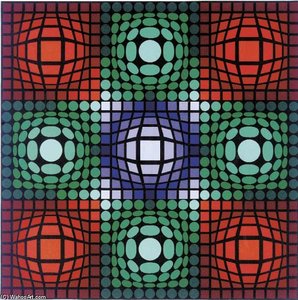
Abstract composition
Format der Reproduktion
Victor Vasarely's 'Abstract Composition' is more than just a painting; it’s an invitation to question the very nature of visual reality. Created by one of the foremost figures in Op Art, this vibrant work encapsulates the movement’s core philosophy – to manipulate perception through carefully constructed geometric forms and intense color contrasts. The image presents a meticulously crafted three-dimensional cube, dissected into four distinct sections, each rendered with a bold palette of red, green, blue, and yellow. The interplay between solid blocks of color and intricate patterned surfaces creates an illusion of movement and depth, drawing the viewer’s eye across the canvas in a captivating dance.
Born in 1906 in Pécs, Croatia – then part of Austria-Hungary – Károly Vaszary, as he was initially known, embarked on an artistic journey profoundly shaped by the intellectual currents of his time. His early studies in medicine were abruptly abandoned in favor of a pursuit far more compelling: visual expression. This pivotal shift occurred during his enrollment at the Podolini-Volkmann Academy and, crucially, within the influential workshop of Sándor Bortnyik, where he was immersed in the principles of functional design and geometric abstraction championed by the Bauhaus movement. The Bauhaus’s emphasis on reducing form to its essential elements – lines, planes, and colors – directly informed Vasarely's groundbreaking approach, laying the foundation for his signature Op Art style. This work exemplifies that influence, demonstrating a deliberate attempt to trick the eye through controlled optical illusions.
Vasarely’s technique in ‘Abstract Composition’ is characterized by its precision and meticulous attention to detail. Each square is rendered with an almost photographic accuracy, yet the combination of solid color and patterned surfaces generates a powerful illusion of depth and movement. The artist skillfully employs contrasting colors – the saturated red against the cool green, the vibrant blue juxtaposed with the warm yellow – to heighten this effect. This deliberate manipulation of visual stimuli creates a dynamic experience for the viewer, forcing them to actively engage with the artwork and question their own perception. The use of flat planes and sharp edges, hallmarks of Op Art, further contributes to the illusion of three-dimensionality, creating a mesmerizing visual paradox.
'Abstract Composition' transcends mere aesthetic appeal; it speaks to fundamental questions about how we experience the world. The geometric cube, a symbol of stability and structure, is deliberately fragmented, suggesting a disruption of traditional notions of form and space. This fragmentation mirrors the anxieties and uncertainties of the modern era, reflecting a desire to understand and control the increasingly complex realities of the 20th century. The overall effect is one of intense visual stimulation – captivating, slightly unsettling, and ultimately profoundly rewarding. It’s a testament to Vasarely's genius that he could create an artwork that simultaneously challenges and delights the viewer, inviting contemplation on the relationship between art, perception, and reality.
Victor Vasarely (geboren Károly Vaszary) war eine zentrale Figur in der Entwicklung der Op Art und kinetischen Kunst. Seine Arbeit versuchte, die traditionelle Malerei zu überwinden, indem er optische Illusionen erforschte und dynamische visuelle Erfahrungen schuf. Geboren in Pécs, damals Teil Österreich-Ungarns (heute Kroatien), umfassten seine frühen Jahre ein Medizinstudium an der Eötvös Loránd Universität in Budapest, bevor er sich ganz der Kunst widmete.
Vasarelys Beitrag zur Kunstgeschichte ist vielschichtig. Er ging über traditionelle Maltechniken hinaus, um Werke zu schaffen, die die Wahrnehmung des Betrachters aktiv einbeziehen. Sein systematischer Ansatz forderte konventionelle Vorstellungen künstlerischer Kreativität heraus und ebnete den Weg für computergenerierte Kunst und digitales Design. Indem er Reproduzierbarkeit und kommerzielle Anwendungen annahm, verschwamm Vasarely die Grenzen zwischen bildender Kunst und Populärkultur und hinterließ einen bleibenden Eindruck in beiden Bereichen.

1906 - 1997 , Kroatien

Explore the profound spiritual depth of geometric abstraction. From Malevich's Suprematism to modern masters, our expert guide reveals how pure form and color command presence in fine art collections.

 Vorschau anzeigen
 Versenden
 Teilen
 Details anzeigen

 Herunterladen
 Ähnliche Objekte
 Röntgenaufnahme
 Diashow

 Weiterlesen







 Die Glasoption ist nur für Größen unter 110 cm verfügbar.