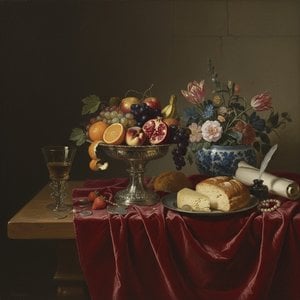
A Silent Witness to Resilience: The Poignant Still Life of Norbert Troller
In the quiet, shadowed corners of art history, few works possess the profound emotional weight found in Terezin: Still-life. Painted in 1942 by the Czech-American artist Norbert Troller, this intimate composition serves as much more than a mere study of objects; it is a hauntingly beautiful testament to the human spirit amidst the darkness of the Theresienstadt concentration camp. At first glance, the viewer is met with a collection of mundane items—a red lipstick tube, various bowls, cups, and bottles—arranged with a deliberate, almost rhythmic precision. Yet, beneath this surface-level arrangement lies a narrative of survival and the desperate attempt to maintain a sense of normalcy and dignity in an environment defined by deprivation.
The composition is anchored by the striking presence of a single red lipstick tube, positioned centrally like a beacon of color against the more muted tones of the surrounding vessels. This splash of crimson acts as a powerful symbol of identity and the lingering traces of civilization. Surrounding this focal point, the artist has meticulously placed bowls and bottles that create a sense of structured space within the frame. The way the light interacts with the glass of the bottles and the curves of the ceramic bowls suggests a mastery of form, where each object occupies its own small territory of existence, much like the prisoners themselves striving to hold onto their individual humanity.
Technically, Troller utilizes a style that blends the observational precision of traditional still life with a poignant, documentary-like gravity. The arrangement of the three bowls and two cups creates a visual movement that guides the eye across the table, yet there is an underlying tension in the stillness. The artist’s background as an architect is subtly evident in the balanced, architectural placement of the objects, providing a sense of order to a world that had descended into chaos. This structural stability provides a stark, moving contrast to the historical reality of the work's creation, making the painting an evocative piece for collectors who value art that speaks to the depth of the human experience.
For the discerning collector or interior designer, Terezin: Still-life offers a unique opportunity to possess a piece of profound historical significance. As a high-quality reproduction, it brings a sophisticated and contemplative energy to any space, serving as a conversation starter that invites deep reflection. It is not merely a decoration but an emotional anchor—a reminder that even in the most desolate circumstances, beauty and the will to create can endure. This work stands as a masterpiece of resilience, making it an invaluable addition to a collection dedicated to art that transcends time and touches the very soul.



 Vorschau anzeigen
 Zu Druck wechseln
 Versenden
 Teilen
 Details anzeigen

 Herunterladen
 Ähnliche Objekte
 Röntgenaufnahme
 Diashow
 Statistiken


 Weiterlesen






































 Die Glasoption ist nur für Größen unter 110 cm verfügbar.