


 Acryl auf LeinwandWandkunstVenetian Renaissance
 1576Renaissance
 146.0 x 155.0 cm
 Palazzo Ducale
Giclée- oder Leinwanddruck in Museumsqualität mit schneller Produktion und flexiblen Veredelungsoptionen. ( Handgemalte Reproduktion bestellen Bild kaufen)





























Wählen Sie aus unseren vordefinierten Formaten, die den ursprünglichen Proportionen des Kunstwerks entsprechen.

Sie können Ihre eigenen Maße eingeben, um ein bestimmtes Format oder einen speziellen Platz einzupassen. Wenn das von Ihnen gewählte Format nicht den Proportionen des Originalbildes entspricht, werden wir das Kunstwerk entweder beschneiden oder das Bild mit einem gespiegelten oder einfarbigen Rand erweitern. Ein digitaler Entwurf wird Ihnen zur Genehmigung zugesandt, bevor die Produktion beginnt.
Bitte beachten Sie, dass die Vorschau auf dem Bildschirm nicht den tatsächlichen Zuschnitt oder die Erweiterung widerspiegelt. Nur der Entwurf zeigt die endgültige Komposition präzise an.
Obwohl Sondermaße verfügbar sind, empfehlen wir die Auswahl eines Maßes aus der vordefinierten Liste, um die ursprünglichen Proportionen zu bewahren.
Weltweiter Versand () innerhalb von 2 Wochen statt der üblichen 4/5 Wochen. (7 September)


Mercure et les Grâces
Format der Reproduktion
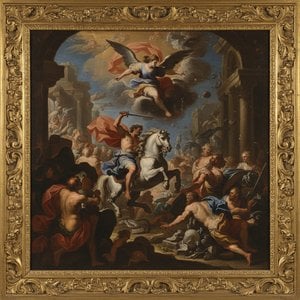
Jacopo Tintoretto’s Mercure et les Grâces stands as a cornerstone of Venetian Renaissance art—a painting that transcends mere depiction to embody an entire worldview. Completed in 1576 and housed within the opulent Palazzo Ducale in Venice, Italy, this monumental oil on canvas isn’t simply a visual spectacle; it's a carefully orchestrated dialogue between pagan mythology and Christian piety.
At first glance, the painting presents a serene tableau featuring Mercury—the Roman messenger god—surrounded by three radiant Graces. These goddesses embody beauty, charm, and grace, their poses conveying an effortless elegance that captivates the eye. Each Grace performs distinct actions: one delicately holds a mirror reflecting divine light, another offers a handkerchief symbolizing purity, while the third seems lost in contemplation – hinting at deeper philosophical questions about human existence.
Beyond the central figures lie additional characters—men and women strategically positioned throughout the scene—contributing to an atmosphere of dynamism and narrative complexity. Tintoretto’s masterful use of chiaroscuro—the dramatic interplay between light and shadow—creates a palpable sense of depth, pulling viewers into this ethereal realm. The luminous glow emanating from Mercury illuminates the Graces' forms, emphasizing their ethereal beauty and reinforcing the painting’s overarching theme: the triumph of divine grace over earthly concerns.
Tintoretto was renowned for his revolutionary approach to painting—a technique he termed “Il Furioso,” characterized by rapid brushwork, bold color palettes, and an unparalleled ability to capture movement. Mercure et les Grâces exemplifies this style perfectly. The artist’s brushstrokes dart across the canvas with astonishing speed, conveying a sense of energy and immediacy that distinguishes Tintoretto from his contemporaries.
Furthermore, Tintoretto's innovative use of perspective—particularly atmospheric perspective—creates an illusion of depth that transports viewers to the palazzo’s interior. The artist skillfully renders textures and contours, capturing the subtle nuances of light and shadow with breathtaking precision. This meticulous attention to detail underscores Tintoretto’s commitment to realism while simultaneously elevating the painting to a level of artistic grandeur.
Tintoretto flourished during the Venetian Renaissance—a period marked by unprecedented artistic innovation and cultural vibrancy. Venice, as a maritime republic, served as a hub for trade and intellectual exchange, fostering an environment conducive to artistic experimentation. Mercure et les Grâces reflects the humanist ideals of the era—celebrating beauty, intellect, and human potential—while simultaneously acknowledging the influence of Christian faith.
The painting’s placement within the Palazzo Ducale—Venice's seat of power—further underscores its significance as a symbol of Venetian prestige and artistic achievement. It stands alongside other masterpieces by Tintoretto and Titian, forming a testament to Venice’s enduring legacy as one of Europe’s most influential cultural centers.
Tintoretto's Mercure et les Grâces remains an unforgettable artwork—a captivating fusion of mythological grandeur and artistic virtuosity. Its luminous colors, dynamic composition, and Tintoretto’s masterful technique continue to inspire admiration and awe centuries after its creation. For those seeking a glimpse into the splendor of Venetian Renaissance art, reproductions of this iconic masterpiece offer a profound connection to one of history's greatest artistic treasures.


1518 - 1594 , Italien

Embark on a sophisticated journey through the eternal allure of mythological art. Discover how master painters breathe life into ancient legends, from Greek deities to Baroque masterpieces, and learn to curate these timeless narratives within your own exquisite art collection.
Explore the breathtaking power of Baroque art. Delve into the dramatic interplay of light, shadow, and motion through the works of masters like Caravaggio. Discover how the era's intense emotional realism continues to inspire collectors and connoisseurs of classical grandeur.

Explore the profound elegance of Baroque Classicism. Discover how masters fused dramatic chiaroscuro with structured order to redefine art history through light, shadow, and emotional grandeur.

Explore the breathtaking drama of the Baroque era. From the mastery of chiaroscuro to epic mythological narratives, discover a definitive guide to art's most powerful period of light, shadow, and emotion for the true classical art enthusiast.

 Vorschau anzeigen
 Versenden
 Teilen
 Details anzeigen

 Herunterladen
 Ähnliche Objekte
 Röntgenaufnahme
 Diashow
 Weiterlesen







 Die Glasoption ist nur für Größen unter 110 cm verfügbar.


