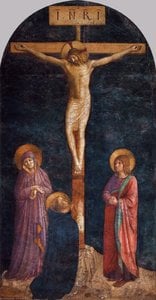
Introduction to the Painting and its Creator
Fra Angelico, born Guido di Pietro, was an early Italian Renaissance painter who is best known for his frescoes in the Convent of San Marco in Florence. His masterpiece, “The Baptism of Christ,” exemplifies the characteristics of the Early Renaissance Art Movement and showcases Fra Angelico’s exceptional skills as an artist.
Born around 1395 in Rupesana, near Florence, Guido di Pietro received his initial artistic training as an illuminator within the monastery walls – a tradition deeply rooted in Florentine piety. This formative experience instilled in him a meticulous attention to detail and a profound understanding of color theory, skills that would later translate into breathtaking frescoes.
The Convent of San Marco itself represents a pivotal moment in Florentine history; it was rebuilt by Cosimo de’ Medici during the Renaissance, attracting artists and intellectuals eager to contribute to its splendor. Fra Angelico's involvement in this ambitious project cemented his reputation as one of Florence’s foremost painters.
Historical Context: The Florentine Renaissance
The Florentine Renaissance, spanning from approximately 1400 to 1600 AD, marked a dramatic shift in European art and culture. Driven by humanist ideals—a renewed fascination with classical antiquity—artists began to explore human anatomy and emotion with unprecedented realism. Simultaneously, the patronage of wealthy families like the Medici fueled artistic innovation and propelled Florence to become the epicenter of artistic creativity.
This movement wasn’t merely about aesthetics; it was a profound reimagining of humanity's place in the cosmos—a belief that man possessed inherent dignity and potential for greatness. This spirit permeated every facet of Florentine life, influencing everything from philosophy to literature to, undeniably, painting.
Artistic Analysis: Fra Angelico’s Masterpiece
"The Baptism of Christ" embodies the core tenets of Early Renaissance Art. The painting's serene landscape—a stylized depiction of the Jordan River—creates a contemplative atmosphere that invites viewers into the sacred narrative. Notice the masterful use of perspective, subtly guiding the eye towards Jesus and John the Baptist, establishing a harmonious visual balance.
Furthermore, Fra Angelico’s meticulous attention to detail is evident in every brushstroke. The drapery folds are rendered with astonishing accuracy, conveying texture and movement—a departure from the stylized forms of Gothic art. The luminous colors—primarily blues and golds—enhance the painting's spiritual grandeur.
The Baptism of Christ: A Narrative Masterpiece
The fresco depicts Jesus being baptized by John the Baptist in the River Jordan, a pivotal moment in Christian theology symbolizing purification and divine grace. Fra Angelico skillfully divides the composition into two distinct sections—the upper portion featuring a dove representing the Holy Spirit descending upon Jesus—and the lower part showcasing the figures of Jesus and John the Baptist.
This arrangement powerfully communicates the theological significance of the event, emphasizing Jesus’s humility before baptism and John’s role as herald of salvation. The faces of the saints are rendered with expressive emotion, conveying reverence and awe – a testament to Fra Angelico's ability to infuse his art with profound spiritual feeling.
The Legacy of Fra Angelico and “The Baptism of Christ”
"The Baptism of Christ" remains an enduring symbol of Renaissance piety and artistic excellence. Its influence can be seen in countless subsequent artworks, inspiring artists across Europe for centuries. Today, you can appreciate Fra Angelico’s genius through high-quality handmade oil painting reproductions at WahooArt.com – allowing you to bring the beauty of San Marco into your own home.
More information about Fra Angelico and his artistic journey can be found on this page.



 Vorschau anzeigen
 Zu Druck wechseln
 Versenden
 Teilen
 Details anzeigen

 Herunterladen
 Ähnliche Objekte
 Röntgenaufnahme
 Diashow
 Statistiken

 Weiterlesen






































 Die Glasoption ist nur für Größen unter 110 cm verfügbar.