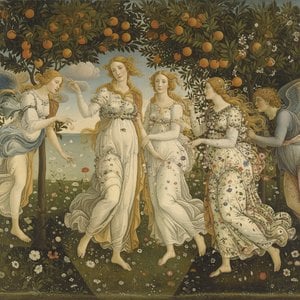
Calumny of Apelles - A Renaissance Masterpiece Decoded
Sandro Botticelli’s *Calumny of Apelles*, painted around 1495, stands as an extraordinary testament to the artistic spirit of Florence during its golden age. More than just a visually striking image—a vibrant depiction of mythological figures bathed in ethereal light—it's a profound meditation on reputation, slander, and the devastating consequences of deceitful words. This artwork continues to fascinate scholars and artists alike, prompting ongoing discussions about its intricate symbolism and masterful execution.
Subject & Narrative: Mythological Allegory Unleashed
The painting draws inspiration from a tale recounted by Pliny the Elder concerning Apelles, the celebrated sculptor of Alexander the Great. The narrative centers on Apelles’s predicament—he is subjected to relentless accusations and whispers of impropriety by Calumny (false accusation), who embodies the destructive force of slander. Surrounding him are figures representing Ignorance, eagerly absorbing the malicious rumors; Suspicion, watchful and wary; and a regal King Alexander, whom Apelles strives to impress with his artistic prowess.
Style & Technique: Botticelli’s Elegant Linearity
- Renaissance Linearity: Botticelli distinguishes himself through an elegant style characterized by flowing lines that define the figures and architectural elements. This stylistic choice reflects a deliberate departure from Gothic conventions, embracing the Renaissance emphasis on clarity and precision—a hallmark of his artistic vision.
- Oil Painting & Detail: Executed in oil paints on canvas, *Calumny* showcases Botticelli’s meticulous attention to detail. The smooth rendering of skin contrasts sharply with the textured drapery, creating a rich surface that captures subtle nuances of light and shadow.
Historical Context & Inspiration: Savonarola's Florence
Botticelli created this painting during a turbulent period in Florence under the influence of Girolamo Savonarola’s fervent religious fervor. The artwork serves as a veiled critique of the slanderous attacks leveled against Botticelli himself and his patrons, particularly Lorenzo de’ Medici—a reflection of the anxieties prevalent within Florentine society at the time.
Symbolism & Meaning: Decoding Layers of Interpretation
- Calumny: The central figure embodies the destructive power of false accusations, depicted as a captivating beauty whose allure masks her malicious intent.
- Truth/Venus: Venus represents Truth attempting to assert herself amidst Calumny’s darkness—a poignant reminder of vulnerability and the importance of safeguarding honor.
*Calumny* resonates deeply with viewers due to its dramatic lighting, expressive gestures, and masterful composition. It invites contemplation on themes of justice, integrity, and the enduring impact of words upon reputation. This artwork remains an exceptional addition to any collection, sparking conversation and inspiring admiration for Botticelli’s unparalleled artistic skill.
Photo Description: --Overall Impression-- The artwork is a Renaissance-era oil painting depicting a scene of divine revelation and human interaction. It features a nude female figure, likely Venus or another goddess associated with beauty and love, standing prominently in the foreground. She gestures upwards towards a celestial being depicted on a pillar behind her. Below, a cloaked and aged man kneels in supplication before her. The composition is complex and layered, utilizing architectural elements like columns and arches to create depth and a sense of grandeur. The use of lines is primarily linear, defining the architecture and figures with sharp edges and precise details. Shapes are predominantly geometric – rectangles, squares, and circles – forming the structure of the scene. Textures appear smooth in areas, particularly on the skin of the female figure, while the drapery and architectural elements exhibit a more tactile quality due to the brushstrokes. Lighting is dramatic, emanating from an unseen source above and behind the central figures, casting strong shadows and highlighting key features. Perspective is employed to create a sense of depth, with receding architectural forms and diminishing size of objects in the distance. The color palette is dominated by warm earth tones – ochres, browns, and reds – contrasted with cooler blues and greens in the background.
Size: Unknown
Date: Unknown
Fragen & Antworten
Welche Atmosphäre würde eine Reproduktion von "Verleumdung" von Sandro Botticelli in einen Raum bringen?
Die Dramatisch Atmosphäre von "Verleumdung" von Sandro Botticelli passt perfekt zu dem empfohlenen Ort: einem Wohnbereich.
Welcher Strömung und welcher Epoche ist "Verleumdung" von Sandro Botticelli zuzuordnen?
In "Verleumdung" von Sandro Botticelli trifft die Renaissance-Strömung auf die Ära der Renaissance.
Wie stellt "Verleumdung" von Sandro Botticelli eine Verbindung zwischen Renaissance und dem Heimatland des Künstlers her?
Das Werk "Verleumdung" aus der Epoche des Renaissance wurde von einem Künstler geschaffen, der in Italien geboren wurde.



 In echtem Maßstab anzeigen
 Handgemalte Reproduktion kaufen
 Versenden als Grußkarte
 Teilen
 Details anzeigen
 Leitfaden öffnen

 Herunterladen
 Ähnliche Objekte
 Röntgenaufnahme
 Diashow
 Besucherstatistiken

 Mehr anzeigen






































 Die Glasoption ist nur für Größen unter 110 cm verfügbar.