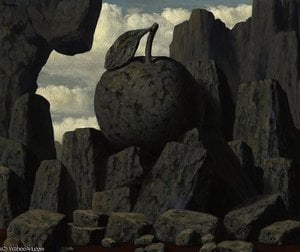
René Magritte’s “Hegel’s Holiday”: A Dreamscape of Paradox
Rene Magritte's "Hegel’s Holiday," painted in 1958, isn’t merely a visual representation; it’s an invitation to a profound meditation on perception and the elusive nature of reality. This iconic surrealist work, rendered in oil on canvas, immediately captivates with its unsettling juxtaposition – a stark black umbrella, seemingly defying gravity, cradling a glass of water as if holding a miniature ocean within its protective curve. The scene unfolds against a backdrop of a calm, almost unnervingly still sea and the distant suggestion of a rocky shoreline, creating an atmosphere both serene and profoundly disquieting. It’s a painting that lingers in the mind long after you've first encountered it, prompting questions about what we *think* we see and how our minds construct meaning from visual stimuli.
The Surrealist Impulse: Challenging Reality
Magritte was a key figure within the burgeoning Surrealist movement of the early 20th century. Rejecting the rationalism that dominated much of Western art at the time, Surrealists sought to unlock the power of the unconscious mind. They believed that dreams, intuition, and illogical juxtapositions held access to deeper truths about human experience. “Hegel’s Holiday” perfectly embodies this approach. Magritte deliberately subverts our expectations, presenting familiar objects – an umbrella, water, a sea – in utterly unexpected combinations. This deliberate disruption forces the viewer to actively engage with the artwork, abandoning passive observation and instead becoming an active participant in constructing meaning.
Symbolism Unveiled: Knowledge, Temptation, and the Unknown
The symbolism within “Hegel’s Holiday” is layered and open to interpretation. The black umbrella, a recurring motif in Magritte's work, often represents protection, but here it feels more like a shield against an unseen threat or perhaps even a barrier between the viewer and the reality depicted. The glass of water, suspended above the sea, can be read as a symbol of knowledge – contained yet potentially overwhelming. It also carries a subtle suggestion of temptation; the water invites us to look closer, to delve deeper into the painting’s mysteries. The sea itself represents the vast, unknowable expanse of existence, while the distant shoreline hints at the challenges and obstacles inherent in navigating life's journey. Interestingly, the title references Georg Wilhelm Friedrich Hegel, a German philosopher known for his complex theories on dialectic and the relationship between thought and reality. Magritte playfully suggests that taking a “holiday” from this intellectual framework is itself an act of rebellion.
Technique and Emotional Resonance: A Masterclass in Illusion
Magritte’s meticulous technique contributes significantly to the painting's unsettling effect. He employs a precise, almost photographic realism – rendering each element with painstaking detail. Yet, this hyperrealism is deliberately combined with illogical arrangements, creating a sense of cognitive dissonance. The smooth, polished surfaces of the umbrella and water contrast sharply with the rough texture of the sea, further emphasizing the painting’s paradoxical nature. The muted color palette—primarily shades of gray, black, and blue—reinforces the atmosphere of quiet contemplation and subtle unease. “Hegel’s Holiday” isn't simply a pretty picture; it’s an emotionally resonant work that taps into our deepest anxieties about perception, knowledge, and the limitations of human understanding. It invites us to confront the unsettling beauty of the unknown.
A high-quality reproduction of “Hegel’s Holiday” offers a remarkable opportunity to bring this captivating surrealist masterpiece into your home or office. Its enigmatic imagery will undoubtedly spark conversation and serve as a constant reminder of the complexities inherent in our perception of reality.



 In echtem Maßstab anzeigen
 Zum Druck wechseln
 Versenden als Grußkarte
 Teilen
 Details anzeigen
 Leitfaden

 Herunterladen
 Ähnliche Objekte
 Röntgenaufnahme
 Diashow
 Besucherstatistiken
 Mehr anzeigen