


Die auf dieser Seite dargestellten Kunstwerke sind urheberrechtlich geschützt, was bedeutet, dass wir keine identische Reproduktion rechtmäßig erstellen oder verkaufen dürfen. Dieser Schutz wird durch internationale Abkommen wie die Berner Übereinkunft und durch nationale Gesetze, einschließlich derer, die von den US-Urheberrecht – Titel 17.
Diese Methode entspricht vollumfänglich den Urheberrechtsbestimmungen, da sie keine Kopie oder Vervielfältigung des geschützten Kunstwerks darstellt. Stattdessen handelt es sich um eine kreative Neuinterpretation – ein neues Gemälde, das vom Original inspiriert, aber nicht identisch mit ihm ist.
Giclée- oder Leinwanddruck in Museumsqualität mit schneller Produktion und flexiblen Veredelungsoptionen. ( Handgemalte Reproduktion bestellen Zum digitalen Bild wechseln)





























Wählen Sie aus unseren vordefinierten Formaten, die den ursprünglichen Proportionen des Kunstwerks entsprechen.

Geben Sie die benötigte Breite und Höhe an, damit der Druck perfekt in Ihren Rahmen oder an Ihre Wand passt. Ein Druck kann nur beschnitten, aber niemals größer als das Originalbild angefertigt werden; daher verliert ein Format mit anderen Proportionen einen Teil des Bildes. Wir senden Ihnen ein digitales Mockup zur Freigabe, bevor wir den Druck ausführen. Das auf dieser Seite gezeigte Bild zeigt nicht den tatsächlichen Beschnitt – dies ist nur im Mockup ersichtlich.
Weltweiter Versand () innerhalb von 2 Wochen statt der üblichen 4/5 Wochen. (10 November)
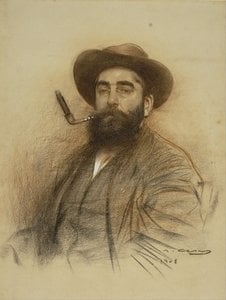
Self-portrait
Format der Reproduktion
In this evocative 1908 drawing, we are invited into the intimate, smoke-filled atmosphere of a bygone era. The piece serves as a profound window into the life of Ramon Casas Carbó, an artist who did not merely paint the world around him but acted as its visual chronicler. Through the delicate yet commanding use of line and shadow, the work captures a moment of quiet introspection. A man, seated with a poised, crossed-legged stance, anchors the composition; his presence is defined by the rugged texture of his beard and the thoughtful weight of his gaze. As he holds a pipe, a thin trail of implied smoke suggests a pause in time, inviting the viewer to share in this contemplative stillness. The monochromatic palette strips away the distractions of color, forcing an encounter with the raw, structural essence of the subject's character.
The technique employed here speaks to the mastery of draftsmanship that defined the Catalan Modernisme movement. Every stroke of the pencil or charcoal serves a purpose, building volume and depth through meticulous hatching and tonal gradations. The artist’s ability to render the heavy fabric of the clothing against the soft, organic textures of facial hair creates a tactile experience for the eye. While the central figure commands our attention, the subtle presence of others in the background adds a layer of social complexity, suggesting that this private moment is occurring within the vibrant, bustling pulse of Barcelona’s intellectual circles. This interplay between the individual and the collective is a hallmark of Casas's ability to capture both personal identity and societal transformation.
For the discerning collector or interior designer, this work offers more than mere decoration; it provides a sense of historical gravity and intellectual depth. The stark, black-and-white aesthetic makes it a versatile masterpiece, capable of anchoring a contemporary minimalist space with its classic elegance or adding a layer of sophisticated nostalgia to a traditional study. It is a piece that demands conversation, acting as a bridge between the late nineteenth-century's artistic revolution and the modern aesthetic. To possess a reproduction of this self-portrait is to hold a fragment of Catalonia's golden age, bringing an atmosphere of timeless wisdom and artistic prestige into any curated environment.
Das Original "Self-portrait" befindet sich im Museu Nacional d'Art de Catalunya; das Werk ist noch urheberrechtlich geschützt.
"Self-portrait" von Ramon Casas Carbó ist noch urheberrechtlich geschützt. Dieser Status bestimmt, wie das Bild des Werkes vervielfältigt werden darf.
"Self-portrait" wird Ramon Casas Carbó zugeschrieben.

Spanien

Erfahren Sie alles über die Meisterschaft von Licht und Schatten in der Fotografie. Entdecken Sie die Ästhetik der Monochromie jetzt.

Verwandeln Sie Ihre wertvollsten Momente in zeitlose Meisterwerke. WahooArt bietet exklusive, handgemalte Ölreproduktionen im Stil der alten Meister. Erleben Sie höchste Handwerkskunst und Chiaroscuro-Technik für ein bleibendes Erbe in Ihrem Zuhause. Jetzt Beratung anfordern.

Explore the profound artistry of graphite drawing. Discover professional techniques for mastering depth, texture, and detail through a lens of art history, from classical sketches to modern masterpieces. Elevate your understanding of the pencil medium with our expert guide.

Erfahren Sie alles über klassische Zeichnungstechniken und Chiaroscuro. Meistern Sie die Kunst der Linie und des Lichts!
 Vorschau anzeigen
 Versenden
 Teilen
 Details anzeigen
 Leitfaden

 Herunterladen
 Ähnliche Objekte
 Röntgenaufnahme
 Diashow
 Fragen & Antworten
 Statistiken


 Weiterlesen









 Die Glasoption ist nur für Größen unter 110 cm verfügbar.


