


Handgemaltes Ölgemälde auf Leinwand in Ihrer Wunschgröße und mit Rahmen, auf Bestellung von unseren Künstlern angefertigt. ( Druck bestellen Bild kaufen)





























Wählen Sie aus unseren vordefinierten Formaten, die den ursprünglichen Proportionen des Kunstwerks entsprechen.

Sie können Ihre eigenen Maße eingeben, um einen bestimmten Rahmen oder Platz auszufüllen. Wenn die gewählte Größe nicht den Proportionen des Originalbildes entspricht, werden wir das Kunstwerk entweder beschneiden oder das Gemälde durch zusätzliche, handgemalte Elemente erweitern. Ein digitales Mockup wird Ihnen zur Genehmigung zugesandt, bevor die Produktion beginnt.
Bitte beachten Sie, dass die Bildschirmvorschau nicht die tatsächliche Beschneidung oder Erweiterung widerspiegelt. Nur das Mockup zeigt die endgültige Komposition exakt an.
Obwohl Sondermaße verfügbar sind, empfehlen wir, eine Größe aus der vordefinierten Liste zu wählen, um die ursprünglichen Proportionen beizubehalten.
Weltweiter Versand () in nur 3 bis 4 Wochen statt der üblichen 5 Wochen. (7 September). Keine Kompromisse bei der Qualität.


St Johannes der Täufer
Format der Reproduktion
Raphael’s *St John the Baptist*, painted in 1506, stands as an emblem of Renaissance idealism—a masterful distillation of humanist thought and artistic innovation. More than merely a depiction of Saint John’s biblical narrative, this painting delves into the profound psychological depth characteristic of Raphael's oeuvre, capturing not just a figure but an essence of faith and nascent spirituality.
The artwork presents a young St John, nude save for a crimson cloak draped artfully over his shoulder, seated amidst a dark and somewhat ambiguous landscape. He holds a reed cross in his left hand – a subtle yet potent symbol of his future destiny as the herald of Christ – while his right hand is raised in a gesture that can be interpreted as both pointing towards heaven and acknowledging divine inspiration. The composition achieves remarkable balance; St John’s relaxed pose, combined with the gentle curve of his body, creates a sense of serene contemplation. He isn't presented as an austere prophet but rather as a beautiful youth on the cusp of fulfilling his sacred role.
*St John the Baptist* exemplifies Raphael’s early style, blending influences from Umbrian masters like Perugino with emerging Renaissance ideals. The use of tempera on canvas – a technique common during this period – allows for delicate layering and luminous color application. Raphael's skill in rendering anatomy is evident, though softened by a characteristic gracefulness that distinguishes his work from the more muscular figures favored by Michelangelo. The sfumato technique, borrowed from Leonardo da Vinci, subtly blurs outlines, creating an ethereal quality and enhancing the figure’s three-dimensionality. The dark background serves to accentuate St John's form, drawing the viewer’s eye directly to his face and expressive gesture.
Created during a period of intense religious fervor and artistic innovation, *St John the Baptist* reflects the Renaissance fascination with classical antiquity and humanism. The depiction of St John as an idealized nude figure draws upon ancient Greek and Roman sculptural traditions. However, Raphael imbues this classical form with Christian symbolism. The reed cross signifies St John’s role as a precursor to Christ, while his gaze directed upwards suggests a connection to the divine realm. The landscape itself, though dark, hints at the wilderness where St John preached repentance. The crimson cloak is often interpreted as foreshadowing the blood he will shed for his faith.
This painting evokes a sense of quiet reverence and introspective beauty. It’s not a dramatic or overtly emotional work; instead, it invites viewers to contemplate the inner life of St John – his vulnerability, his devotion, and his acceptance of his divine calling. The artwork's enduring appeal lies in its ability to connect with universal themes of faith, self-discovery, and spiritual awakening. As a testament to Raphael’s genius, this painting represents not only an aesthetic investment but also a connection to one of the most influential artists in history.
This work stands as a powerful example of Raphael’s early mastery, foreshadowing the brilliance that would define his career and solidify his place among the greatest painters of all time.


1483 - 1520 , Italien

Explore the profound beauty of the Italian Renaissance. From Raphael's divine frescoes to Michelangelo's anatomical mastery, discover how this era of classical grandeur and humanistic ideals continues to inspire the world's most sophisticated art collectors and designers.
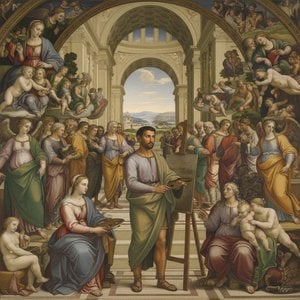
Elevate your home with the sublime harmony of Raphael’s masterpieces. Explore iconic High Renaissance works, from St. George to The School of Athens, and discover how premium, hand-painted reproductions can transform your space into a sanctuary of classical elegance and timeless beauty.

Embark on a journey through the High Renaissance. Discover the mastery of light, form, and classical harmony through an expert exploration of the era's greatest masters, techniques, and enduring artistic legacy.

 Vorschau anzeigen
 Versenden
 Teilen
 Details anzeigen

 Herunterladen
 Ähnliche Objekte
 Röntgenaufnahme
 Diashow

 Weiterlesen







 Die Glasoption ist nur für Größen unter 110 cm verfügbar.


