Vorschau anzeigen In AR ansehen Handgemalte Reproduktion bestellen Zum digitalen Bild wechseln Versenden
Details anzeigen Leitfaden Zu Favoriten hinzufügen Herunterladen Ähnliche Objekte Röntgenaufnahme Diashow Q&A Statistiken

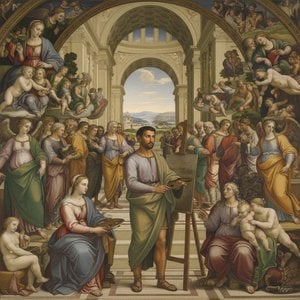
St George Fighting the Dragon

"St George Fighting the Dragon" von Raffaello Sanzio: Ein Meisterwerk der Renaissance! Entdeckt die Schönheit dieses kleinen Gemäldes im Louvre und erfahrt mehr über den Künstler."

Entdecken Sie Raffael (1483-1520), den italienischen Meister der Hochrenaissance, der für seine Anmut, Klarheit und harmonischen Kompositionen bekannt ist. Erkunden Sie ikonische Werke wie 'Die Akademie der Künste', Madonnen und Fresken, die klassische Schönheit definieren. #Hochrenaissance #Italien

Giclée / Kunstdruck

Giclée- oder Leinwanddruck in Museumsqualität mit schneller Produktion und flexiblen Veredelungsoptionen. ( Handgemalte Reproduktion bestellen Zum digitalen Bild wechseln)

Corner sample of the P118B picture frame: formgepresstes Polystyrol, 5 cm wide and 3 cm thick
P118B €10
Corner sample of the P118H picture frame: formgepresstes Polystyrol, 5 cm wide and 3 cm thick
P118H €10
Corner sample of the P118W picture frame: formgepresstes Polystyrol, 5 cm wide and 3 cm thick
P118W €10
Corner sample of the P438Z picture frame: formgepresstes Polystyrol, 5.5 cm wide and 3.5 cm thick
P438Z €10
Corner sample of the P508JH picture frame: formgepresstes Polystyrol, 7 cm wide and 3.5 cm thick
P508JH €12
Corner sample of the P508YH picture frame: formgepresstes Polystyrol, 7 cm wide and 3.5 cm thick
P508YH €12
Corner sample of the P805H picture frame: formgepresstes Polystyrol, 5 cm wide and 3.5 cm thick
P805H €10
Corner sample of the P805Z picture frame: formgepresstes Polystyrol, 5 cm wide and 3.5 cm thick
P805Z €10
Corner sample of the P919BZ picture frame: formgepresstes Polystyrol, 7 cm wide and 3.5 cm thick
P919BZ €10
Corner sample of the P919G picture frame: formgepresstes Polystyrol, 7 cm wide and 3.5 cm thick
P919G €10
Corner sample of the P919XJ picture frame: formgepresstes Polystyrol, 7 cm wide and 3.5 cm thick
P919XJ €10
Corner sample of the P959ZH picture frame: formgepresstes Polystyrol, 5 cm wide and 3 cm thick
P959ZH €10
Corner sample of the P968JZ picture frame: formgepresstes Polystyrol, 6 cm wide and 4 cm thick
P968JZ €12
Corner sample of the W106C picture frame: Massivholz, 5 cm wide and 3 cm thick
W106C €8
Corner sample of the W218G picture frame: Massivholz, 5 cm wide and 3 cm thick
W218G €10
Corner sample of the W218JH picture frame: Massivholz, 5 cm wide and 3 cm thick
W218JH €8
Corner sample of the W218Y picture frame: Massivholz, 5 cm wide and 3 cm thick
W218Y €10
Corner sample of the W307PJ picture frame: Massivholz, 6 cm wide and 3 cm thick
W307PJ €10
Corner sample of the W316G picture frame: Massivholz, 6 cm wide and 3 cm thick
W316G €10
Corner sample of the W316PJ picture frame: Massivholz, 6 cm wide and 3 cm thick
W316PJ €8
Corner sample of the W316Y picture frame: Massivholz, 6 cm wide and 3 cm thick
W316Y €10
Corner sample of the W398PJ picture frame: Massivholz, 5 cm wide and 3 cm thick
W398PJ €8
Corner sample of the W4111J picture frame: Massivholz, 6.5 cm wide and 3.5 cm thick
W4111J €10
Corner sample of the W500HY picture frame: Massivholz, 7 cm wide and 5 cm thick
W500HY €15
Corner sample of the W500JH picture frame: Massivholz, 7 cm wide and 5 cm thick
W500JH €15
Corner sample of the W692G picture frame: Massivholz, 8 cm wide and 4 cm thick
W692G €12
Corner sample of the W849H picture frame: Massivholz, 5 cm wide and 3 cm thick
W849H €8
Corner sample of the W940BG picture frame: Massivholz, 7.5 cm wide and 4.5 cm thick
W940BG €15
Corner sample of the W953PJ picture frame: Massivholz, 6 cm wide and 3.5 cm thick
W953PJ €8

Standardformat
individuell anpassbar
CM
INCH

Wählen Sie aus unseren vordefinierten Formaten, die den ursprünglichen Proportionen des Kunstwerks entsprechen.

Breite
Höhe

Geben Sie die benötigte Breite und Höhe an, damit der Druck perfekt in Ihren Rahmen oder an Ihre Wand passt. Ein Druck kann nur beschnitten, aber niemals größer als das Originalbild angefertigt werden; daher verliert ein Format mit anderen Proportionen einen Teil des Bildes. Wir senden Ihnen ein digitales Mockup zur Freigabe, bevor wir den Druck ausführen. Das auf dieser Seite gezeigte Bild zeigt nicht den tatsächlichen Beschnitt – dies ist nur im Mockup ersichtlich.

Weltweiter Versand () innerhalb von 2 Wochen statt der üblichen 4/5 Wochen. (29 Oktober)

Kostenloser weltweiter Expressversand
Hochwertige Leinenleinwand
Umfassender Versicherungsschutz beim Versand
Zollgebühren-Rückerstattungsgarantie
Garantie für exakte Farbtreue
100 Tage Rückgaberecht (nur bei Mängeln)
100% Geld-zurück-Garantie
Mengenrabatt verfügbar

Gesamtpreis

€ 60

St George Fighting the Dragon

Giclée / Kunstdruck

Format der Reproduktion

-

Endpreis

€ 60

Eckdaten

  • Dimensions: 31 cm × 27 cm
  • Movement: High Renaissance
  • Influences: Federico da Montefeltro
  • Artist: Raffaello Sanzio da Urbino
  • Notable elements or techniques: Chiaroscuro
  • Subject or theme: Christian Mythology

St George Fighting the Dragon – A Renaissance Icon

Saint George and the Dragon remains one of the most enduring symbols of Christian virtue—courage, faith, and chivalry—and Raphael’s depiction in 1506 embodies the ideals of the High Renaissance. Commissioned by Duke Guidobaldo da Montefeltro for his court at Urbino, this painting transcends mere narrative; it speaks to fundamental human aspirations for righteousness and triumph over adversity.

  • Subject Matter: The scene portrays Saint George battling a fearsome dragon—a creature representing evil and pagan superstition—protecting the princess from its venomous breath. This allegory draws upon ancient myths, predating Christianity itself, reflecting the broader humanist fascination with classical sources.
  • Style & Technique: Raphael’s masterful use of oil paint on wood demonstrates his command of chiaroscuro—the dramatic interplay of light and shadow—creating a palpable sense of movement and tension. The composition is carefully balanced, guiding the viewer's eye from Saint George’s lance to the dragon’s head, emphasizing the heroic struggle.
  • Historical Context: Urbino under Guidobaldo represented one of the most sophisticated cultural centres in Italy during Raphael’s time. The Duke’s patronage fostered artistic innovation and intellectual debate—a spirit that permeated Raphael's oeuvre. This painting reflects the humanist preoccupation with moral virtue and heroic ideals, aligning perfectly with Castiglione’s vision of court life.
  • Symbolism: Beyond its narrative depiction, the artwork is rich in symbolic significance. Saint George’s lance symbolizes divine righteousness—a weapon wielded against evil—while his shield represents protection from harm. The dragon embodies pagan darkness and deceit, vanquished by Christian courage and faith.
  • Emotional Impact: Raphael's painting evokes a profound sense of awe and admiration for the heroic spirit—the willingness to confront danger for the sake of righteousness. It serves as a timeless reminder of the triumph of good over evil, resonating with viewers across centuries.

The painting’s serene palette—dominated by blues and reds—contrasts sharply with the fiery hues of the dragon, highlighting Raphael's ability to convey emotion through colour. The meticulous detail in depicting Saint George’s armour and horse—a testament to Renaissance artistic skill—further enhances its visual impact.

  • Provenance: Originally destined for Guidobaldo’s court, it passed through several aristocratic hands before finding its way into the Royal Collection following Charles I's reign. Its subsequent acquisition by Andrew Mellon solidified its place as a cornerstone of American art history.
  • Louvre Museum: Today, St George Fighting the Dragon resides in the Louvre Museum in Paris—a testament to Raphael’s enduring legacy and the importance of preserving artistic masterpieces for future generations.

A hand-made oil painting reproduction from WahooArt.com allows you to experience the beauty and grandeur of this Renaissance icon within your own home, capturing its essence with unparalleled fidelity.

Fragen & Antworten

Welcher Kunstrichtung lässt sich "St George Fighting the Dragon" von Raffael zuordnen?

„St George Fighting the Dragon“ ist ein Werk der Renaissance. Die Stilrichtung gibt die künstlerische Tradition an, der das Werk angehört.

Mit welcher Technik wurde "St George Fighting the Dragon" erstellt?

Das Medium von "St George Fighting the Dragon" von Raffael ist Öl auf Leinwand. Die Reproduktionen zielen darauf ab, die Optik dieser Technik wiederzugeben.

Ist "St George Fighting the Dragon" von Raffael ein helles oder ein dunkles Kunstwerk?

"St George Fighting the Dragon" von Raffael weist eine Helligkeit von Schattenhaft mit einer Luminanz von Dunkel auf.


Künstlerbiografie

**frühes Leben und Ausbildung**

Raphael (Raffaello Sanzio da Urbino), ein renommierter italienischer Maler und Architekt, wurde zwischen dem 28. März und dem 6. April 1483 in der kleinen, aber kulturell bedeutenden Stadt Urbino geboren. Sein Vater, Giovanni Santi, war Hofmaler des Herzogs und vermittelte Raphael von Anfang an eine frühe Auseinandersetzung mit der künstlerischen Welt. Nach dem Tod seines Vaters im Alter von elf Jahren betrieb Raphael wahrscheinlich die Familienwerkstatt weiter, was seine künstlerische Grundlage festigte.

**Künstlerischer Werdegang und Einflüsse**

Raphaels künstlerischer Weg lässt sich in drei verschiedene Phasen einteilen, jede mit einem einzigartigen Stil gekennzeichnet:
  • Frühe Jahre in Umbrien: Charakterisiert durch den Einfluss seines Vaters und die kulturelle Atmosphäre von Urbino.
  • Florentinische Periode (1504-1508): Aufnahme der künstlerischen Traditionen Florenz, die seinen Stil maßgeblich prägte.
  • Römische Periode (1508-1520): Arbeitete für zwei Päpste und ihre Mitarbeiter und schuf einige seiner bekanntesten Werke, darunter die Schule der Athene in der Vatikanische Stanza della Segnatura.

**Bekannte Werke und Vermächtnis**

Einige der bekannten Werke von Raphael sind:

**Einfluss und Vermächtnis**

Raphaels Einfluss auf die Kunst ist tiefgreifend, wobei sein Werk ein Eckpfeiler der Hochrenaissance darstellt. Sein ruhiger und harmonischer Stil war ein Vorbild für die neoklassische Malerei, wie von Kunsthistoriker Johann Joachim Winckelmann bemerkt. Trotz des späteren Einflusses von Michelangelos Stil bleibt Raphael einer der verehrtesten Künstler in der Geschichte. ansicht des Profils von Raphael auf WahooArt
Raffael

Raffael

1483 - 1520 , Italien

Kurzinfos

  • Beeinflusste Künstler:
    • Giovanni Santi
    • Pietro Perugino
  • Bemerkenswerte Werke:
    • Das Urteil des Salomon
    • Esterházy-Madonna
    • Die Schule der Athener
    • St. Sebastian
    • La Donna Velata
  • Einfluss Auf Kunst: Neoklassische Malerei
  • Geburtsdatum: 1483
  • Geburtsort: Urbino, Italien
  • Künstlerischer Stil: Hochrenaissance
  • Nationalität: Italienisch
  • Todatum: 1520
  • Vollständiger Name: Raffaello Sanzio da Urbino
  • Von Künstlern Beeinflusst:
    • Leonardo da Vinci
    • Michelangelo
Entdecken Sie Kunstwerke, die nach Themen, Stilen und Merkmalen sortiert sind.