A Glimpse into the Golden Age: The Elegance of Motion
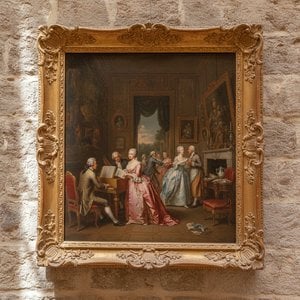
In the quiet, sun-drenched interiors of the seventeenth-century Netherlands, moments of domestic grace were often captured with profound reverence. Pieter Jacobsz Codde’s "The Dancing Lesson," painted in 1627, serves as a breathtaking window into this era of refined social ritual. At the heart of this composition stands a woman, her presence commanding yet graceful, draped in a striking black dress that anchors the scene's visual weight. As she guides her pupils through the rhythmic steps of a dance, the painting transcends a mere instructional moment, becoming a poetic meditation on poise, etiquette, and the structured beauty of Dutch social life. The room around her is alive with the subtle energy of a gathering, where the soft interplay of light and shadow breathes life into every figure and object.
The mastery of Codde lies in his ability to weave a complex narrative through meticulous detail and a sophisticated use of chiaroscuro. Influenced by the legendary Frans Hals, Codde employs a technique that emphasizes naturalism and psychological depth. Notice how the light falls upon the ruffled collar of the central figure, creating a brilliant contrast against the dark fabric of her gown, drawing the eye immediately to the focal point of the lesson. The surrounding figures, though partially obscured in the periphery, contribute to a sense of atmospheric depth, their positions suggesting a layered, bustling environment. Every element, from the heavy wooden chair to the books resting upon the dining table, is rendered with such precision that one can almost feel the stillness of the room punctuated by the soft shuffling of feet.
Technical Brilliance and the Dutch Aesthetic
For the discerning collector or interior designer, this piece offers a masterclass in the silvery-gray tonalities that defined the Dutch Golden Age. Codde’s brushwork captures the tactile reality of the era—the crispness of linen, the weight of dark wool, and the smooth surface of polished wood. The composition is balanced yet dynamic; while the central figure provides a stable vertical axis, the scattered arrangement of people and objects creates a rhythmic flow that mimics the dance itself. This careful orchestration of space makes the artwork an exceptional choice for creating a focal point in a room, offering both a sense of historical gravity and a light, airy sophistication.
Beyond its technical brilliance, "The Dancing Lesson" carries a profound emotional resonance. There is a sense of nostalgic tranquility in the scene—a celebration of a world where time moved to the tempo of music and social interaction was governed by a graceful, shared decorum. It invites the viewer to step back into a period of burgeoning prosperity and cultural refinement. Whether placed in a formal study or a contemporary living space, this reproduction serves as more than mere decoration; it is an invitation to contemplate the enduring beauty of human connection and the quiet elegance found in life's most simple, choreographed moments.



 In echtem Maßstab anzeigen
 Zum Druck wechseln
 Versenden als Grußkarte
 Teilen
 Details anzeigen
 Leitfaden

 Herunterladen
 Ähnliche Objekte
 Röntgenaufnahme
 Diashow
 Besucherstatistiken


 Mehr anzeigen






































 Die Glasoption ist nur für Größen unter 110 cm verfügbar.