In echtem Maßstab anzeigen In AR an der Wand sehen Zum Druck wechseln Zum digitalen Bild wechseln Versenden als Grußkarte
Details anzeigen Leitfaden öffnen Zu Favoriten hinzufügen Herunterladen Ähnliche Objekte Röntgenaufnahme Diashow Besucherstatistiken

Komposition Nr. 1 mit Rot und Blau

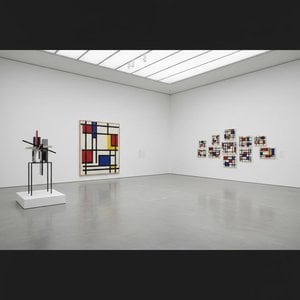
Piet Mondrian's "Komposition Nr. 1 mit Rot und Blau" verkörpert die Essenz von Neoplasticismus: Einfachheit, Ordnung und universelle Harmonie durch geometrische Formen und reine Farben. Ein Meisterwerk moderner Kunst!

Erkunden Sie die Kunst von Piët Mondrian (1872-1944), einem Pionier der abstrakten Kunst und der De Stijl Bewegung. Entdecken Sie seine ikonischen geometrischen Gemälde, seinen Neoplastischen Stil und seinen bleibenden Einfluss auf modernes Design, Architektur und 20. Jahrhundert Kunst.

Handgefertigte Ölreproduktion

Handgemaltes Ölgemälde auf Leinwand in Ihrer Wunschgröße und mit Rahmen, auf Bestellung von unseren Künstlern angefertigt. ( Zum Druck wechseln Zum digitalen Bild wechseln)

P118B $10
P118H $10
P118W $10
P438Z $10
P508JH $12
P508YH $12
P805H $10
P805Z $10
P919BZ $10
P919G $10
P919XJ $10
P959ZH $10
P968JZ $12
W106C $8
W218G $10
W218JH $8
W218Y $10
W307PJ $10
W316G $10
W316PJ $8
W316Y $10
W398PJ $8
W4111J $10
W500HY $15
W500JH $15
W692G $12
W849H $8
W940BG $15
W953PJ $8

Standardformat
individuell anpassbar
CM
INCH

Wählen Sie aus unseren vordefinierten Formaten, die den ursprünglichen Proportionen des Kunstwerks entsprechen.

Breite
Höhe

Sie können Ihre eigenen Maße eingeben, um einen bestimmten Rahmen oder Platz auszufüllen. Wenn die gewählte Größe nicht den Proportionen des Originalbildes entspricht, werden wir das Kunstwerk entweder beschneiden oder das Gemälde durch zusätzliche, handgemalte Elemente erweitern. Ein digitales Mockup wird Ihnen zur Genehmigung zugesandt, bevor die Produktion beginnt.
Bitte beachten Sie, dass die Bildschirmvorschau nicht die tatsächliche Beschneidung oder Erweiterung widerspiegelt. Nur das Mockup zeigt die endgültige Komposition exakt an.
Obwohl Sondermaße verfügbar sind, empfehlen wir, eine Größe aus der vordefinierten Liste zu wählen, um die ursprünglichen Proportionen beizubehalten.

Beispiele für Anpassungsmöglichkeiten: Gesicht durch Kundenfoto ersetzen; Haustier hinzufügen (z. B. Katze durch Hund ersetzen); eine versteckte Nachricht im Hintergrund einfügen; Hintergrundlandschaft oder -elemente ändern.
Nach der Bestellung wird das WahooArt.com-Team dem Kunden Anweisungen per E-Mail zusenden und eine Mockup-Vorschau bereitstellen.

Weltweiter Versand () in nur 3 bis 4 Wochen statt der üblichen 5 Wochen. (27 September). Keine Kompromisse bei der Qualität.

why_choose_icon
Kostenloser weltweiter Expressversand
why_choose_icon
Hochwertige Leinenleinwand
why_choose_icon
Vollständiger Versicherungsschutz beim Versand
why_choose_icon
Zollgebühren-Rückerstattungsgarantie
why_choose_icon
Garantie für exakte Farbtreue
why_choose_icon
100-tägiges Rückgaberecht (nur bei Mängeln)
why_choose_icon
100% Geld-zurück-Garantie
why_choose_icon
Angebot für Mengenrabatt

Gesamtpreis

$ 272

reproduction

Komposition Nr. 1 mit Rot und Blau

Reproduktionsmedium

Format der Reproduktion

-

Gesamtpreis

$ 272

Kurzübersicht

  • Year: 1931
  • Artistic style: Abstract geometric art
  • Title: Composition N. 1 with Red and Blue
  • Movement: Neoplasticism
  • Influences:
    • Cubism
    • De Stijl

Kunst-Quiz

Jede Frage hat nur eine richtige Antwort.

Frage 1:
Piet Mondrian is most closely associated with which artistic movement?
Frage 2:
What are the primary visual elements that define Mondrian's style in 'Composition N. 1 with Red and Blue'?
Frage 3:
In what year was 'Composition N. 1 with Red and Blue' created?
Frage 4:
Before developing his signature abstract style, Mondrian's early works were primarily focused on what subject matter?
Frage 5:
What was Mondrian's goal in reducing his artistic vocabulary to primary colors and simple shapes?

Composition N. 1 with Red and Blue: A Symphony of Geometric Harmony

Piet Mondrian’s *Composition N. 1 with Red and Blue*, painted in 1931, transcends mere visual arrangement; it embodies a profound philosophical quest for spiritual equilibrium through the radical simplification of artistic expression. Emerging from a period marked by intense experimentation within the burgeoning avant-garde movement of his time—specifically De Stijl—this artwork stands as a cornerstone of Neoplasticism, a stylistic doctrine Mondrian himself championed alongside Theo van Doesburg. The painting presents a meticulously calibrated grid of black lines delineating squares and rectangles filled with primary colors – red, yellow, and blue – juxtaposed against expanses of white and gray. This deceptively understated composition belies an intellectual depth that continues to resonate powerfully today. It’s not simply about what is depicted but rather about the deliberate excision of extraneous elements, leaving only the essential forms to communicate pure visual force. The impact is immediate: a sense of order, balance, and serene contemplation washes over the viewer's gaze.
  • Historical Context: Painted during the height of Mondrian’s artistic maturity, *Composition N. 1* reflects the broader intellectual currents of its era – particularly the influence of Rudolf Steiner’s Anthroposophy and the desire to transcend representational art in favor of a more universal aesthetic.
  • Style & Technique: Mondrian employed a technique characterized by precise geometric construction, utilizing oil paint on canvas with meticulous attention to detail. The black lines serve as structural anchors, defining the boundaries of the squares and rectangles while simultaneously emphasizing their orthogonality – a deliberate rejection of curvilinear forms in favor of straight lines.
  • Color Palette: The restricted palette—primarily red, yellow, and blue—is not merely decorative; it represents fundamental forces within nature according to Mondrian’s belief system. These colors are positioned strategically within the grid to create dynamic equilibrium, mirroring the underlying harmony he sought to express.
  • Symbolism: Beyond its formal beauty, *Composition N. 1* carries symbolic significance rooted in Mondrian's philosophical convictions. The squares and rectangles symbolize elemental forms—earth and air—while the black lines represent the unifying principle of structure and order.

From Dutch Landscapes to Universal Forms: A Journey Towards Abstraction

Before embracing Neoplasticism, Mondrian’s artistic trajectory was firmly rooted in the traditions of Dutch landscape painting. Influenced by the Hague School and Impressionism, his early works—such as *The Red Mill*—demonstrate a masterful command of technique and an unwavering dedication to capturing the nuances of natural light and color. However, Mondrian recognized that true artistic expression demanded a move beyond mere imitation; it necessitated uncovering the underlying structures governing reality itself. This pivotal realization propelled him toward experimentation with Cubism, where he began deconstructing objects into their geometric components—a transformative process that ultimately led him away from representational art and towards pure abstraction.

The Language of Neoplasticism: A Spiritual Quest Embodied in Color and Line

Mondrian’s unwavering belief in the power of art to transcend materiality fueled his development of Neoplasticism—a stylistic doctrine that sought to distill painting to its most fundamental elements. As he eloquently articulated, “Art is higher than reality and has no direct relation to reality. To approach the spiritual in art, one will make as little use as possible of reality…” By reducing visual language to orthogonal lines, primary colors, and neutral tones—a deliberate rejection of organic forms and subjective perception—Mondrian aimed to create a harmonious composition that mirrored the underlying order of the cosmos. *Composition N. 1 with Red and Blue* exemplifies this profound philosophical commitment, inviting contemplation and fostering an appreciation for the beauty inherent in simplicity and geometric precision.

A Legacy Enduring Beyond Canvas: Influence on Design and Culture

The impact of Mondrian’s artistic vision extends far beyond the confines of painting itself. His aesthetic principles—characterized by clean lines, geometric forms, and restrained color palettes—have profoundly influenced countless disciplines, from architecture to furniture design to fashion and graphic arts. As Stephen Bayley aptly noted, “Mondrian has come to mean Modernism. His name and his work sum up the High Modernist ideal.” Owning a reproduction of *Composition N. 1 with Red and Blue* isn’t merely acquiring an artwork; it's embracing a timeless aesthetic—a testament to Mondrian’s enduring legacy as one of the most influential artists of the 20th century, continuing to inspire creativity and elegance in contemporary spaces.

Biografie des Künstlers

**frühes Leben und Karriere in den Niederlanden (1872–1911)**

pieter cornelis mondriaan, bekannt ab 1911 als piet mondrian, war ein niederländischer Maler und Kunsttheoretiker, geboren am 7. März 1872 in Amersfoort, Niederlande. Er begann seine Karriere als Lehrer an der Grundschule und betrieb gleichzeitig Malerei, zunächst im Stil der Haag School des niederländischen Impressionismus.
  • Sein frühes Werk, das von naturalistischen Landschaften geprägt ist, kann in Gemälden wie the red mill und trees in moonrise zu sehen ist, die im kunstmuseum den haag ausgestellt wurden.
  • Mondrians Suche nach einem persönlichen Stil führte ihn dazu, verschiedene künstlerische Bewegungen zu erkunden, darunter Pointillismus und Fauvismus.
  • Seine erste Ausstellung im Jahr 1893 markierte den Beginn seiner produktiven Karriere.

**Die Entwicklung des Stils von Mondrian**

Von figurativ zu abstrakt Mondrians künstlerische Richtung verschob sich hin zu einem zunehmend abstrakten Stil, der in eine nicht-repräsentative Form mündete, die er Neoplasticismus nannte. Diese „reine plastische Kunst“ zielte darauf ab, „universelle Schönheit“ zu schaffen und seinen formalen Wortschatz auf Primärfarben (Rot, Blau und Gelb), Werte (Schwarz, Weiß und Grau) und Richtungen (horizontal und vertikal) zu beschränken.

**Vermächtnis und Einfluss**

Mondrians Vermächtnis erstreckt sich über sein eigenes Werk hinaus und beeinflusst wichtige Stile und Bewegungen wie Farbflächenmalerei, abstrakten Expressionismus und Minimalismus. Kunsthistoriker stephen bayley stellte fest, dass Mondrian zum Totem für alles geworden ist, was der Modernismus zu sein versuchte.
  • Entdecken Sie mehr von Mondrians Werk unter WahooArt.com.
  • Erfahren Sie mehr über die De Stijl-Bewegung und ihren Einfluss auf die moderne Kunst auf wikipedia.
  • Entdecken Sie andere einflussreiche Künstler wie vincent van gogh und ihre Auswirkungen auf die Kunstwelt.

**Wichtige Werke und Ausstellungen**

* piet mondrian: apple blossom (Cubismus) (ansicht auf WahooArt.com) * piet mondrian: still life with vase of spices ii (Cubismus) (ansicht auf WahooArt.com) * piet mondrian: passionflower (73 x 48 cm, Kunstmuseum Den Haag, Postimpressionismus, Aquarell) (ansicht auf WahooArt.com)
Piët Mondrian

Piët Mondrian

1872 - 1944 , Niederlande

Eckdaten zum Künstler

  • Beeinflusste Künstler:
    • Hague School
    • Pointillismus
    • Fauvismus
    • Kubismus
  • Bemerkenswerte Werke:
    • Komposition mit Rot, Gelb und Blau
    • Broadway Boogie Woogie
    • Tableau Nr. 2 Komposition V
    • Rhythmus der schwarzen Linien
  • Geburtsdatum: 7. März 1872
  • Geburtsort: Amersfoort, Niederlande
  • Künstlerische Bewegung: De Stijl, Neoplasticismus
  • Nationalität: Niederländisch
  • Sterbedatum: 1944
  • Vollständiger Name: Piët Mondriaan
  • Von Künstlern Beeinflusst:
    • Farbfeldmalerei
    • Abstrakter Expressionismus
    • Minimalismus
Entdecken Sie Kunstwerke, die nach Themen, Stilen und Merkmalen sortiert sind.