Vorschau anzeigen In AR ansehen Zum Druck wechseln Zum digitalen Bild wechseln Versenden
Details anzeigen Leitfaden Zu Favoriten hinzufügen Herunterladen Ähnliche Objekte Röntgenaufnahme Diashow Statistiken

Komposition mit Grau

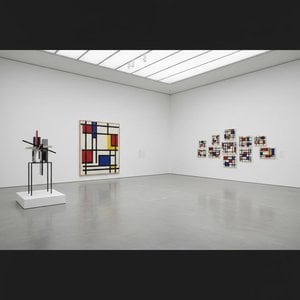
Komposition mit Grau von Piet Mondrian: Eine ikonische Darstellung des abstrakten Expressionismus und Stilbruch der klassischen Malerei im Dienste einer universellen Ästhetik.

Erkunden Sie die Kunst von Piët Mondrian (1872-1944), einem Pionier der abstrakten Kunst und der De Stijl Bewegung. Entdecken Sie seine ikonischen geometrischen Gemälde, seinen Neoplastischen Stil und seinen bleibenden Einfluss auf modernes Design, Architektur und 20. Jahrhundert Kunst.

Handgefertigte Ölreproduktion

Handgemaltes Ölgemälde auf Leinwand in Ihrer Wunschgröße und mit Rahmen, auf Bestellung von unseren Künstlern angefertigt. ( Zum Druck wechseln Zum digitalen Bild wechseln)

Corner sample of the P118B picture frame: formgepresstes Polystyrol, 5 cm wide and 3 cm thick
P118B €10
Corner sample of the P118H picture frame: formgepresstes Polystyrol, 5 cm wide and 3 cm thick
P118H €10
Corner sample of the P118W picture frame: formgepresstes Polystyrol, 5 cm wide and 3 cm thick
P118W €10
Corner sample of the P438Z picture frame: formgepresstes Polystyrol, 5.5 cm wide and 3.5 cm thick
P438Z €10
Corner sample of the P508JH picture frame: formgepresstes Polystyrol, 7 cm wide and 3.5 cm thick
P508JH €12
Corner sample of the P508YH picture frame: formgepresstes Polystyrol, 7 cm wide and 3.5 cm thick
P508YH €12
Corner sample of the P805H picture frame: formgepresstes Polystyrol, 5 cm wide and 3.5 cm thick
P805H €10
Corner sample of the P805Z picture frame: formgepresstes Polystyrol, 5 cm wide and 3.5 cm thick
P805Z €10
Corner sample of the P919BZ picture frame: formgepresstes Polystyrol, 7 cm wide and 3.5 cm thick
P919BZ €10
Corner sample of the P919G picture frame: formgepresstes Polystyrol, 7 cm wide and 3.5 cm thick
P919G €10
Corner sample of the P919XJ picture frame: formgepresstes Polystyrol, 7 cm wide and 3.5 cm thick
P919XJ €10
Corner sample of the P959ZH picture frame: formgepresstes Polystyrol, 5 cm wide and 3 cm thick
P959ZH €10
Corner sample of the P968JZ picture frame: formgepresstes Polystyrol, 6 cm wide and 4 cm thick
P968JZ €12
Corner sample of the W106C picture frame: Massivholz, 5 cm wide and 3 cm thick
W106C €8
Corner sample of the W218G picture frame: Massivholz, 5 cm wide and 3 cm thick
W218G €10
Corner sample of the W218JH picture frame: Massivholz, 5 cm wide and 3 cm thick
W218JH €8
Corner sample of the W218Y picture frame: Massivholz, 5 cm wide and 3 cm thick
W218Y €10
Corner sample of the W307PJ picture frame: Massivholz, 6 cm wide and 3 cm thick
W307PJ €10
Corner sample of the W316G picture frame: Massivholz, 6 cm wide and 3 cm thick
W316G €10
Corner sample of the W316PJ picture frame: Massivholz, 6 cm wide and 3 cm thick
W316PJ €8
Corner sample of the W316Y picture frame: Massivholz, 6 cm wide and 3 cm thick
W316Y €10
Corner sample of the W398PJ picture frame: Massivholz, 5 cm wide and 3 cm thick
W398PJ €8
Corner sample of the W4111J picture frame: Massivholz, 6.5 cm wide and 3.5 cm thick
W4111J €10
Corner sample of the W500HY picture frame: Massivholz, 7 cm wide and 5 cm thick
W500HY €15
Corner sample of the W500JH picture frame: Massivholz, 7 cm wide and 5 cm thick
W500JH €15
Corner sample of the W692G picture frame: Massivholz, 8 cm wide and 4 cm thick
W692G €12
Corner sample of the W849H picture frame: Massivholz, 5 cm wide and 3 cm thick
W849H €8
Corner sample of the W940BG picture frame: Massivholz, 7.5 cm wide and 4.5 cm thick
W940BG €15
Corner sample of the W953PJ picture frame: Massivholz, 6 cm wide and 3.5 cm thick
W953PJ €8

Standardformat
individuell anpassbar
CM
INCH

Wählen Sie aus unseren vordefinierten Formaten, die den ursprünglichen Proportionen des Kunstwerks entsprechen.

Breite
Höhe

Geben Sie die Breite und die Höhe an, die Sie für Ihren Rahmen oder Ihre Wand benötigen. Da dieses Werk handgemalt ist, kann der Künstler bei einer anderen Form etwas mehr um das Bild herum malen oder etwas abschneiden – Sie entscheiden. Wir senden Ihnen ein digitales Mockup zur Freigabe, bevor mit dem Malen begonnen wird. Das auf dieser Seite gezeigte Bild stellt nicht das tatsächliche Ergebnis dar – dies tut nur das Mockup.

Beispiele für Anpassungsmöglichkeiten: Gesicht durch Kundenfoto ersetzen; Haustier hinzufügen (z. B. Katze durch Hund ersetzen); eine versteckte Nachricht im Hintergrund einfügen; Hintergrundlandschaft oder -elemente ändern.
Nach der Bestellung wird das WahooArt.com-Team dem Kunden Anweisungen per E-Mail zusenden und eine Mockup-Vorschau bereitstellen.

Weltweiter Versand () in nur 3 bis 4 Wochen statt der üblichen 5 Wochen. (26 Oktober). Keine Kompromisse bei der Qualität.

Kostenloser weltweiter Expressversand
Hochwertige Leinenleinwand
Umfassender Versicherungsschutz beim Versand
Zollgebühren-Rückerstattungsgarantie
Garantie für exakte Farbtreue
100 Tage Rückgaberecht (nur bei Mängeln)
100% Geld-zurück-Garantie
Mengenrabatt verfügbar

Gesamtpreis

€ 239

Komposition mit Grau

Art der Reproduktion

Format der Reproduktion

-

Endpreis

€ 239

Eckdaten

  • Movement: Neoplasticismus
  • Subject or theme: Geometrie; Universelle Schönheit
  • Influences:
    • Hague Schule
    • Impressionismus
  • Location: Kröller-Müller Museum, Otterlo
  • Notable elements or techniques: Rasterstruktur; Primärfarben (Rot, Blau und Gelb)
  • Title: Komposition mit Raster VII

Kunst-Quiz

Jede Frage hat nur eine richtige Antwort.

Frage 1:
¿Cuál fue el movimiento artístico al que Mondrian perteneció?
Frage 2:
¿Por qué Mondrian utilizó colores primarios y líneas rectas?
Frage 3:
¿En qué año fue creada esta obra?
Frage 4:
¿Qué simboliza la estructura de líneas y colores en 'Composition with Grid VII' según Mondrian?
Frage 5:
¿Cómo influyó esta obra en otros artistas y diseñadores?

A Geometry of Feeling: Deconstructing Reality in Piet Mondrian’s Composition with Grid VII

Piet Mondrian's Composition with Grid VII, created in 1919, is not merely an arrangement of colored squares and black lines; it is a visual manifesto of a radical artistic philosophy. Emerging from the tumultuous aftermath of World War I, this work embodies a yearning for order and universality amidst chaos – a distillation of reality into its most fundamental components. The painting presents a carefully calibrated grid structure populated with rectangles of varying sizes, each filled with hues of blue, yellow, pink, and gray, alongside areas of stark white. This isn’t about depicting the world *as* it is seen, but rather exploring the underlying principles that govern existence itself.

The Path to Neoplasticism: A Journey of Abstraction

To understand Composition with Grid VII, one must trace Mondrian's artistic evolution. Born Pieter Cornelis Mondriaan in Amersfoort, Netherlands, he began his career painting naturalistic landscapes, influenced by the Hague School and Dutch Impressionism. However, a restless spirit drove him to experiment – Pointillism, Fauvism, and ultimately, Cubism. His pivotal move to Paris in 1912 exposed him to the avant-garde, sparking a deconstruction of form that would define his life’s work. He began stripping away representational elements, seeking an art free from the subjective distortions of individual perception. This quest culminated in Neoplasticism (also known as De Stijl), a style predicated on pure abstraction and universal harmony. Composition with Grid VII stands as a crucial stepping stone within this journey; it’s not yet the fully realized, rigorously geometric aesthetic of his later works like Composition with Red, Blue and Yellow, but rather a dynamic exploration *towards* that endpoint. The grid isn’t absolute here – lines are slightly irregular, colors subtly nuanced – hinting at the organic origins from which this abstract language emerged.

Beyond Aesthetics: A Spiritual and Philosophical Undertone

Mondrian wasn’t simply interested in creating visually pleasing arrangements; his art was deeply rooted in spiritual and philosophical beliefs. Influenced by Theosophy, he believed that underlying all of reality were fundamental geometric forms and primary colors – the building blocks of the universe. By reducing painting to these essential elements, he aimed to express a universal truth, transcending individual experience and cultural specificity. The horizontal and vertical lines, in particular, represented opposing forces—masculine and feminine, static and dynamic—brought into equilibrium. The limited palette wasn’t arbitrary; it was chosen for its purity and symbolic resonance. The grid itself can be interpreted as a metaphor for the structure of existence, while the colored rectangles represent individual energies contained within that framework. This isn’t cold intellectualism, however. There is an emotional current running through the work – a sense of calm, balance, and quiet contemplation.

A Lasting Legacy: Mondrian’s Influence on Modern Design

The impact of Piet Mondrian extends far beyond the realm of painting. His aesthetic principles have profoundly influenced countless designers, architects, and artists. From fashion to furniture, the clean lines, geometric forms, and primary color palettes characteristic of Neoplasticism continue to resonate in contemporary design. Composition with Grid VII, as a key work within this movement, serves as a powerful reminder of Mondrian’s enduring vision – a vision that sought not merely to depict the world, but to reshape our perception of it. Owning a reproduction of this artwork isn’t just acquiring a beautiful object; it is inviting a piece of art history and philosophical inquiry into your space—a testament to the power of abstraction to evoke emotion, inspire thought, and transform our surroundings.

  • Artist: Piet Mondrian
  • Born Year: 1872
  • Death Year: 1944
  • Birth City: Amersfoort
  • Birth Country: Netherlands

Mondrian's artistic journey began with landscapes, reflecting the Hague School’s Impressionistic traditions. However, he swiftly embraced Cubism and experimented with Pointillism and Fauvism before discovering Neoplasticism.

This style prioritizes pure abstraction and universal harmony, distilling reality into its most fundamental geometric forms – red, blue, yellow, black, white and gray.

Fragen & Antworten

Aus welcher Schaffensperiode von Piët Mondrian stammt "Komposition mit Grau"?

"Komposition mit Grau" repräsentiert die Mature Period von Piët Mondrian.

Welcher Raum passt farblich zu "Komposition mit Grau" von Piët Mondrian?

Die Pastelltöne-Farben von "Komposition mit Grau" von Piët Mondrian passen perfekt zum empfohlenen Raum: einem Wohnbereich.

Welcher Phase der Karriere von Piët Mondrian lässt sich das Entstehungsjahr 1919 von „Komposition mit Grau“ zuordnen?

"Komposition mit Grau", entstanden im Jahr 1919, stammt aus der Mature Period von Piët Mondrian.


Künstlerbiografie

**frühes Leben und Karriere in den Niederlanden (1872–1911)**

pieter cornelis mondriaan, bekannt ab 1911 als piet mondrian, war ein niederländischer Maler und Kunsttheoretiker, geboren am 7. März 1872 in Amersfoort, Niederlande. Er begann seine Karriere als Lehrer an der Grundschule und betrieb gleichzeitig Malerei, zunächst im Stil der Haag School des niederländischen Impressionismus.
  • Sein frühes Werk, das von naturalistischen Landschaften geprägt ist, kann in Gemälden wie the red mill und trees in moonrise zu sehen ist, die im kunstmuseum den haag ausgestellt wurden.
  • Mondrians Suche nach einem persönlichen Stil führte ihn dazu, verschiedene künstlerische Bewegungen zu erkunden, darunter Pointillismus und Fauvismus.
  • Seine erste Ausstellung im Jahr 1893 markierte den Beginn seiner produktiven Karriere.

**Die Entwicklung des Stils von Mondrian**

Von figurativ zu abstrakt Mondrians künstlerische Richtung verschob sich hin zu einem zunehmend abstrakten Stil, der in eine nicht-repräsentative Form mündete, die er Neoplasticismus nannte. Diese „reine plastische Kunst“ zielte darauf ab, „universelle Schönheit“ zu schaffen und seinen formalen Wortschatz auf Primärfarben (Rot, Blau und Gelb), Werte (Schwarz, Weiß und Grau) und Richtungen (horizontal und vertikal) zu beschränken.

**Vermächtnis und Einfluss**

Mondrians Vermächtnis erstreckt sich über sein eigenes Werk hinaus und beeinflusst wichtige Stile und Bewegungen wie Farbflächenmalerei, abstrakten Expressionismus und Minimalismus. Kunsthistoriker stephen bayley stellte fest, dass Mondrian zum Totem für alles geworden ist, was der Modernismus zu sein versuchte.
  • Entdecken Sie mehr von Mondrians Werk unter WahooArt.com.
  • Erfahren Sie mehr über die De Stijl-Bewegung und ihren Einfluss auf die moderne Kunst auf wikipedia.
  • Entdecken Sie andere einflussreiche Künstler wie vincent van gogh und ihre Auswirkungen auf die Kunstwelt.

**Wichtige Werke und Ausstellungen**

* piet mondrian: apple blossom (Cubismus) (ansicht auf WahooArt.com) * piet mondrian: still life with vase of spices ii (Cubismus) (ansicht auf WahooArt.com) * piet mondrian: passionflower (73 x 48 cm, Kunstmuseum Den Haag, Postimpressionismus, Aquarell) (ansicht auf WahooArt.com)
Piët Mondrian

Piët Mondrian

1872 - 1944 , Niederlande

Kurzinfos

  • Beeinflusste Künstler:
    • Hague School
    • Pointillismus
    • Fauvismus
    • Kubismus
  • Bemerkenswerte Werke:
    • Komposition mit Rot, Gelb und Blau
    • Broadway Boogie Woogie
    • Tableau Nr. 2 Komposition V
    • Rhythmus der schwarzen Linien
  • Geburtsdatum: 7. März 1872
  • Geburtsort: Amersfoort, Niederlande
  • Künstlerische Bewegung: De Stijl, Neoplasticismus
  • Nationalität: Niederländisch
  • Sterbedatum: 1944
  • Vollständiger Name: Piët Mondriaan
  • Von Künstlern Beeinflusst:
    • Farbfeldmalerei
    • Abstrakter Expressionismus
    • Minimalismus
Entdecken Sie Kunstwerke, die nach Themen, Stilen und Merkmalen sortiert sind.