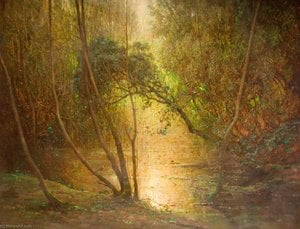
The Soul of the Moor: The Atmospheric World of Philip Stevens
In the quiet, mist-laden expanses of Dartmoor, where the earth meets a heavy sky, lies the heart of Philip Stevens’ artistic vision. A British landscape painter born in Plymouth, Devon, Stevens has cultivated a reputation for capturing the profound, often somber beauty of the English countryside. His work does not merely depict scenery; it evokes a palpable sense of presence, inviting the viewer into a realm of stillness and contemplation. Through a masterful command of oil paint, he translates the fleeting moods of nature into enduring compositions, establishing himself as a significant voice in contemporary British landscape art.
The foundations of Stevens’ disciplined approach can be traced back to his formative years, shaped by the influence of his father's military service. This early exposure instilled in him a meticulous attention to detail and a structural precision that would later define his compositional mastery. His formal journey led him to the prestigious Royal College of Art, where he immersed himself in traditional landscape techniques while absorbing the revolutionary spirit of Impressionism and Post-Impressionism. From these movements, he adopted the essential pursuit of capturing light and color in their most transient states, yet he filtered these influences through a uniquely British lens—one that favors the weight of shadow and the depth of texture over mere brightness.
Technique and the Texture of Nature
To encounter a Philip Stevens painting is to experience the physical weight of the landscape. He is renowned for his use of thick impasto, a technique where paint is applied in heavy, sculptural layers onto the canvas or wood. This method creates a rugged, tactile surface that mirrors the geological complexity of the moorlands he loves. His palette is intentionally restrained, eschewing vibrant or jarring colors in favor of a sophisticated spectrum of deep greens, muted browns, and somber blues. These tones work in harmony to convey the solemnity of Dartmoor’s vistas, capturing the way light struggles through heavy clouds or settles upon damp moss.
Beyond the mere application of pigment, Stevens’ work is an exploration of atmosphere. Whether he is working on oil on canvas or the more intimate medium of oil on wood, his focus remains steadfastly on the effects of season, weather, and light. His brushstrokes, though deliberate and textured, possess a rhythmic quality that contributes to an overall feeling of tranquility. In pieces such as Across the Water (study), one can observe how he utilizes warmer hues to evoke the gentle transition of autumn, contrasting beautifully with the more brooding, heavy textures found in his depictions of the rugged Dartmoor terrain.
Legacy and Notable Expressions
The significance of Stevens’ contribution to contemporary art lies in his ability to find emotional depth within the landscape. His paintings serve as a bridge between the classical tradition of landscape portraiture and a modern, emotive interpretation of nature. Some of his most recognized works include:
- Dartmoor VI (Clearbrook): A mesmerizing example of his impressionistic approach, where thick impasto and atmospheric hues merge to capture the very essence of the Devon countryside.
- Postbridge: A hauntingly beautiful piece from 1998 that utilizes muted tones and evocative brushwork to create a sense of historical weight and solitude.
- Dartmoor Oak: A testament to his ability to find monumental strength in individual elements of the natural world.
Through his dedication to the landscapes of Devon and beyond, Philip Stevens has created a body of work that resonates with anyone who has felt the quiet power of a misty morning or the lonely beauty of an ancient moor. His art remains a profound tribute to the enduring spirit of the British landscape, preserved through layers of pigment and a deep, abiding respect for the natural world.



 In echtem Maßstab anzeigen
 Zum Druck wechseln
 Versenden als Grußkarte
 Teilen
 Details anzeigen
 Leitfaden

 Herunterladen
 Ähnliche Objekte
 Röntgenaufnahme
 Diashow
 Besucherstatistiken


 Mehr anzeigen






































 Die Glasoption ist nur für Größen unter 110 cm verfügbar.