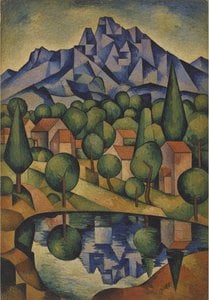
Paul Cézanne’s Still Life with Soup Tureen: A Window into Post-Impressionist Vision
Paul Cézanne's Still Life with Soup Tureen, painted in 1884 and now residing within the hallowed halls of the Musée d'Orsay in Paris, is far more than a simple arrangement of fruit and tableware. It’s a pivotal moment in art history—a declaration of independence from the constraints of academic tradition and a bold step toward the radical innovations that would define modern painting. This work isn’t merely depicting objects; it’s exploring their essence, their underlying structure, and their relationship to space and light with an unprecedented intensity.
Cézanne's approach during this period was revolutionary. He moved away from the fleeting impressions of Impressionism—the capturing of a momentary effect of light—and instead focused on distilling the essential forms of his subjects. The soup tureen, a commonplace object, becomes a vehicle for investigating geometry and volume. Notice how Cézanne doesn’t render the tureen as a smoothly polished surface reflecting light; rather, he breaks it down into planes, suggesting its three-dimensionality through carefully placed brushstrokes. This deliberate simplification of form anticipates Cubism by years, demonstrating his profound influence on the movement that would follow.
The Composition: A Symphony of Color and Form
The painting’s composition is deceptively simple yet remarkably dynamic. The central focus is undeniably the basket overflowing with apples—a vibrant cluster of crimson, yellow, and green that commands attention. These aren't idealized, perfect fruits; they possess a palpable sense of ripeness and texture, rendered through Cézanne’s confident brushwork. The oranges scattered around the table contribute to this richness, their warm hues contrasting beautifully with the cooler tones of the bowl and bottle. The placement of these elements—the basket dominating the center, the bowl and bottle anchoring the sides—creates a balanced yet subtly unsettling arrangement, as if the objects are poised on the brink of movement.
The inclusion of the bowl, partially obscured by shadow, hints at a hidden narrative – perhaps a suggestion of nourishment, domesticity, or even melancholy. The bottle, positioned to the right, adds another layer of visual interest, its form echoing the curves of the tureen and contributing to the overall sense of balance. Even the background—a muted wall with a glimpse of a framed picture—is treated with Cézanne’s characteristic simplification, serving primarily as a backdrop to emphasize the foreground elements.
A Post-Impressionist Masterpiece: Technique and Influence
Cézanne's technique is instantly recognizable. He employs bold, expressive brushstrokes – not blended smoothly like an Impressionist—but applied with deliberate force and direction. These strokes aren’t meant to mimic reality; they are used to build up form, create texture, and convey the artist’s subjective experience of the subject. The use of color is equally significant. Cézanne doesn't adhere to naturalistic hues but manipulates them to achieve a desired effect—intensifying colors, juxtaposing complementary tones, and creating a sense of depth through subtle variations in shade.
The influence of Cézanne’s work extends far beyond his own lifetime. Vincent van Gogh, deeply inspired by Cézanne's exploration of color and form, incorporated similar techniques into his own still life paintings, notably those created during his time in Paris. Similarly, Pablo Picasso acknowledged Cézanne as a key figure in the development of Cubism, recognizing his pioneering approach to representing three-dimensional space on a two-dimensional surface. Cézanne’s legacy lies not just in his individual masterpieces but also in his profound impact on subsequent generations of artists.
Owning a Piece of Art History: Reproductions by WahooArt
At WahooArt, we are dedicated to preserving and celebrating the beauty of iconic artworks like Cézanne’s Still Life with Soup Tureen. Our skilled artisans meticulously recreate this masterpiece using traditional oil painting techniques, ensuring that every detail—from the vibrant colors to the expressive brushstrokes—is faithfully reproduced. When you choose a WahooArt reproduction, you're not simply acquiring an image; you're bringing home a tangible piece of art history.
These reproductions offer a unique opportunity to experience the emotional impact and artistic brilliance of Cézanne’s work in your own space. Whether displayed in a grand salon or a cozy corner, this painting will undoubtedly become a focal point, sparking conversation and inspiring contemplation. Explore our collection today and discover the perfect way to add a touch of Post-Impressionist elegance to your home.



 Vorschau anzeigen
 Druck bestellen
 Versenden
 Teilen
 Details anzeigen

 Herunterladen
 Ähnliche Objekte
 Röntgenaufnahme
 Diashow


 Weiterlesen






































 Die Glasoption ist nur für Größen unter 110 cm verfügbar.