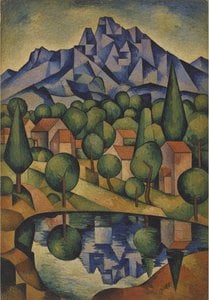
Mont Sainte-Victoire: A Mountain’s Enduring Echo in Cézanne's Vision
Paul Cézanne’s “Mont Sainte-Victoire” isn’t merely a landscape painting; it’s an intimate encounter with a place, a meditation on form and perception, and a pivotal moment in the transition from Impressionism to modern art. This iconic image of the towering limestone peak that dominates the Provençal countryside near Aix-en-Provence represents more than just a mountain – it embodies Cézanne's relentless pursuit of distilling the essence of nature onto canvas, transforming fleeting impressions into enduring structures. The painting, created between 1887 and 1906 across numerous iterations, reveals a deeply personal and evolving relationship with this familiar subject, reflecting both his artistic ambition and his profound connection to his homeland.
Cézanne’s approach diverges dramatically from the Impressionists' focus on capturing momentary light effects. Instead of striving for photographic realism, he meticulously analyzed the mountain’s geometry – its sharp angles, receding planes, and interlocking forms. He employed a technique known as “alla prima,” working directly onto the canvas with loose, expressive brushstrokes, layering colors to build up volume and create an illusion of solidity. Notice how Cézanne doesn't blend his colours; instead he uses them in distinct strokes that define the mountain’s contours. The result is not a smooth, atmospheric depiction but a carefully constructed representation of three-dimensional space, anticipating the principles of Cubism by breaking down objects into their fundamental geometric components.
The Painter’s Obsession: A Series of Transformations
What distinguishes “Mont Sainte-Victoire” from many landscape paintings is its status as part of a vast and intensely personal series. Cézanne returned to the mountain countless times, painting it from various vantage points – from his home in Aix, from the nearby village of Les Lauves, and even from the train tracks that offered a distant view. Each iteration reveals subtle shifts in perspective, color palette, and composition. This wasn’t simply repetition for the sake of it; Cézanne was actively engaged in a process of intellectual and artistic exploration, constantly refining his understanding of how to represent three-dimensional space on a two-dimensional surface. The variations across these paintings demonstrate his meticulous study of light, shadow, and form – a testament to his dedication and innovative approach.
The inclusion of the railway viaduct in several versions adds an intriguing layer of complexity. It serves as a visual anchor, grounding the composition and providing a sense of scale. However, it also subtly disrupts the idealized landscape, hinting at the intrusion of modernity into this timeless setting. The bridge’s presence forces us to consider the relationship between nature and human intervention – a theme that resonates throughout Cézanne's work.
Symbolism and Emotional Resonance
Beyond its formal qualities, “Mont Sainte-Victoire” is imbued with a powerful sense of emotional resonance. For Cézanne, the mountain represented more than just a geographical feature; it was a symbol of stability, permanence, and the enduring spirit of Provence. The painting evokes feelings of tranquility, contemplation, and perhaps even a touch of melancholy – reflecting the artist’s own struggles with self-doubt and his yearning for artistic recognition. The muted color palette—dominated by greens, blues, and browns—contributes to this atmosphere of quiet introspection.
Consider the way Cézanne uses color to suggest depth and distance. The darker hues in the foreground recede into shadow, while the brighter tones of the sky and distant hills create a sense of atmospheric perspective. This masterful manipulation of color not only enhances the painting’s visual impact but also invites us to lose ourselves in its immersive quality. The subtle interplay of light and shadow creates an almost palpable sense of presence—as if we too are standing on the hillside, gazing upon this majestic mountain.
A Legacy of Innovation
“Mont Sainte-Victoire” stands as a cornerstone of modern art, profoundly influencing generations of artists who followed in Cézanne’s footsteps. His innovative approach to form, color, and perspective paved the way for Cubism and other avant-garde movements. Reproductions of this masterpiece offer an accessible entry point into Cézanne's revolutionary vision, allowing viewers to appreciate his groundbreaking techniques and profound understanding of nature. Owning a high-quality reproduction is not just acquiring a beautiful image; it’s connecting with a pivotal moment in art history—a testament to the enduring power of one man’s unwavering dedication to his craft.



 Vorschau anzeigen
 Handgemalte Reproduktion bestellen
 Versenden
 Teilen
 Details anzeigen

 Herunterladen
 Ähnliche Objekte
 Röntgenaufnahme
 Diashow
 Statistiken

 Weiterlesen






































 Die Glasoption ist nur für Größen unter 110 cm verfügbar.