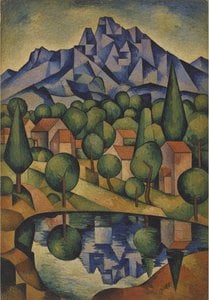
Paul Cézanne’s Mill on the Couleuvre at Pontoise: A Vision of Rural Tranquility
Paul Cézanne's Mill on the Couleuvre at Pontoise stands as a cornerstone of Post-Impressionism, capturing not merely a scene from rural France but also a profound shift in artistic perception. Painted in 1881 and currently housed in the Staatliche Museen zu Berlin, this oil-on-canvas masterpiece transcends mere representation; it embodies Cézanne’s revolutionary approach to color and form—a departure from Impressionism's fleeting effects of light that paved the way for the burgeoning Cubist movement.
The Artistic Context: Beyond Impressionistic Illusion
Impressionists sought to depict the sensory experience of a moment, prioritizing optical sensations over detailed observation. Cézanne reacted against this preoccupation with illusion, recognizing that art could convey deeper truths about reality. Influenced by Romanticism’s emotive landscapes and Realism's meticulous depiction of everyday life, Cézanne embarked on his own exploration—one driven by an unwavering desire to distill the essence of nature into geometric shapes. This ambition foreshadowed the radical experimentation that would characterize 20th-century art.
Composition and Elements: A Harmonious Balance
The painting’s visual impact derives from its carefully considered composition. Cézanne presents a modest village nestled beneath a towering tree—a dominant element that anchors the scene. Scattered figures populate the landscape, adding human presence to the serene rural setting. Notably, a boat occupies the central space, while a horse appears on the left side, contributing to the overall atmosphere of tranquility and observation. Cézanne’s masterful use of perspective creates depth, inviting viewers into the depicted environment.
Artistic Style: Bold Strokes and Geometric Forms
Cézanne's distinctive style is immediately recognizable through his characteristic brushstrokes—bold, irregular marks that reject Impressionist blending. He scrutinized the materiality of paint itself, prioritizing texture and solidity over optical illusion. This approach reflects Cézanne’s fascination with underlying structure—a desire to represent not what we see but what we know to be there. The painting's color palette is subdued yet expressive, favoring earthy tones that convey a sense of permanence and groundedness.
Relevance to Art History: Cézanne’s Legacy
Mill on the Couleuvre at Pontoise holds immense significance in art history as it represents a pivotal moment in artistic evolution. Cézanne profoundly influenced artists like Pablo Picasso, who adopted his geometric style and fragmented perspective—techniques that would become foundational to Cubism. Consider Picasso’s Las golondrinas and Portrait of Gustave Coquiot 1—works that demonstrate the enduring impact of Cézanne’s innovative vision. This painting serves as a testament to Cézanne's ability to capture beauty and convey profound artistic ideas.



 In echtem Maßstab anzeigen
 Handgemalte Reproduktion kaufen
 Versenden als Grußkarte
 Teilen
 Details anzeigen
 Leitfaden

 Herunterladen
 Ähnliche Objekte
 Röntgenaufnahme
 Diashow
 Besucherstatistiken

 Mehr anzeigen






































 Die Glasoption ist nur für Größen unter 110 cm verfügbar.