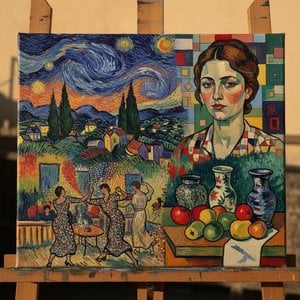
Mardi Gras: A Celebration Captured in Cézanne’s Vision
Paul Cézanne's *Mardi Gras*, completed in 1888, stands as a remarkable testament to Post-Impressionist artistic exploration and a poignant reflection of the era’s fascination with theatrical spectacle. Housed within the E. G. Buhrle Collection in Switzerland, this oil on canvas painting transcends mere depiction; it strives to convey an atmosphere—a palpable sense of festive exuberance—that distinguishes itself from conventional academic art.
The composition centers around two figures: a clown and a man dressed in checkered pants. Cézanne’s deliberate use of geometric forms – particularly the rectangular curtain backdrop – establishes a framework that contrasts sharply with Impressionistic brushstrokes, prioritizing structural solidity over fleeting visual impressions. The inclusion of a knife held by the clown adds an element of tension and intrigue, hinting at underlying anxieties within the joyous celebration.
- Style: Cézanne’s signature style is characterized by repetitive, exploratory brushstrokes that dissect objects into fundamental planes of color and form. This approach deliberately rejects academic conventions, prioritizing visual truth over idealized representation.
- Technique: Cézanne employed a technique known as “alla prima,” applying paint directly onto the canvas without preliminary sketches or underdrawings—a bold decision that ensured spontaneity and immediacy in his artistic process.
- Color Modulation: Cézanne’s masterful manipulation of color contributes significantly to the painting's emotional impact, creating harmonious blends that evoke a sense of warmth and vibrancy.
The artwork’s historical significance extends beyond its aesthetic qualities. Cézanne’s work anticipated the revolutionary developments of Cubism, marking a pivotal moment in art history. Furthermore, it garnered considerable acclaim from fellow artists like Camille Pissarro and Ambroise Vollard, who recognized Cézanne's groundbreaking vision.
The initial reception of *Mardi Gras* was marked by skepticism and criticism—a common fate for avant-garde artists at the time. However, Vollard’s influential solo exhibition in 1895 brought Cézanne’s paintings to a wider audience, fostering recognition among figures like Henri Matisse and Pablo Picasso who acknowledged him as “the father of us all.” This enduring legacy underscores Cézanne's profound influence on subsequent generations of artists.
For those seeking inspiration or considering acquiring a high-quality reproduction of *Mardi Gras*, exploring Cézanne’s biography—particularly his formative years and his unwavering dedication to artistic innovation—provides invaluable insight into the genesis of this iconic masterpiece. You can find more information on WahooArt or delve deeper into Cézanne's life on Wikipedia.



 Vorschau anzeigen
 Handgemalte Reproduktion bestellen
 Versenden
 Teilen
 Details anzeigen

 Herunterladen
 Ähnliche Objekte
 Röntgenaufnahme
 Diashow
 Statistiken

 Weiterlesen






































 Die Glasoption ist nur für Größen unter 110 cm verfügbar.