


x

 Druck bestellen Bild kaufen
 Versenden
 Details
 Zu Favoriten hinzufügen
 Herunterladen
 Ähnliche Objekte
 X-Ray
X-Ray
 Diashow anzeigen
 Öl auf LeinwandWandkunstPost-Impressionism
 189019. Jahrhundert
 21.0 x 20.0 cm
Handgemaltes Ölgemälde auf Leinwand in Ihrer Wunschgröße und mit Rahmen, auf Bestellung von unseren Künstlern angefertigt.





























Wählen Sie aus unseren vordefinierten Größen, die den ursprünglichen Proportionen des Kunstwerks entsprechen.

Sie können Ihre eigenen Maße eingeben, um einen bestimmten Rahmen oder Platz auszufüllen. Wenn die gewählte Größe nicht den Proportionen des Originalbildes entspricht, werden wir das Kunstwerk entweder beschneiden oder das Gemälde durch zusätzliche, handgemalte Elemente erweitern. Ein digitales Mockup wird Ihnen zur Genehmigung zugesandt, bevor die Produktion beginnt.
Bitte beachten Sie, dass die Bildschirmvorschau nicht die tatsächliche Beschneidung oder Erweiterung widerspiegelt. Nur das Mockup zeigt die endgültige Komposition exakt an.
Obwohl Sondermaße verfügbar sind, empfehlen wir, eine Größe aus der vordefinierten Liste zu wählen, um die ursprünglichen Proportionen beizubehalten.
Weltweiter Versand () in nur 3 bis 4 Wochen statt der üblichen 5 Wochen. (1 Juli). Keine Kompromisse bei der Qualität.


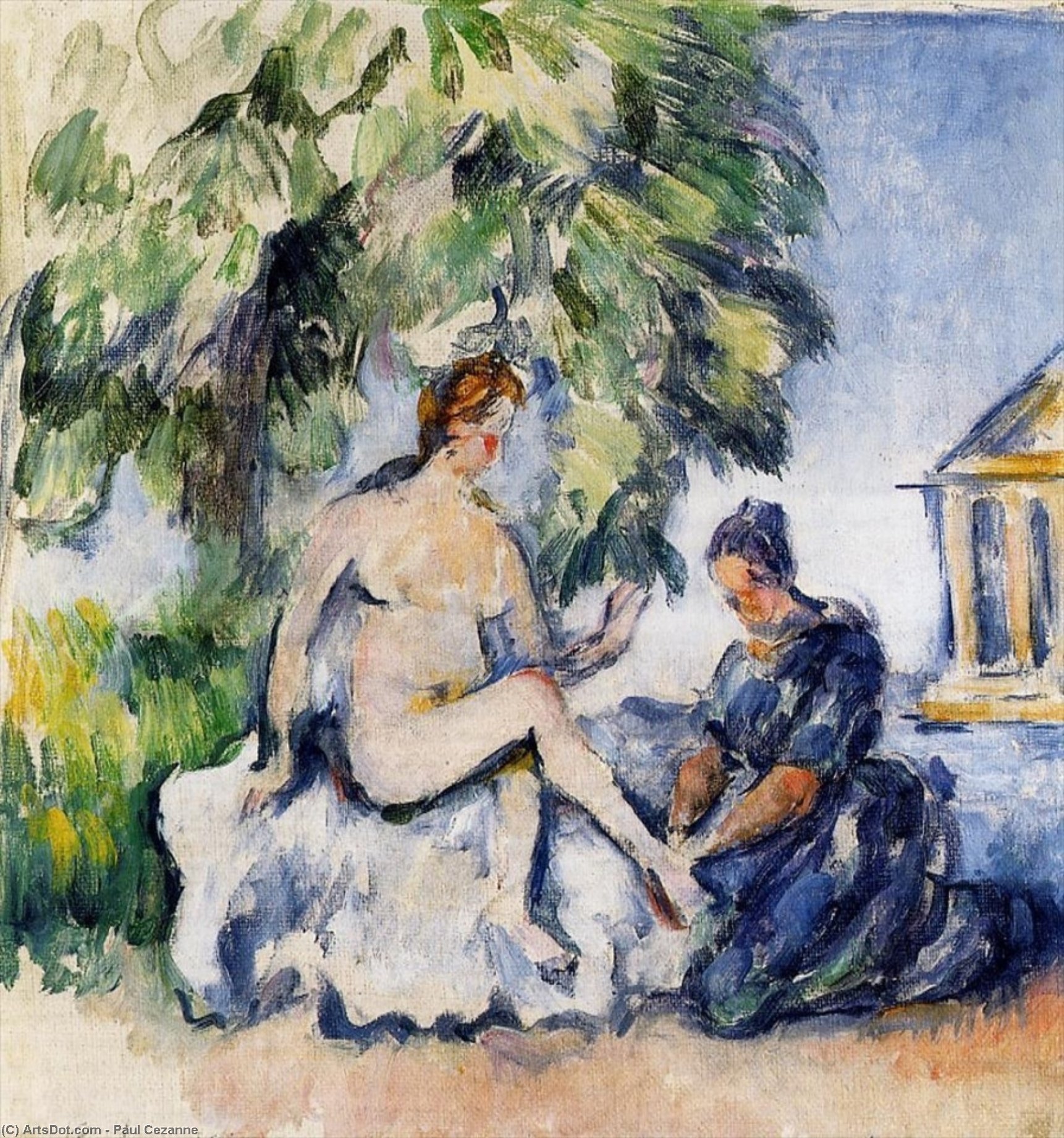
Bathsheba
Größe der Reproduktion
Paul Cézanne's "Bathsheba," painted in 1890, is more than just a portrait; it’s a carefully constructed tableau vivant – a snapshot of a fleeting moment imbued with profound symbolism. This work, residing within the Post-Impressionist movement, represents a pivotal shift away from the ephemeral impressions of its predecessors and towards a deliberate exploration of form, structure, and the very essence of observation. The painting depicts two women seated before a tree, an arrangement that immediately draws the viewer into a scene brimming with quiet contemplation and subtle narrative tension.
The composition itself is remarkably restrained yet powerfully suggestive. On the left sits a woman in a state of apparent nudity, her posture relaxed and inviting. Her gaze is directed towards the other figure, while her hands rest gently on an object – perhaps a book or a small token – hinting at a shared conversation or observation. In contrast, the woman to her right is clothed, her attire suggesting a more formal role within this intimate setting. A simple bench provides a grounding element, anchoring the scene and drawing attention to the interplay between these two figures. The inclusion of two birds, perched above the seated women, adds an element of serenity and natural harmony, subtly elevating the mood.
Cézanne's approach to painting in “Bathsheba” is deeply rooted in his exploration of Post-Impressionism. Unlike the Impressionists, who sought to capture the fleeting effects of light and color, Cézanne was less concerned with replicating visual reality than with representing its underlying structure. He employed a technique known as "constructive strokes," building up forms through deliberate, geometric brushstrokes that create a sense of solidity and permanence. This is particularly evident in the depiction of the tree – not merely a backdrop but an integral element of the composition, defined by sharp angles and carefully placed planes.
The color palette is equally significant. Cézanne eschews bright, vibrant hues in favor of muted tones and subtle gradations, creating a sense of depth and atmosphere. He uses color to define form rather than simply to represent it, employing complementary colors – such as the blues and oranges – to create visual interest and enhance the three-dimensionality of the scene. This deliberate manipulation of color is characteristic of Cézanne’s broader artistic philosophy: to reveal the essential nature of his subjects through a rigorous analysis of their forms and structures.
While seemingly simple, “Bathsheba” is rich in symbolic potential. The painting draws parallels with the biblical story of Bathsheba, David’s concubine and mother of King Solomon. However, Cézanne deliberately obscures any direct reference to this narrative, allowing the scene to resonate on a more universal level. The two women can be interpreted as representing different aspects of human experience – perhaps intimacy, contemplation, or simply the quiet pleasures of companionship. The book on the bench could symbolize knowledge, conversation, or shared interests.
The positioning of the figures and the arrangement of objects within the composition create a sense of visual equilibrium, suggesting a harmonious relationship between the two women. Yet, there is also an underlying tension – a subtle awareness of their differing roles and perspectives. This duality contributes to the painting’s enduring appeal, inviting viewers to contemplate its hidden meanings and emotional resonance.
“Bathsheba” stands as a cornerstone in Cézanne's oeuvre and a pivotal work in the development of modern art. His innovative approach to painting – his emphasis on structure, form, and color—laid the groundwork for movements such as Cubism and Fauvism. Artists like Pablo Picasso were profoundly influenced by Cézanne’s exploration of perspective and spatial relationships, while Henri Matisse embraced his use of color to define form. Today, “Bathsheba” continues to captivate audiences with its quiet beauty, structural rigor, and profound symbolic depth. It remains a testament to Cézanne's genius as one of the most influential artists of the 20th century.


1839 - 1906 , Frankreich
Entdecken Sie die 25 Meisterwerke von Henri Matisse! Tauchen Sie ein in die Welt des Fauvismus, der leuchtenden Farben und ikonischen Formen. Kunstreproduktionen & Inspiration für Ihr Zuhause – exklusiv auf WahooArt.com.

Explore the rich history of women in art – from iconic muses to groundbreaking artists. Discover feminist movements, global perspectives & reclaim female narratives with WahooArt.
Entdecken Sie die 10 legendärsten Ölgemälde der Kunstgeschichte! Von Van Gogh bis Da Vinci – erfahren Sie die Geschichten hinter Meisterwerken wie Mona Lisa & Die Sternennacht. Hochwertige Reproduktionen auf .

Entdecken Sie die 10 legendärsten Gemälde auf Holz – von Renaissance bis Impressionismus! Erfahren Sie die Geschichten der Künstler & ihre Meisterwerke. Hochwertige Reproduktionen bei .
Entdecken Sie die 25 bedeutendsten Kunstwerke von Georges Braque – vom Kubismus bis zum Fauvismus. Erfahren Sie die Geschichten hinter den Meisterwerken und finden Sie hochwertige Reproduktionen für Ihr Zuhause auf WahooArt.com.


Bleiben Sie über die neuesten Kunstnachrichten, exklusive Angebote und Dekorationsideen auf dem Laufenden.
Erzählen Sie uns von Ihrem Projekt und unsere Kunstexperten erstellen für Sie 3 personalisierte Kunstvorschläge.
Wir kuratieren 3 Optionen exklusiv für Sie – kostenlos!
 Teilen








 Weiterlesen
 Die Glasoption ist nur in Größen unter 110 cm verfügbar.


