Acryl auf LeinwandWandkunstPost-Impressionism
 1866Frühmittelalter
 167.0 x 105.0 cm
 Chrysler Museum of Art
Giclée- oder Leinwanddruck in Museumsqualität mit schneller Produktion und flexiblen Veredelungsoptionen. ( Handgemalte Reproduktion bestellen Bild kaufen)





























Wählen Sie aus unseren vordefinierten Formaten, die den ursprünglichen Proportionen des Kunstwerks entsprechen.

Sie können Ihre eigenen Maße eingeben, um ein bestimmtes Format oder einen speziellen Platz einzupassen. Wenn das von Ihnen gewählte Format nicht den Proportionen des Originalbildes entspricht, werden wir das Kunstwerk entweder beschneiden oder das Bild mit einem gespiegelten oder einfarbigen Rand erweitern. Ein digitaler Entwurf wird Ihnen zur Genehmigung zugesandt, bevor die Produktion beginnt.
Bitte beachten Sie, dass die Vorschau auf dem Bildschirm nicht den tatsächlichen Zuschnitt oder die Erweiterung widerspiegelt. Nur der Entwurf zeigt die endgültige Komposition präzise an.
Obwohl Sondermaße verfügbar sind, empfehlen wir die Auswahl eines Maßes aus der vordefinierten Liste, um die ursprünglichen Proportionen zu bewahren.
Weltweiter Versand () innerhalb von 2 Wochen statt der üblichen 4/5 Wochen. (6 September)


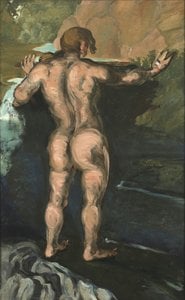
Bather und Felsen
Format der Reproduktion
Paul Cézanne’s “Bather and Rocks” isn't merely a depiction of a man enjoying the water; it’s an intensely personal exploration of form, space, and the very essence of being. Painted in 1866, this fragment from a larger mural offers a glimpse into the artist’s revolutionary vision – a vision that would fundamentally reshape modern art. Imagine Cézanne, residing in his family estate near Aix-en-Provence, transforming a wall of his grand salon into a landscape brimming with observation and deliberate distortion. This particular section, detached later and sold as a standalone piece, retains an almost palpable energy, a testament to the artist’s unwavering commitment to capturing not just what he saw, but how he *felt* about what he saw.
The painting emerged during a pivotal period in Cézanne's artistic development. He was wrestling with the conventions of academic art – the smooth surfaces, the precise rendering of detail – and seeking a new language to express his inner world. The influence of Japanese prints, particularly their flattened perspectives and emphasis on line, is evident here. Cézanne wasn’t interested in creating an illusionistic representation; instead, he aimed to distill the essential forms of nature onto canvas. This fragment, removed from its original setting, becomes a microcosm of his larger project – a deliberate departure from traditional landscape painting. The mansion where it was created provided him with the financial freedom to experiment and push boundaries, something rare for an artist at that time.
Cézanne’s technique in “Bather and Rocks” is strikingly unconventional. He employs a thick impasto – layers of paint applied with visible brushstrokes – to build up the forms, creating a tactile surface that seems to vibrate with energy. The musculature of the nude figure is rendered with an almost brutal honesty, emphasizing strength and power. Notice how he simplifies the contours, reducing complex shapes to their fundamental geometric components: cylinders, cones, and spheres. This approach anticipates Cubism, where objects are broken down into fragmented planes and reassembled in a new spatial arrangement. The rocks themselves aren’t realistically depicted; they're blocks of color and form, anchoring the composition and suggesting an immense, unseen force – the relentless power of the water.
Beyond its formal innovations, “Bather and Rocks” resonates with a profound sense of introspection. The figure’s averted gaze – he looks towards his back – suggests a moment of solitude, a connection to the primal forces of nature. He is not actively engaged in an activity; rather, he stands as a silent observer, confronting the power of the water. The rocks themselves can be interpreted as symbols of resilience and stability, offering a counterpoint to the fluidity of the waves. The painting evokes a feeling of both vulnerability and strength – a recognition of our own place within the vastness of the natural world. It’s a meditation on the relationship between humanity and nature, a theme that would continue to occupy Cézanne throughout his career.
A high-quality reproduction of “Bather and Rocks” offers a captivating glimpse into the mind of one of art history's most influential figures. Its dynamic composition and bold use of color make it an ideal addition to any collection, while its evocative symbolism invites contemplation and reflection. Consider how this powerful image might complement your interior design – bringing a touch of Cézanne’s revolutionary spirit to your space.


1839 - 1906 , Frankreich

Explore the structural genius of Paul Cézanne. Discover how his mastery of geometric form and color bridged Impressionism and Cubism in this definitive guide for art enthusiasts and collectors.
Explore the profound legacy of Paul Cézanne. Discover how his mastery of geometric forms and vibrant color bridged Impressionism and Cubism, offering timeless inspiration for fine art collectors and enthusiasts seeking to understand the foundations of modern art.

Explore the transformative era of Post-Impressionism. Discover how masters like Cézanne and Matisse revolutionized color and form, moving beyond Impressionism to shape modern art history through structural innovation and expressive emotion.

Master the nuances of Impressionism vs. Post-Impressionism with our expert guide. Explore the revolutionary shift from Monet’s fleeting light to Van Gogh’s emotional depth. Discover how these iconic movements continue to inspire fine art collectors and modern interiors today.

 Vorschau anzeigen
 Versenden
 Teilen
 Details anzeigen

 Herunterladen
 Ähnliche Objekte
 Röntgenaufnahme
 Diashow
 Weiterlesen







 Die Glasoption ist nur für Größen unter 110 cm verfügbar.