


 Acryl auf LeinwandWandkunstEarly Renaissance
 1460
1460 45.0 x 67.0 cm
 Museo Thyssen-Bornemisza
Handgemaltes Ölgemälde auf Leinwand in Ihrer Wunschgröße und mit Rahmen, auf Bestellung von unseren Künstlern angefertigt. ( Druck bestellen Bild kaufen)





























Wählen Sie aus unseren vordefinierten Formaten, die den ursprünglichen Proportionen des Kunstwerks entsprechen.

Sie können Ihre eigenen Maße eingeben, um einen bestimmten Rahmen oder Platz auszufüllen. Wenn die gewählte Größe nicht den Proportionen des Originalbildes entspricht, werden wir das Kunstwerk entweder beschneiden oder das Gemälde durch zusätzliche, handgemalte Elemente erweitern. Ein digitales Mockup wird Ihnen zur Genehmigung zugesandt, bevor die Produktion beginnt.
Bitte beachten Sie, dass die Bildschirmvorschau nicht die tatsächliche Beschneidung oder Erweiterung widerspiegelt. Nur das Mockup zeigt die endgültige Komposition exakt an.
Obwohl Sondermaße verfügbar sind, empfehlen wir, eine Größe aus der vordefinierten Liste zu wählen, um die ursprünglichen Proportionen beizubehalten.
Weltweiter Versand () in nur 3 bis 4 Wochen statt der üblichen 5 Wochen. (7 September). Keine Kompromisse bei der Qualität.


Kreuzigung
Format der Reproduktion
Paolo Uccello’s “Kreuzigung,” painted around 1460, is not merely a depiction of a pivotal religious event; it's a profound exploration of perspective and space, rendered with the meticulous detail characteristic of a Florentine visionary. Born in Pratovecchio in 1397, Uccello wasn’t simply a painter; he was an architect of vision, driven by a desire to understand and represent the world as accurately – and perhaps dramatically – as possible. His early training under Lorenzo Ghiberti instilled within him a deep appreciation for classical forms and a burgeoning interest in mathematical principles applied to art. This “Kreuzigung” embodies this intellectual curiosity, pushing the boundaries of artistic convention while remaining firmly rooted in the devotional subject matter of its time.
What immediately captivates the viewer is Uccello’s radical approach to perspective. Unlike the largely illusionistic techniques employed by his contemporaries, such as Masaccio or Piero della Francesca, Uccello deliberately exaggerates spatial relationships. The cross itself appears unusually large and dominates the composition, drawing the eye directly to Jesus Christ, who is depicted with a quiet dignity amidst the unfolding drama. Notice how the figures surrounding the crucifixion – Mary Magdalene, John the Baptist, and the angels – are positioned not in a naturalistic arrangement but rather within a carefully constructed geometric framework. This isn’t an attempt at photographic realism; it's a deliberate manipulation of space designed to heighten the emotional impact of the scene. The mountains in the background, rendered with meticulous detail, further contribute to this sense of depth and grandeur, creating a theatrical stage for the tragedy unfolding before us.
Beyond the technical innovations, “Kreuzigung” is rich in religious symbolism. Jesus Christ, at the center of the composition, represents sacrifice and redemption. Mary Magdalene, traditionally depicted as a repentant sinner, embodies compassion and devotion. John the Baptist, often associated with repentance and baptism, stands as a witness to the event. The angels flanking the cross are messengers of God’s judgment and mercy. The overall scene speaks powerfully of faith, suffering, and hope – themes central to Christian theology. It's important to remember that Uccello was working within a context where religious imagery served not only as devotional art but also as a means of reinforcing social and political hierarchies.
Uccello’s mastery lies in his meticulous attention to detail. The figures are rendered with a remarkable level of realism, particularly in their drapery and facial expressions. He employs a vibrant palette, dominated by deep reds, blues, and golds, which heighten the drama and emotional intensity of the scene. The use of tempera on panel – a technique favored during this period – allowed for layering colors and creating subtle gradations of tone. The surface is remarkably smooth, reflecting Uccello’s dedication to achieving a polished finish. This painting demonstrates his skill in rendering textures, from the rough fabric of the cross to the flowing garments of the figures. The reproduction offered here captures these nuances with exceptional fidelity, allowing you to appreciate the full beauty and complexity of this remarkable work.
WahooArt offers a meticulously crafted hand-painted reproduction of Paolo Uccello’s “Kreuzigung,” ensuring that you can bring this iconic Renaissance masterpiece into your home or office. Each reproduction is created with the same care and attention to detail as the original, providing an authentic representation of Uccello's artistic vision.


1397 - 1475 , Italien
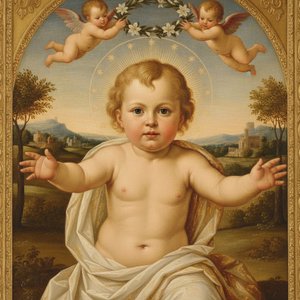
Explore the profound beauty of Baby Jesus in fine art history. From Raphael's Renaissance masterpieces to symbolic light, discover how classical painters captured divine innocence through masterful technique and sacred iconography.

 Vorschau anzeigen
 Versenden
 Teilen
 Details anzeigen

 Herunterladen
 Ähnliche Objekte
 Röntgenaufnahme
 Diashow
 Weiterlesen







 Die Glasoption ist nur für Größen unter 110 cm verfügbar.


