Vorschau anzeigenVorschau anzeigen In AR erlebenIn AR erleben Handgemalte Reproduktion bestellen Handgemalte Reproduktion bestellenZum digitalen Bild wechseln Zum digitalen Bild wechseln VersendenVersenden
Details anzeigenDetails anzeigen Zu Favoriten hinzufügen Zu Favoriten hinzufügen HerunterladenHerunterladen Ähnliche ObjekteÄhnliche Objekte RöntgenaufnahmeRöntgenaufnahme DiashowDiashow StatistikenStatistiken

The painter and his model 5

Experience Pablo Picasso’s revolutionary Cubist masterpiece, ‘The Painter and His Model,’ a fragmented portrait exploring perception and the anxieties of 1937 Spain. Discover this iconic artwork and bring its intellectual depth into your space.

Entdecken Sie Pablo Picassos revolutionäre Kunst! Kubismus, Blaue & Rosafarbene Periode, Guernica & sein bleibender Einfluss auf die moderne Kunst des 20. Jahrhunderts.

Giclée / Kunstdruck

Giclée- oder Leinwanddruck in Museumsqualität mit schneller Produktion und flexiblen Veredelungsoptionen. (Handgemalte Reproduktion bestellen Handgemalte Reproduktion bestellenZum digitalen Bild wechseln Zum digitalen Bild wechseln)

P118B $10
P118H $10
P118W $10
P438Z $10
P508JH $12
P508YH $12
P805H $10
P805Z $10
P919BZ $10
P919G $10
P919XJ $10
P959ZH $10
P968JZ $12
W106C $8
W218G $10
W218JH $8
W218Y $10
W307PJ $10
W316G $10
W316PJ $8
W316Y $10
W398PJ $8
W4111J $10
W500HY $15
W500JH $15
W692G $12
W849H $8
W940BG $15
W953PJ $8

Standardformat
individuell anpassbar
CM
INCH

Wählen Sie aus unseren vordefinierten Formaten, die den ursprünglichen Proportionen des Kunstwerks entsprechen.

Breite
Höhe

Sie können Ihre eigenen Maße eingeben, um ein bestimmtes Format oder einen speziellen Platz einzupassen. Wenn das von Ihnen gewählte Format nicht den Proportionen des Originalbildes entspricht, werden wir das Kunstwerk entweder beschneiden oder das Bild mit einem gespiegelten oder einfarbigen Rand erweitern. Ein digitaler Entwurf wird Ihnen zur Genehmigung zugesandt, bevor die Produktion beginnt.
Bitte beachten Sie, dass die Vorschau auf dem Bildschirm nicht den tatsächlichen Zuschnitt oder die Erweiterung widerspiegelt. Nur der Entwurf zeigt die endgültige Komposition präzise an.
Obwohl Sondermaße verfügbar sind, empfehlen wir die Auswahl eines Maßes aus der vordefinierten Liste, um die ursprünglichen Proportionen zu bewahren.

Weltweiter Versand () innerhalb von 2 Wochen statt der üblichen 4/5 Wochen. (11 September)

why_choose_icon
Kostenloser weltweiter Expressversand
why_choose_icon
Hochwertige Leinenleinwand
why_choose_icon
Umfassender Versicherungsschutz beim Versand
why_choose_icon
Zollgebühren-Rückerstattungsgarantie
why_choose_icon
Garantie für exakte Farbtreue
why_choose_icon
100-Tage-Rückgaberecht (nur bei Mängeln)
why_choose_icon
100% Geld-zurück-Garantie
why_choose_icon
Mengenrabatt verfügbar

Gesamtpreis

$ 68

reproduction

The painter and his model 5

Giclée / Kunstdruck

Format der Reproduktion

-

Gesamtpreis

$ 68

Eckdaten

  • Influences: Georges Braque
  • Artistic style: Analytical Cubism
  • Medium: Oil on canvas
  • Location: Private Collection
  • Subject or theme: Portraiture
  • Notable elements or techniques: Fragmentation, Multiple perspectives

Kunst-Quiz

Jede Frage hat nur eine richtige Antwort.

Frage 1:
What artistic movement is Pablo Picasso’s ‘The Painter and His Model 5’ primarily associated with?
Frage 2:
Describe the dominant visual style of the painting. Consider elements like perspective, color palette and representation.
Frage 3:
What objects are prominently featured in the painting's composition?
Frage 4:
Pablo Picasso’s personal life experiences influenced his artistic style. How might the loss of his sister contribute to the mood or themes explored in this artwork?
Frage 5:
The painting utilizes a technique known for breaking down objects into geometric shapes. What is this technique called?

A Fractured Vision: Picasso’s Cubist Masterpiece

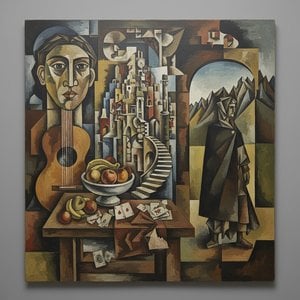
In the annals of twentieth-century art, few works possess the intellectual gravity and stylistic audacity of Pablo Picasso's "The Painter and His Model." Completed in 1937, this painting serves as a profound window into the heart of Cubism, a movement that shattered the traditional mirror of realism to reveal a more complex, multi-dimensional truth. As we gaze upon this composition, we are not merely looking at a portrait of two figures; we are witnessing an ambitious exploration of perception itself. Created against the somber backdrop of the Spanish Civil War, the work vibrates with the anxieties of an era in flux, reflecting a world where the old certainties were being dismantled as surely as the geometric planes on Picasso's canvas.

The painting presents a scene that feels both intimate and profoundly disconnected. A man sits with his back turned to the viewer, anchored by a chair, while a woman stands beside him, her form intertwined with the surrounding space. They are joined by the presence of others—shadowy figures that flank the central duo—creating a sense of a shared, yet fragmented, social reality. This arrangement invites the viewer to move beyond a simple observation of subjects and instead engage in a rhythmic dance of sight and interpretation, where every angle offers a new layer of meaning.

The Architecture of Geometry and Light

To understand the technical brilliance of this piece, one must delve into Picasso's masterful application of Cubist principles. Eschewing the soft, atmospheric light of Impressionism, Picasso employs a rigorous deconstruction of form. The figures are broken into angular, intersecting planes that overlap in a way that defies traditional depth. This technique creates a spatial ambiguity that is both disconcerting and mesmerizing; the man and woman appear to exist in multiple viewpoints simultaneously, capturing the essence of how memory and sight actually function—not as a single snapshot, but as a collection of fragmented impressions.

The color palette is intentionally restrained, utilizing a sophisticated arrangement of muted earthy tones. Ochre, deep browns, and slate greys dominate the canvas, lending the work a heavy, contemplative mood. This somber tonality reinforces the conceptual depth of the piece, ensuring that the viewer's focus remains on the structural interplay of light and shadow rather than being distracted by vibrant hues. For the collector or interior designer, this palette offers a timeless elegance, providing a sophisticated focal point that complements both modern minimalist settings and more classical, textured environments.

Symbolism and the Soul of Creativity

Beyond its striking geometry lies a rich tapestry of symbolic resonance. The presence of bowls held by the figures serves as a poignant metaphor for nourishment—not merely the physical sustenance required for life, but the intellectual and spiritual nourishment essential for the creative process. Yet, even these symbols of stability are subject to the Cubist fracture; their broken edges mirror the difficulty of achieving wholeness in an era of political and social upheaval. The very act of painting, represented by the interaction between the model and the artist, becomes a metaphor for the struggle to capture truth within a fragmented reality.

For those seeking to bring a piece of art history into their personal spaces, "The Painter and His Model" offers more than just aesthetic beauty. It provides an emotional anchor—a conversation piece that speaks to resilience, complexity, and the enduring power of human expression. Owning a high-quality reproduction of this work allows one to inhabit the intellectual ferment of 1937, bringing a sense of profound historical depth and avant-garde sophistication to any curated collection or thoughtfully designed interior.


Über den Künstler

Pablo Picasso: Ein revolutionärer Künstler

Frühes Leben und Ausbildung (1881-1904)

  • Geboren am 25. Oktober 1881 in Málaga, Spanien, zeigte Pablo Ruiz y Picasso von sehr jungem an sein künstlerisches Talent.
  • Sein Vater, José Ruiz y Blasco, war Kunstlehrer und gab seinem Sohn eine frühe Ausbildung. Es heißt, Picassos erste Worte waren “piz, piz” – ein Versuch, ‘Bleistift’ zu sagen.
  • Picasso übertraf seine Vaters Fähigkeiten schnell und zeigte bemerkenswerte Begabung in naturalistischen Darstellungen.
  • Die Familie zog nach A Coruña und später nach Barcelona nach dem tragischen Verlust Picassos Schwester.
  • In Barcelona besuchte er die Kunsthochschule, störte sich aber oft an der traditionellen akademischen Lehre. Er studierte kurzzeitig an der Königlichen Akademie San Fernando in Madrid und fand es beengend, bevorzugte aber das unabhängige Studium von Meistern wie Velázquez und Goya.

Die Blauen und Rosafarbenen Perioden (1901-1906)

  • Die Blaue Periode (ungefähr 1901-1904) ist durch düstere Gemälde geprägt, die von Blautönen und Blaugrün dominiert werden.
  • Diese Werke stellen oft marginalisierte Figuren dar – Bettler, blinde Menschen, Prostituierte – und spiegeln Melancholie und sozialen Kommentar wider. Wichtige Beispiele sind La Vie (1903) und Der alte Gitarrist (1903-1904).
  • Nachfolgend entstand die Rosafarbene Periode (1904-1906) mit wärmeren Tönen – Rosa-, Orange- und Rottönen.
  • Diese Periode spiegelt eine optimistischere Sichtweise wider und stellt oft Zirkusclowns, Harlekinen und Akrobaten dar. Familie der Saltimbanques (1905) ist ein Beispiel dafür.

Die revolutionären Jahre: Kubismus und darüber hinaus (1907-1919)

  • 1907 markierte einen Wendepunkt mit Les Demoiselles d'Avignon, der von iberischer Skulptur und afrikanischen Masken beeinflusst wurde. Dieses Gemälde zerstörte die traditionelle Perspektive und ebnete den Weg für den Kubismus.
  • Picasso arbeitete eng mit Georges Braque zusammen und gründete den Kubismus, der die Art und Weise, wie Künstler Realität darstellten, grundlegend veränderte.
  • Analytischer Kubismus (1909-1912) zeichnete sich durch fragmentierte Formen, gedämpfte Farben und die Zerlegung von Objekten in geometrische Formen aus.
  • Synthetischer Kubismus (1912-1919) integrierte Collagen – Zeitungsartikel, Stoffreste – um texturierte Oberflächen und neue visuelle Schichten zu schaffen.

Neoklassizismus und Surrealismus (1920er - 1930er Jahre)

  • In den 1920er Jahren erkundete Picasso neoklasische Stile mit monumentalen Figuren, die klassische Formen betonten.
  • Er beschäftigte sich auch mit dem Surrealismus, obwohl er sich nie vollständig mit dessen Prinzipien identifizierte. Seine Werke vermischten frühere Stile mit surrealistischer Bildsprache und verzerrten Perspektiven.

Spätere Jahre und Vermächtnis (1940-1973)

  • Während des Zweiten Weltkriegs blieb Picasso in Frankreich und produzierte kraftvolle Antikriegserklärungen wie Guernica (1937), eine wirkliche Reaktion auf den Angriff auf Guernica während des Spanischen Bürgerkriegs.
  • Guernica wurde zu einem bleibenden Symbol der Schrecken des Krieges und gilt als eines seiner bekanntesten Werke.
  • In den 1950er und 60er Jahren experimentierte Picasso weiterhin mit verschiedenen Medien – Keramik, Skulptur, Druckgrafik – und demonstrierte bemerkenswerte Vielseitigkeit.
  • Er heiratete Jacqueline Roque im Jahr 1961. Er starb am 8. April 1973 in Mougins, Frankreich.

Einflüsse und historische Bedeutung

  • Picassos künstlerische Entwicklung wurde von spanischen Meistern wie Velázquez und Goya, iberischer Skulptur, afrikanischer Kunst und Henri Matisse geprägt.
  • Sein Einfluss auf die Kunst des 20. Jahrhunderts ist unermesslich. Er gründete den Kubismus, pionierte Collagen und konstruktive Skulpturen und stellte traditionelle künstlerische Konventionen kontinuierlich in Frage.
  • Picassos unerbittliche Experimentierfreude definierte die moderne Kunst neu und inspiriert Künstler bis heute.
  • Seine fruchtbare Produktion – geschätzt auf über 50.000 Werke – festigt seine Position als einer der wichtigsten und einflussreichsten Künstler in der Geschichte.
Pablo Picasso

Pablo Picasso

1881 - 1973 , Spanien

Kurzinfos

  • Beeinflusste Künstler:
    • Velázquez
    • Goya
    • Henri Matisse
  • Bemerkenswerte Werke:
    • Les Demoiselles d'Avignon
    • Guernica
    • Der alte Gitarrist
    • Familie der Saltimbanques
  • Geburtsdatum: 25. Oktober 1881
  • Geburtsort: Málaga, Spanien
  • Künstlerische Richtung: Kubismus, Surrealismus
  • Nationalität: Spanisch
  • Sterbedatum: 8. April 1973
  • Vollständiger Name: Pablo Picasso
  • Von Künstlern Beeinflusst:
    • Iberische Skulptur
    • Afrikanische Kunst
Entdecken Sie Kunstwerke, die nach Themen, Stilen und Merkmalen sortiert sind.