


Erwerben Sie ein hochauflösendes, optimiertes digitales Bild, das der Online-Vorschau weit überlegen ist.
Jede Datei wird von unseren hauseigenen Spezialisten mit modernsten Werkzeugen und fachmännischer manueller Retusche sorgfältig vorbereitet. Wir stellen sicher, dass jedes Bild eine außergewöhnliche Klarheit, präzise Farbgenauigkeit und feinste Details aufweist.
Die endgültige Datei wird innerhalb von 72 Stunden per E-Mail zugestellt und ist für den sofortigen Einsatz in professionellen, redaktionellen und Druckumgebungen optimiert. Es handelt sich um dieselbe Qualität, der führende Designstudios, Verlage und Galerien vertrauen.
Laden Sie eine hochauflösende Datei für die persönliche Präsentation, den Druck und kreative Projekte herunter. ( Druck bestellen Handgemalte Reproduktion bestellen)
Wenn Sie sich für WahooArt.com entscheiden, erhalten Sie nicht nur ein Bild – Sie erhalten ein professionell aufbereitetes digitales Kunstwerk, das mit höchster Präzision erstellt und durch eine Zufriedenheitsgarantie abgesichert wird. Hier ist alles, was automatisch mit Ihrer Bestellung geliefert wird:

Ihre hochauflösende digitale Bilddatei wird Ihnen innerhalb von 72 Stunden nach der Bestellung per E-Mail zugestellt – bereit zur sofortigen Verwendung.

Ihre Kunstwerke werden professionell mithilfe fortschrittlicher KI-Tools und manueller Bearbeitung optimiert, um maximale Detailtreue, Klarheit und Farbgenauigkeit zu gewährleisten.

Datei versehentlich gelöscht oder verloren? Keine Sorge – wir senden sie Ihnen jederzeit kostenlos erneut zu.

Genießen Sie Ihr Kunstwerk sofort ohne Zollgebühren, Einfuhrabgaben oder Versandkosten – digitale Downloads sind immer steuerfrei.

Wir garantieren, dass Ihr digitales Bild mithilfe professioneller Werkzeuge und Farbmanagement die Originalfarben so präzise wie möglich wiedergibt.

Wenn Sie mit Ihrem digitalen Bild nicht zufrieden sind, werden wir es überarbeiten oder 100% innerhalb von 100 Tagen erstatten – ohne Wenn und Aber.

Nicht zufrieden? Erhalten Sie innerhalb von 100 Tagen nach Erhalt Ihrer digitalen Datei eine vollständige Rückerstattung – ohne Wenn und Aber.

3 Bilder kaufen, 10% sparen – 5 Bilder kaufen, 15% sparen – Ab 10 Bildern 20% sparen. Ideal für kreative Projekte, Galerien und Agenturen.
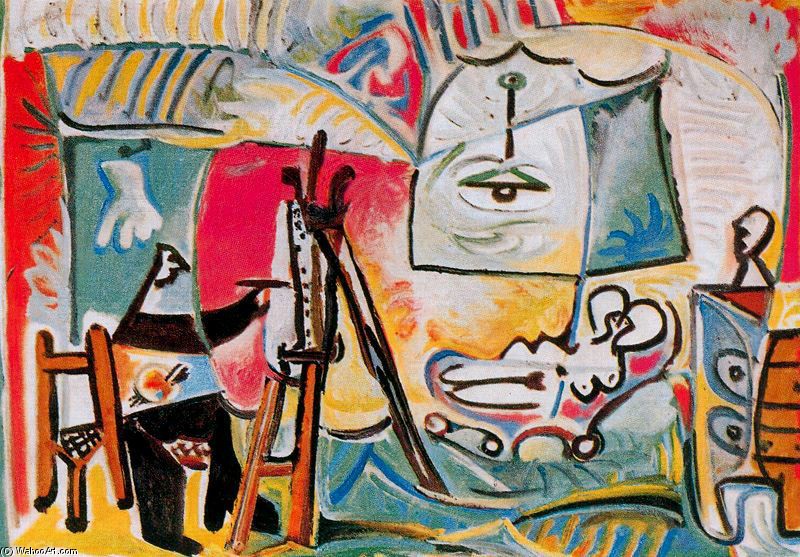
Pablo Picasso’s “The Painter and His Model,” painted in 1929-30 during his prolific Parisian period, is far more than a simple portrait; it's a meticulously constructed exploration of the relationship between artist and subject, rendered through the fractured logic of Cubism. This work, housed at The Art Institute of Chicago, offers a captivating glimpse into Picasso’s evolving artistic language and his profound interest in capturing not just appearances but also the underlying dynamics of human interaction.
The scene unfolds within a modestly sized studio – a space deliberately devoid of grandiosity, suggesting an intimate setting rather than a formal atelier. A man, presumed to be Picasso himself, sits on a chair, holding a camera or perhaps a paintbrush, his gaze directed towards the woman standing behind him. She is not presented as a passive object of observation but as an active participant in the creative process, her presence subtly challenging the traditional role of the model. The composition isn’t about capturing a single, unified image; instead, Picasso employs multiple viewpoints simultaneously, presenting fragmented perspectives of both figures. This deliberate distortion creates a sense of dynamism and movement, suggesting that reality itself is inherently complex and multifaceted.
Picasso's masterful use of Cubism is immediately apparent. The figures are broken down into geometric shapes – triangles, rectangles, and cylinders – which are then reassembled in a way that defies conventional perspective. This technique isn’t merely an aesthetic choice; it represents Picasso’s attempt to capture the essence of his subjects by analyzing them from multiple angles at once. Notice how the man's body is dissected into sharp planes, while the woman’s form is similarly fragmented, yet retains a recognizable human shape. The interplay between these geometric elements creates a visual tension that mirrors the complexities of their relationship.
The color palette is restrained – primarily consisting of muted browns, grays, and ochres – contributing to the painting's overall sense of quiet contemplation. However, subtle hints of blue and green peek through, adding depth and richness to the composition. The background, rendered in a darker tone, further emphasizes the figures and draws attention to their interaction. The careful balance between form and color is characteristic of Picasso’s mature Cubist style.
Beyond its formal qualities, “The Painter and His Model” is rich in symbolic meaning. The presence of the camera – or potential paintbrush – suggests the act of recording and documenting reality. It raises questions about the nature of representation and the role of the artist as a witness to the world. The woman’s posture—leaning slightly towards the man, her hand resting on his arm—hints at a connection that transcends mere observation. She is not simply posing for him; she appears engaged in a collaborative dialogue.
Furthermore, the eye-like shape located near the top right corner has been interpreted as a symbol of vision and perception. It could represent Picasso’s own artistic gaze, or perhaps the shared perspective of both figures. The painting, therefore, becomes a meditation on the creative process itself – a visual exploration of how ideas are formed, communicated, and ultimately captured on canvas.
“The Painter and His Model” is more than just a portrait; it’s a profound statement about the nature of art, relationships, and perception. Picasso's innovative use of Cubism, combined with his subtle symbolic gestures, creates a work that continues to resonate with viewers today. It invites us to contemplate the complexities of human interaction and the transformative power of artistic expression. Reproductions of this iconic piece offer an exceptional opportunity to bring this captivating vision into your home, adding a touch of intellectual depth and visual intrigue to any space.


1881 - 1973 , Spanien

 Vorschau anzeigen
 Versenden
 Teilen
 Details anzeigen

 Herunterladen
 Ähnliche Objekte
 Röntgenaufnahme
 Diashow
 Weiterlesen


