The Genesis of a Fragmented Portrait
Pablo Picasso’s “Man and Woman,” painted in 1902, isn't merely a depiction of two figures; it’s a pivotal moment in the artist’s evolution, a visual distillation of his burgeoning exploration into form, emotion, and the complexities of human relationships. Created during a period of intense experimentation – a time when Picasso was shedding the constraints of academic realism and embracing the nascent possibilities of Cubism – this small canvas (measuring just 8 x 12 centimeters) pulsates with an arresting immediacy. The work’s genesis lies in a private commission for a wealthy collector, yet it quickly transcended its initial purpose to become a deeply personal statement about love, loss, and the inherent instability of perception.
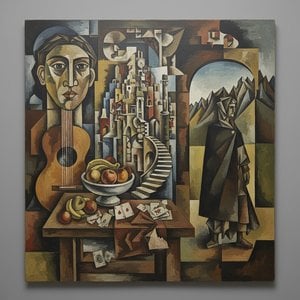
The scene unfolds within a dimly lit interior, rendered with a deliberate lack of detail. The figures are presented in profile, their bodies simplified into geometric shapes – a testament to Picasso’s growing fascination with deconstructing objects and reducing them to their essential components. Notice the subtle interplay of blues and browns that dominate the palette; these muted tones evoke a sense of melancholy and introspection, mirroring the emotional weight of the subject matter. The artist's use of pencil, ink, and paper lends the work an intimate quality, as if captured in a fleeting moment of observation.
The Language of Cubism: Deconstructing Reality
“Man and Woman” stands as a crucial stepping stone towards Picasso’s later development of Cubism. While not fully embracing the analytical approach that would characterize his most famous Cubist works, this piece demonstrates an early inclination toward breaking down forms into their constituent parts and presenting multiple viewpoints simultaneously. The figures are not depicted from a single perspective; instead, we see fragments of their bodies – a shoulder here, a hand there – as if viewed through a shattered mirror. This fragmentation reflects Picasso’s growing interest in exploring the subjective nature of reality and challenging traditional notions of representation.
- Geometric Forms: The figures are reduced to basic geometric shapes—rectangles, triangles, circles—a hallmark of early Cubist experimentation.
- Multiple Perspectives: The simultaneous presentation of different viewpoints creates a sense of dynamism and instability, suggesting that reality is not fixed but rather fluid and multifaceted.
- Simplified Details: Picasso deliberately omits extraneous details, focusing on the essential forms and lines that define the figures’ presence.
Symbolism and Emotional Resonance
Beyond its formal innovations, “Man and Woman” is imbued with a potent emotional resonance. The figures are depicted in an embrace, suggesting intimacy and connection—yet this closeness is immediately undercut by the work's fragmented composition. The woman’s head is tilted downwards, her gaze averted, hinting at vulnerability or perhaps even sadness. The man’s hand rests gently on her shoulder, conveying a sense of concern and protection, but his expression remains ambiguous. The overall effect is one of quiet contemplation—a poignant meditation on the complexities of human relationships and the enduring power of memory.
Some art historians have suggested that the painting may be inspired by Picasso’s own personal experiences, including the loss of his sister Conchita. The subdued colors and melancholic atmosphere evoke a sense of grief and longing, while the fragmented composition reflects the shattered nature of experience following profound loss. Regardless of its specific origins, “Man and Woman” remains a deeply moving work that speaks to the universal human condition.
A Legacy of Innovation
“Man and Woman” is more than just a beautiful painting; it’s a landmark achievement in the history of art. It represents a pivotal moment in Picasso's artistic journey, marking his transition from traditional realism to the revolutionary principles of Cubism. Reproductions of this work continue to captivate viewers today, offering a glimpse into the mind of one of the 20th century’s most influential artists. Its enduring appeal lies not only in its formal innovations but also in its ability to evoke profound emotions and provoke contemplation about the nature of love, loss, and the human experience.



 In echtem Maßstab anzeigen
 Handgemalte Reproduktion kaufen
 Versenden als Grußkarte
 Teilen
 Details anzeigen
 Leitfaden

 Herunterladen
 Ähnliche Objekte
 Röntgenaufnahme
 Diashow
 Besucherstatistiken


 Mehr anzeigen






































 Die Glasoption ist nur für Größen unter 110 cm verfügbar.