In echtem Maßstab anzeigen In AR an der Wand sehen Handgemalte Reproduktion kaufen Zum digitalen Bild wechseln Versenden als Grußkarte
Details anzeigen Leitfaden öffnen Zu Favoriten hinzufügen Herunterladen Ähnliche Objekte Röntgenaufnahme Diashow Besucherstatistiken

Geigen

Pablo Picassos 'Geige' (1913) verkörpert den synthetischen Kubismus mit Collage und Fragmentierung. Entdecken Sie die innovative Kunst des 20. Jahrhunderts!

Entdecken Sie Pablo Picassos revolutionäre Kunst! Kubismus, Blaue & Rosafarbene Periode, Guernica & sein bleibender Einfluss auf die moderne Kunst des 20. Jahrhunderts.

Die auf dieser Seite dargestellten Kunstwerke sind urheberrechtlich geschützt, was bedeutet, dass wir keine identische Reproduktion rechtmäßig erstellen oder verkaufen dürfen. Dieser Schutz wird durch internationale Abkommen wie die Berner Übereinkunft und durch nationale Gesetze, einschließlich derer, die von den ... festgelegt wurden US-Urheberrecht – Titel 17.

Diese Methode entspricht vollumfänglich den Urheberrechtsbestimmungen, da sie keine Kopie oder Vervielfältigung des geschützten Kunstwerks darstellt. Stattdessen handelt es sich um eine kreative Neuinterpretation – ein neues Gemälde, das vom Original inspiriert, aber nicht identisch mit ihm ist.

Giclée / Kunstdruck

Giclée- oder Leinwanddruck in Museumsqualität mit schneller Produktion und flexiblen Veredelungsoptionen. ( Handgemalte Reproduktion kaufen Zum digitalen Bild wechseln)

Corner sample of the P118B picture frame: formgepresstes Polystyrol, 5 cm wide and 3 cm thick
P118B €10
Corner sample of the P118H picture frame: formgepresstes Polystyrol, 5 cm wide and 3 cm thick
P118H €10
Corner sample of the P118W picture frame: formgepresstes Polystyrol, 5 cm wide and 3 cm thick
P118W €10
Corner sample of the P438Z picture frame: formgepresstes Polystyrol, 5.5 cm wide and 3.5 cm thick
P438Z €10
Corner sample of the P508JH picture frame: formgepresstes Polystyrol, 7 cm wide and 3.5 cm thick
P508JH €12
Corner sample of the P508YH picture frame: formgepresstes Polystyrol, 7 cm wide and 3.5 cm thick
P508YH €12
Corner sample of the P805H picture frame: formgepresstes Polystyrol, 5 cm wide and 3.5 cm thick
P805H €10
Corner sample of the P805Z picture frame: formgepresstes Polystyrol, 5 cm wide and 3.5 cm thick
P805Z €10
Corner sample of the P919BZ picture frame: formgepresstes Polystyrol, 7 cm wide and 3.5 cm thick
P919BZ €10
Corner sample of the P919G picture frame: formgepresstes Polystyrol, 7 cm wide and 3.5 cm thick
P919G €10
Corner sample of the P919XJ picture frame: formgepresstes Polystyrol, 7 cm wide and 3.5 cm thick
P919XJ €10
Corner sample of the P959ZH picture frame: formgepresstes Polystyrol, 5 cm wide and 3 cm thick
P959ZH €10
Corner sample of the P968JZ picture frame: formgepresstes Polystyrol, 6 cm wide and 4 cm thick
P968JZ €12
Corner sample of the W106C picture frame: Massivholz, 5 cm wide and 3 cm thick
W106C €8
Corner sample of the W218G picture frame: Massivholz, 5 cm wide and 3 cm thick
W218G €10
Corner sample of the W218JH picture frame: Massivholz, 5 cm wide and 3 cm thick
W218JH €8
Corner sample of the W218Y picture frame: Massivholz, 5 cm wide and 3 cm thick
W218Y €10
Corner sample of the W307PJ picture frame: Massivholz, 6 cm wide and 3 cm thick
W307PJ €10
Corner sample of the W316G picture frame: Massivholz, 6 cm wide and 3 cm thick
W316G €10
Corner sample of the W316PJ picture frame: Massivholz, 6 cm wide and 3 cm thick
W316PJ €8
Corner sample of the W316Y picture frame: Massivholz, 6 cm wide and 3 cm thick
W316Y €10
Corner sample of the W398PJ picture frame: Massivholz, 5 cm wide and 3 cm thick
W398PJ €8
Corner sample of the W4111J picture frame: Massivholz, 6.5 cm wide and 3.5 cm thick
W4111J €10
Corner sample of the W500HY picture frame: Massivholz, 7 cm wide and 5 cm thick
W500HY €15
Corner sample of the W500JH picture frame: Massivholz, 7 cm wide and 5 cm thick
W500JH €15
Corner sample of the W692G picture frame: Massivholz, 8 cm wide and 4 cm thick
W692G €12
Corner sample of the W849H picture frame: Massivholz, 5 cm wide and 3 cm thick
W849H €8
Corner sample of the W940BG picture frame: Massivholz, 7.5 cm wide and 4.5 cm thick
W940BG €15
Corner sample of the W953PJ picture frame: Massivholz, 6 cm wide and 3.5 cm thick
W953PJ €8

Standardformat
individuell anpassbar
CM
INCH

Wählen Sie aus unseren vordefinierten Formaten, die den ursprünglichen Proportionen des Kunstwerks entsprechen.

Breite
Höhe

Sie können Ihre eigenen Maße eingeben, um ein bestimmtes Format oder einen speziellen Platz einzupassen. Wenn das von Ihnen gewählte Format nicht den Proportionen des Originalbildes entspricht, werden wir das Kunstwerk entweder beschneiden oder das Bild mit einem gespiegelten oder einfarbigen Rand erweitern. Ein digitaler Entwurf wird Ihnen zur Genehmigung zugesandt, bevor die Produktion beginnt.
Bitte beachten Sie, dass die Vorschau auf dem Bildschirm nicht den tatsächlichen Zuschnitt oder die Erweiterung widerspiegelt. Nur der Entwurf zeigt die endgültige Komposition präzise an.
Obwohl Sondermaße verfügbar sind, empfehlen wir die Auswahl eines Maßes aus der vordefinierten Liste, um die ursprünglichen Proportionen zu bewahren.

Weltweiter Versand () innerhalb von 2 Wochen statt der üblichen 4/5 Wochen. (13 Oktober)

Kostenloser weltweiter Expressversand
Hochwertige Leinenleinwand
Vollständiger Versicherungsschutz beim Versand
Zollgebühren-Rückerstattungsgarantie
Garantie für exakte Farbtreue
100-tägiges Rückgaberecht (nur bei Mängeln)
100% Geld-zurück-Garantie
Angebot für Mengenrabatt

Gesamtpreis

€ 59

Geigen

Giclée / Kunstdruck

Format der Reproduktion

-

Gesamtpreis

€ 59

Kurzübersicht

  • Artist: Pablo Picasso
  • Influences:
    • Braque
    • Cubism
  • Artistic style: Kubismus
  • Medium: Charcoal, Collage, Öl, Pappe
  • Subject: Violin, Objekte
  • Title: Violin

Kunst-Quiz

Jede Frage hat nur eine richtige Antwort.

Frage 1:
Welche Kunstrichtung kennzeichnet hauptsächlich Picassos Gemälde "Violin"?
Frage 2:
Welches Material wurde hauptsächlich von Picasso zur Darstellung des Violins verwendet?
Frage 3:
Welche der folgenden Elemente ist NICHT auf dem Gemälde "Violin" zu sehen?
Frage 4:
In welchem Zeitraum wurde das Gemälde "Violin" von Picasso geschaffen?
Frage 5:
Welche Bedeutung hat die Verwendung von Collage in "Violin"?

Pablo Picasso’s ‘Violin’: A Fragmented Symphony of Modernity

Pablo Picasso's 'Violin', painted in 1913 during his pivotal Synthetic Cubist period, isn't merely a depiction of an instrument; it’s a radical exploration of perception and representation. This artwork, housed within the vibrant tapestry of Picasso’s artistic evolution, stands as a testament to the artist’s relentless pursuit of innovation and his profound impact on the trajectory of modern art. Far removed from the analytical deconstruction of its predecessor, Analytical Cubism, ‘Violin’ embraces a reassembly of fragmented forms—a deliberate act of synthesis that invites the viewer into a world where familiar objects are rendered simultaneously as recognizable shapes and abstract planes.

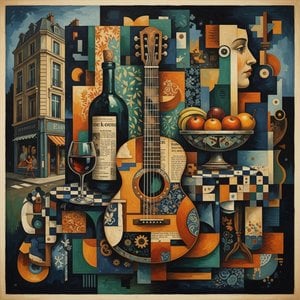
The painting immediately captivates with its unconventional composition. A violin, centrally positioned yet subtly distorted, dominates the scene. However, it’s not a straightforward portrait; instead, Picasso employs a masterful manipulation of perspective, layering multiple viewpoints onto a single canvas. Surrounding this central figure are carefully arranged elements: two birds – symbols often associated with freedom and aspiration – and three books, each contributing to the artwork's layered meaning. The inclusion of these seemingly disparate objects creates a dynamic tension, suggesting a meditation on harmony, knowledge, and the very nature of artistic creation itself. Charcoal serves as the primary medium, lending a raw, almost sketch-like quality that contrasts beautifully with the vibrant colors and textured surfaces.

Synthetic Cubism: A Rebirth of Form

‘Violin’ is a quintessential example of Synthetic Cubism, a stylistic shift initiated by Picasso and Georges Braque. Moving away from the analytical reduction of forms in their earlier work, Synthetic Cubism sought to reconstruct recognizable subjects through the reassembly of fragmented shapes and materials. This approach moved beyond simply breaking down objects into geometric components; it involved actively rebuilding them, often incorporating elements like newspaper clippings, fabric, and other found objects – a technique that adds tactile depth and complexity to the artwork. The use of collage is particularly evident here, transforming the canvas into a dynamic surface where different planes intersect and overlap, challenging traditional notions of pictorial space.

The painting’s flatness—a hallmark of Synthetic Cubism—is deliberately emphasized. Picasso consciously rejects illusionistic depth, instead prioritizing the interplay between different planes and creating a sense of visual ambiguity. This flattening effect mirrors the broader modernist movement's rejection of academic traditions and its embrace of abstraction and subjective experience. The violin itself is rendered in simplified, geometric forms, mirroring the Synthetic Cubist style’s preference for constructing recognizable subjects from basic shapes.

Context within Picasso’s Oeuvre

Picasso’s work during this period was deeply influenced by his collaboration with Georges Braque, a fellow pioneer of Cubism. Together, they pushed the boundaries of traditional representation, forging a new visual language that profoundly impacted European art. ‘Violin’ is part of a series—including “Woman with guitar” and “Bottle, glass, violin”—that explores similar themes of fragmentation, multiple perspectives, and the interplay between object and representation. These works demonstrate Picasso's ongoing experimentation with form and his desire to capture not just the appearance of objects but also their essence and underlying structure.

Furthermore, it’s important to consider the broader historical context. The early 20th century was a period of rapid social and cultural change, marked by industrialization, urbanization, and increasing skepticism towards established institutions. Picasso's Cubist works reflect this spirit of innovation and challenge, mirroring the modernist movement’s rejection of traditional values and its embrace of experimentation. The influence of Crystal Cubism, characterized by the incorporation of transparent materials like glass and cellophane, can also be detected in the painting’s layered composition and use of contrasting textures.

A Legacy of Innovation

Pablo Picasso's ‘Violin’ is more than just a still life; it’s a powerful statement about the nature of perception, representation, and artistic innovation. Through its intricate composition, bold use of color, and incorporation of unconventional materials, this painting embodies the spirit of Synthetic Cubism and stands as a cornerstone of modern art's evolution. Reproductions offered by WahooArt.com capture the essence of this groundbreaking work, allowing viewers to experience Picasso’s revolutionary vision in stunning detail.

Explore the full beauty and complexity of ‘Violin’ through a meticulously crafted reproduction from WahooArt.com – a testament to artistic genius.

Fragen & Antworten

Ist "Geigen" eines der beliebtesten Werke von Pablo Picasso?

Der Beliebtheitsgrad für "Geigen" von Pablo Picasso liegt bei Ikonisch.

Welches Motiv und welche Atmosphäre vereint "Geigen" von Pablo Picasso?

"Geigen" von Pablo Picasso verbindet violin, picasso, cubism, collage, birds, books, composition, modern art mit einer Zeitgenössisch minimalistisch Atmosphäre.

Was sind die Technik und das Entstehungsdatum von "Geigen" von Pablo Picasso?

Das Medium von "Geigen" von Pablo Picasso ist Ölfarbe, und das Werk wird auf 1913 datiert.

Für welchen Raum wird "Geigen" von Pablo Picasso empfohlen?

"Geigen" von Pablo Picasso wird für ein Wohnbereich empfohlen. Dieser Vorschlag basiert auf dem Motiv, den Farben und der Stimmung des Werkes.

Wie stellt "Geigen" von Pablo Picasso eine Verbindung zwischen Specifically, Synthetic Cubism. und dem Heimatland des Künstlers her?

"Geigen" verbindet die Specifically, Synthetic Cubism.-Bewegung durch den Geburtsort ihres Schöpfers mit Spanien.

Wo kann ich eine handgemalte Reproduktion von "Geigen" von Pablo Picasso kaufen?

Handgemalte Repliken von "Geigen" von Pablo Picasso sind auf diese Website erhältlich: eine handgemalte Ölreproduktion auf Leinenleinwand, bestellbar über diese Seite.

Für welchen Raum wird "Geigen" von Pablo Picasso aufgrund seiner Farben empfohlen?

Angesichts seiner Erdig Farben wird „Geigen“ für ein Wohnbereich empfohlen.

Unter welchen Pseudonymen oder Alternativnamen ist Pablo Picasso bekannt?

Pablo Picasso ist auch unter dem Namen Pablo Ruiz y Picasso bekannt.


Biografie des Künstlers

Pablo Picasso: Ein revolutionärer Künstler

Frühes Leben und Ausbildung (1881-1904)

  • Geboren am 25. Oktober 1881 in Málaga, Spanien, zeigte Pablo Ruiz y Picasso von sehr jungem an sein künstlerisches Talent.
  • Sein Vater, José Ruiz y Blasco, war Kunstlehrer und gab seinem Sohn eine frühe Ausbildung. Es heißt, Picassos erste Worte waren “piz, piz” – ein Versuch, ‘Bleistift’ zu sagen.
  • Picasso übertraf seine Vaters Fähigkeiten schnell und zeigte bemerkenswerte Begabung in naturalistischen Darstellungen.
  • Die Familie zog nach A Coruña und später nach Barcelona nach dem tragischen Verlust Picassos Schwester.
  • In Barcelona besuchte er die Kunsthochschule, störte sich aber oft an der traditionellen akademischen Lehre. Er studierte kurzzeitig an der Königlichen Akademie San Fernando in Madrid und fand es beengend, bevorzugte aber das unabhängige Studium von Meistern wie Velázquez und Goya.

Die Blauen und Rosafarbenen Perioden (1901-1906)

  • Die Blaue Periode (ungefähr 1901-1904) ist durch düstere Gemälde geprägt, die von Blautönen und Blaugrün dominiert werden.
  • Diese Werke stellen oft marginalisierte Figuren dar – Bettler, blinde Menschen, Prostituierte – und spiegeln Melancholie und sozialen Kommentar wider. Wichtige Beispiele sind La Vie (1903) und Der alte Gitarrist (1903-1904).
  • Nachfolgend entstand die Rosafarbene Periode (1904-1906) mit wärmeren Tönen – Rosa-, Orange- und Rottönen.
  • Diese Periode spiegelt eine optimistischere Sichtweise wider und stellt oft Zirkusclowns, Harlekinen und Akrobaten dar. Familie der Saltimbanques (1905) ist ein Beispiel dafür.

Die revolutionären Jahre: Kubismus und darüber hinaus (1907-1919)

  • 1907 markierte einen Wendepunkt mit Les Demoiselles d'Avignon, der von iberischer Skulptur und afrikanischen Masken beeinflusst wurde. Dieses Gemälde zerstörte die traditionelle Perspektive und ebnete den Weg für den Kubismus.
  • Picasso arbeitete eng mit Georges Braque zusammen und gründete den Kubismus, der die Art und Weise, wie Künstler Realität darstellten, grundlegend veränderte.
  • Analytischer Kubismus (1909-1912) zeichnete sich durch fragmentierte Formen, gedämpfte Farben und die Zerlegung von Objekten in geometrische Formen aus.
  • Synthetischer Kubismus (1912-1919) integrierte Collagen – Zeitungsartikel, Stoffreste – um texturierte Oberflächen und neue visuelle Schichten zu schaffen.

Neoklassizismus und Surrealismus (1920er - 1930er Jahre)

  • In den 1920er Jahren erkundete Picasso neoklasische Stile mit monumentalen Figuren, die klassische Formen betonten.
  • Er beschäftigte sich auch mit dem Surrealismus, obwohl er sich nie vollständig mit dessen Prinzipien identifizierte. Seine Werke vermischten frühere Stile mit surrealistischer Bildsprache und verzerrten Perspektiven.

Spätere Jahre und Vermächtnis (1940-1973)

  • Während des Zweiten Weltkriegs blieb Picasso in Frankreich und produzierte kraftvolle Antikriegserklärungen wie Guernica (1937), eine wirkliche Reaktion auf den Angriff auf Guernica während des Spanischen Bürgerkriegs.
  • Guernica wurde zu einem bleibenden Symbol der Schrecken des Krieges und gilt als eines seiner bekanntesten Werke.
  • In den 1950er und 60er Jahren experimentierte Picasso weiterhin mit verschiedenen Medien – Keramik, Skulptur, Druckgrafik – und demonstrierte bemerkenswerte Vielseitigkeit.
  • Er heiratete Jacqueline Roque im Jahr 1961. Er starb am 8. April 1973 in Mougins, Frankreich.

Einflüsse und historische Bedeutung

  • Picassos künstlerische Entwicklung wurde von spanischen Meistern wie Velázquez und Goya, iberischer Skulptur, afrikanischer Kunst und Henri Matisse geprägt.
  • Sein Einfluss auf die Kunst des 20. Jahrhunderts ist unermesslich. Er gründete den Kubismus, pionierte Collagen und konstruktive Skulpturen und stellte traditionelle künstlerische Konventionen kontinuierlich in Frage.
  • Picassos unerbittliche Experimentierfreude definierte die moderne Kunst neu und inspiriert Künstler bis heute.
  • Seine fruchtbare Produktion – geschätzt auf über 50.000 Werke – festigt seine Position als einer der wichtigsten und einflussreichsten Künstler in der Geschichte.
Pablo Picasso

Pablo Picasso

1881 - 1973 , Spanien

Eckdaten zum Künstler

  • Beeinflusste Künstler:
    • Velázquez
    • Goya
    • Henri Matisse
  • Bemerkenswerte Werke:
    • Les Demoiselles d'Avignon
    • Guernica
    • Der alte Gitarrist
    • Familie der Saltimbanques
  • Geburtsdatum: 25. Oktober 1881
  • Geburtsort: Málaga, Spanien
  • Künstlerische Richtung: Kubismus, Surrealismus
  • Nationalität: Spanisch
  • Sterbedatum: 8. April 1973
  • Vollständiger Name: Pablo Picasso
  • Von Künstlern Beeinflusst:
    • Iberische Skulptur
    • Afrikanische Kunst
Entdecken Sie Kunstwerke, die nach Themen, Stilen und Merkmalen sortiert sind.