Vorschau anzeigenVorschau anzeigen In AR erlebenIn AR erleben Zu Druck wechseln Zu Druck wechselnZum digitalen Bild wechseln Zum digitalen Bild wechseln VersendenVersenden
Details anzeigenDetails anzeigen Zu Favoriten hinzufügen Zu Favoriten hinzufügen HerunterladenHerunterladen Ähnliche ObjekteÄhnliche Objekte RöntgenaufnahmeRöntgenaufnahme DiashowDiashow StatistikenStatistiken

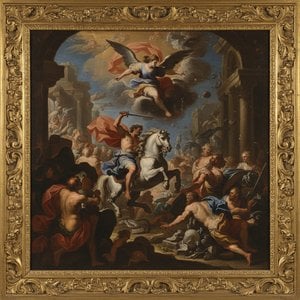
Stürmisches Landschaftsbild mit Pyramus und Thisbe

Ein beeindruckendes Gemälde von Nicolas Poussin aus dem Jahr 1651 zeigt eine dramatische Landschaft und die tragische Geschichte von Pyramus und Thisbe im Stil des französischen Barock.

Erkunden Sie die Meisterwerke von Nicolas Poussin (1594-1665), einem führenden französischen Barockmaler. Entdecken Sie seine klassischen Kompositionen, historische und mythologische Szenen sowie ruhige Landschaften – welche Künstler wie David & Cézanne beeinflussten. #Poussin #Barockkunst #

Handgefertigte Ölreproduktion

Handgemaltes Ölgemälde auf Leinwand in Ihrer Wunschgröße und mit Rahmen, auf Bestellung von unseren Künstlern angefertigt. (Zu Druck wechseln Zu Druck wechselnZum digitalen Bild wechseln Zum digitalen Bild wechseln)

P118B $10
P118H $10
P118W $10
P438Z $10
P508JH $12
P508YH $12
P805H $10
P805Z $10
P919BZ $10
P919G $10
P919XJ $10
P959ZH $10
P968JZ $12
W106C $8
W218G $10
W218JH $8
W218Y $10
W307PJ $10
W316G $10
W316PJ $8
W316Y $10
W398PJ $8
W4111J $10
W500HY $15
W500JH $15
W692G $12
W849H $8
W940BG $15
W953PJ $8

Standardformat
individuell anpassbar
CM
INCH

Wählen Sie aus unseren vordefinierten Formaten, die den ursprünglichen Proportionen des Kunstwerks entsprechen.

Breite
Höhe

Sie können Ihre eigenen Maße eingeben, um einen bestimmten Rahmen oder Platz auszufüllen. Wenn die gewählte Größe nicht den Proportionen des Originalbildes entspricht, werden wir das Kunstwerk entweder beschneiden oder das Gemälde durch zusätzliche, handgemalte Elemente erweitern. Ein digitales Mockup wird Ihnen zur Genehmigung zugesandt, bevor die Produktion beginnt.
Bitte beachten Sie, dass die Bildschirmvorschau nicht die tatsächliche Beschneidung oder Erweiterung widerspiegelt. Nur das Mockup zeigt die endgültige Komposition exakt an.
Obwohl Sondermaße verfügbar sind, empfehlen wir, eine Größe aus der vordefinierten Liste zu wählen, um die ursprünglichen Proportionen beizubehalten.

Beispiele für Anpassungsmöglichkeiten: Gesicht durch Kundenfoto ersetzen; Haustier hinzufügen (z. B. Katze durch Hund ersetzen); eine versteckte Nachricht im Hintergrund einfügen; Hintergrundlandschaft oder -elemente ändern.
Nach der Bestellung wird das WahooArt.com-Team dem Kunden Anweisungen per E-Mail zusenden und eine Mockup-Vorschau bereitstellen.

Weltweiter Versand () in nur 3 bis 4 Wochen statt der üblichen 5 Wochen. (10 September). Keine Kompromisse bei der Qualität.

why_choose_icon
Kostenloser weltweiter Expressversand
why_choose_icon
Hochwertige Leinenleinwand
why_choose_icon
Umfassender Versicherungsschutz beim Versand
why_choose_icon
Zollgebühren-Rückerstattungsgarantie
why_choose_icon
Garantie für exakte Farbtreue
why_choose_icon
100-Tage-Rückgaberecht (nur bei Mängeln)
why_choose_icon
100% Geld-zurück-Garantie
why_choose_icon
Mengenrabatt verfügbar

Gesamtpreis

$ 272

reproduction

Stürmisches Landschaftsbild mit Pyramus und Thisbe

Art der Reproduktion

Format der Reproduktion

-

Gesamtpreis

$ 272

Eckdaten

  • Artist: Nicolas Poussin
  • Influences: Italian Renaissance
  • Dimensions: 192 x 273 cm
  • Year: 1651
  • Title: Stormy Landscape with Pyramus and Thisbe
  • Movement: Baroque
  • Notable elements or techniques: Dramatic lighting; Classical composition

Kunst-Quiz

Jede Frage hat nur eine richtige Antwort.

Frage 1:
What is the primary subject matter of Nicolas Poussin’s ‘Stormy Landscape with Pyramus and Thisbe’?
Frage 2:
The painting’s dramatic lighting contributes to which artistic element?
Frage 3:
Where is Nicolas Poussin’s ‘Stormy Landscape with Pyramus and Thisbe’ currently housed?
Frage 4:
Which artistic movement is Nicolas Poussin’s style most closely associated with?
Frage 5:
Who commissioned the painting ‘Stormy Landscape with Pyramus and Thisbe’?

A Symphony of Sorrow Amidst Ancient Echoes: Exploring Nicolas Poussin’s Stormy Landscape with Pyramus and Thisbe

Nicolas Poussin's "Stormy Landscape with Pyramus and Thisbe," completed in 1651, stands as a cornerstone of Baroque art—a masterful distillation of classical ideals within the dramatic framework of Romantic sensibility. Commissioned by Cassiano dal Pozzo, a wealthy Roman patron who championed humanist scholarship and artistic innovation, this monumental canvas transcends mere depiction; it’s an invitation into a profound meditation on love, loss, and the inescapable influence of myth upon human experience. The painting resides proudly at the Städelsches Kunstinstitut museum in Frankfurt, Germany, where its enduring beauty continues to captivate audiences centuries after its creation.

The Narrative Landscape: Setting the Stage for Tragedy

Poussin’s genius lies not just in his technical prowess but in his ability to transform a simple topographical vista into a vehicle for complex storytelling. The landscape itself—a turbulent expanse of dark clouds punctuated by flashes of lightning—isn't merely decorative; it embodies the emotional turmoil gripping Pyramus and Thisbe. The jagged peaks of distant mountains loom ominously, mirroring the fractured relationship between the lovers and foreshadowing their impending doom. A winding river snakes through the scene, symbolizing the passage of time and the relentless flow of fate, carrying with it the debris of shattered dreams. Careful observation reveals subtle details—a solitary shepherd tending his flock—representing innocence amidst the encroaching darkness, a poignant counterpoint to the tragic drama unfolding before us.

Classical Composition: Harmony Within Chaos

Poussin adhered rigorously to principles of classical composition, prioritizing balance and clarity despite the tempestuous atmosphere. The figures – Pyramus and Thisbe – are positioned centrally within the frame, bathed in diffused light that illuminates their grief-stricken faces. Their postures convey vulnerability and despair, mirroring the pathos inherent in Shakespeare’s retelling of the tale. Poussin employs a pyramidal structure—a technique borrowed from Renaissance artists like Raphael—to organize the scene hierarchically, guiding the viewer's eye upwards towards the heavens and reinforcing the sense of grandeur. The meticulous rendering of drapery and architectural elements underscores his commitment to realism while simultaneously elevating the subject matter beyond mere observation.

Symbolism Rooted in Myth: Echoes of Romeo and Juliet

“Stormy Landscape with Pyramus and Thisbe” draws heavily upon Virgil’s Aeneid and Ovid's Metamorphoses, adapting the myth of Pyramus and Thisbe—a tale of forbidden love thwarted by familial enmity—to explore universal themes. The lioness represents death and destruction, symbolizing the insurmountable obstacle separating Pyramus and Thisbe. Their bodies lie intertwined on the riverbank, signifying their inseparable bond even in death. The overarching symbolism speaks to the inevitability of suffering and the poignant beauty found within moments of profound sorrow. Poussin’s masterful use of color—primarily muted earth tones contrasted with flashes of brilliant white—further enhances the emotional impact of the painting, conveying both solemn dignity and heartbreaking vulnerability.

Technique: Oil Paint on Canvas – A Legacy of Brilliance

Executed in oil paint on canvas, “Stormy Landscape with Pyramus and Thisbe” exemplifies Poussin’s mastery of chiaroscuro—the dramatic interplay between light and shadow—a technique perfected during the Baroque era. Layers upon layers of pigment create a velvety surface texture that captures the nuances of atmospheric perspective, convincingly portraying the distant mountains and conveying the palpable sense of weather conditions. The artist's meticulous attention to detail ensures that every element contributes to the overall narrative and aesthetic experience. This monumental artwork continues to inspire admiration for its artistic innovation and enduring emotional resonance—a testament to Nicolas Poussin’s unparalleled contribution to European art history.

Über den Künstler

frühes Leben und Ausbildung

Nikos Poussin, geboren im Juni 1594, war die Quintessenz der französischen Barockmalerei des Klassikers. Obwohl er den Großteil seiner Karriere in Rom verbrachte, blieb er tief in den französischen künstlerischen Traditionen verwurzelt. Seine frühen Tage als Maler waren von Unsicherheit umhüllt, aber bereits im Jahr 1612 hatte er formale Studien in Paris begonnen und sich von weniger bekannten Künstlern beeinflussen lassen, bevor er 1624 nach Rom zog.

Künstlerischer Stil und Einflüsse

Poussins Ästhetik, die für ihre kohärente Komposition und Priorisierung der Linearität bekannt ist, legte einen Präzedenzfall fest, der Meister wie Jacques-Louis David und Paul Cézanne noch bis ins 20. Jahrhundert beeinflusste. Sein unverwechselbarer Stil kristallisierte sich in herausragenden Werken wie Der Tod des Germanikers und seiner einflussreichen Sieben Sakramente-Serie.

Bekannte Werke und Museen

Vermächtnis und Einfluss

Poussins Loyalität blieb Rom, wo er schließlich darauf konzentrierte sich, weitreichende Landschaften in seine Kunst zu integrieren. Seine Reife als Künstler wird in Werken wie Orion, der von der Sonne geblendet sucht und Die Jahreszeiten verkörpert, die eine Ära strenger Komposition einleitet, die von der ruhigen Schönheit der Natur durchdrungen ist.

Erfahren Sie mehr mit WahooArt.com

Entdecken Sie die Meisterwerke des Musée France und tauchen Sie ein in die Welt der französischen Barockmalerei mit Musée Picasso, Musée des Beaux-Arts de Carcassonne und anderen bemerkenswerten Museen. Besuchen Sie Nikos Poussins Seite auf WahooArt.com, um mehr über seine Werke zu erfahren und den Kontext, in dem sie entstanden sind.

Referenzen

Nikolaus Poussin

Nikolaus Poussin

1594 - 1665 , Frankreich

Kurzinfos

  • Bemerkenswerte Werke:
    • Der Tod des Germanicus
    • Die Sieben Sakramente
    • Eine römische Straße
    • Orion auf der Suche nach der Sonne
    • Die Jahreszeiten
  • Geburtsdatum: Juni 1594
  • Geburtsort: Le Havre, Frankreich
  • Künstler, Die Ihn Beeinflussten:
    • Raphael
    • Titian
  • Künstlerische Bewegung: Barock
  • Nationalität: Französisch
  • Todatum: 1665
  • Vollständiger Name: Nicolas Poussin
  • Von Ihm Beeinflusste Künstler:
    • Jacques-Louis David
    • Paul Cézanne
Entdecken Sie Kunstwerke, die nach Themen, Stilen und Merkmalen sortiert sind.