
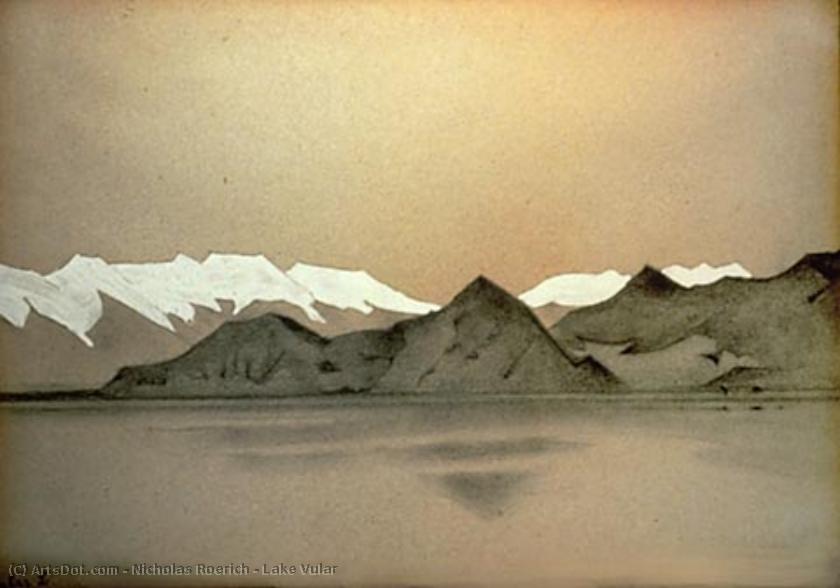
Lake Vular (1925) by Nikolai Konstantinowitsch Roerich, hand-painted oil painting reproduction by a master artist
Vorschau anzeigen In AR ansehen Zum Druck wechseln Zum digitalen Bild wechseln Versenden
Details anzeigen Leitfaden Zu Favoriten hinzufügen Herunterladen Ähnliche Objekte Röntgenaufnahme Diashow Q&A Statistiken

Lake Vular Hand-painted oil painting reproduction

Nicholas Roerich’s serene ‘Lake Vular,’ painted in Symbolism style during the 1920s, captures a breathtaking mountain landscape imbued with tranquility and awe—a timeless masterpiece to explore or cherish.

Erkunden Sie die fesselnde Kunst von Nicholas Roerich (1874-1947): Symbolismus, Himalaya-Landschaften und mystische Gemälde. Entwürfe für das Ballett Russes und Verfechter der kulturellen Bewahrung.

Handgefertigte Ölreproduktion

Handgemaltes Ölgemälde auf Leinwand in Ihrer Wunschgröße und mit Rahmen, auf Bestellung von unseren Künstlern angefertigt. ( Zum Druck wechseln Zum digitalen Bild wechseln)

Corner sample of the P118B picture frame: formgepresstes Polystyrol, 5 cm wide and 3 cm thick
P118B €10
Corner sample of the P118H picture frame: formgepresstes Polystyrol, 5 cm wide and 3 cm thick
P118H €10
Corner sample of the P118W picture frame: formgepresstes Polystyrol, 5 cm wide and 3 cm thick
P118W €10
Corner sample of the P438Z picture frame: formgepresstes Polystyrol, 5.5 cm wide and 3.5 cm thick
P438Z €10
Corner sample of the P508JH picture frame: formgepresstes Polystyrol, 7 cm wide and 3.5 cm thick
P508JH €12
Corner sample of the P508YH picture frame: formgepresstes Polystyrol, 7 cm wide and 3.5 cm thick
P508YH €12
Corner sample of the P805H picture frame: formgepresstes Polystyrol, 5 cm wide and 3.5 cm thick
P805H €10
Corner sample of the P805Z picture frame: formgepresstes Polystyrol, 5 cm wide and 3.5 cm thick
P805Z €10
Corner sample of the P919BZ picture frame: formgepresstes Polystyrol, 7 cm wide and 3.5 cm thick
P919BZ €10
Corner sample of the P919G picture frame: formgepresstes Polystyrol, 7 cm wide and 3.5 cm thick
P919G €10
Corner sample of the P919XJ picture frame: formgepresstes Polystyrol, 7 cm wide and 3.5 cm thick
P919XJ €10
Corner sample of the P959ZH picture frame: formgepresstes Polystyrol, 5 cm wide and 3 cm thick
P959ZH €10
Corner sample of the P968JZ picture frame: formgepresstes Polystyrol, 6 cm wide and 4 cm thick
P968JZ €12
Corner sample of the W106C picture frame: Massivholz, 5 cm wide and 3 cm thick
W106C €8
Corner sample of the W218G picture frame: Massivholz, 5 cm wide and 3 cm thick
W218G €10
Corner sample of the W218JH picture frame: Massivholz, 5 cm wide and 3 cm thick
W218JH €8
Corner sample of the W218Y picture frame: Massivholz, 5 cm wide and 3 cm thick
W218Y €10
Corner sample of the W307PJ picture frame: Massivholz, 6 cm wide and 3 cm thick
W307PJ €10
Corner sample of the W316G picture frame: Massivholz, 6 cm wide and 3 cm thick
W316G €10
Corner sample of the W316PJ picture frame: Massivholz, 6 cm wide and 3 cm thick
W316PJ €8
Corner sample of the W316Y picture frame: Massivholz, 6 cm wide and 3 cm thick
W316Y €10
Corner sample of the W398PJ picture frame: Massivholz, 5 cm wide and 3 cm thick
W398PJ €8
Corner sample of the W4111J picture frame: Massivholz, 6.5 cm wide and 3.5 cm thick
W4111J €10
Corner sample of the W500HY picture frame: Massivholz, 7 cm wide and 5 cm thick
W500HY €15
Corner sample of the W500JH picture frame: Massivholz, 7 cm wide and 5 cm thick
W500JH €15
Corner sample of the W692G picture frame: Massivholz, 8 cm wide and 4 cm thick
W692G €12
Corner sample of the W849H picture frame: Massivholz, 5 cm wide and 3 cm thick
W849H €8
Corner sample of the W940BG picture frame: Massivholz, 7.5 cm wide and 4.5 cm thick
W940BG €15
Corner sample of the W953PJ picture frame: Massivholz, 6 cm wide and 3.5 cm thick
W953PJ €8

Standardformat
individuell anpassbar
CM
INCH

Wählen Sie aus unseren vordefinierten Formaten, die den ursprünglichen Proportionen des Kunstwerks entsprechen.

Breite
Höhe

Geben Sie die Breite und die Höhe an, die Sie für Ihren Rahmen oder Ihre Wand benötigen. Da dieses Werk handgemalt ist, kann der Künstler bei einer anderen Form etwas mehr um das Bild herum malen oder etwas abschneiden – Sie entscheiden. Wir senden Ihnen ein digitales Mockup zur Freigabe, bevor mit dem Malen begonnen wird. Das auf dieser Seite gezeigte Bild stellt nicht das tatsächliche Ergebnis dar – dies tut nur das Mockup.

Beispiele für Anpassungsmöglichkeiten: Gesicht durch Kundenfoto ersetzen; Haustier hinzufügen (z. B. Katze durch Hund ersetzen); eine versteckte Nachricht im Hintergrund einfügen; Hintergrundlandschaft oder -elemente ändern.
Nach der Bestellung wird das WahooArt.com-Team dem Kunden Anweisungen per E-Mail zusenden und eine Mockup-Vorschau bereitstellen.

Weltweiter Versand () in nur 3 bis 4 Wochen statt der üblichen 5 Wochen. (1 November). Keine Kompromisse bei der Qualität.

Kostenloser weltweiter Expressversand
Hochwertige Leinenleinwand
Umfassender Versicherungsschutz beim Versand
Zollgebühren-Rückerstattungsgarantie
Garantie für exakte Farbtreue
100 Tage Rückgaberecht (nur bei Mängeln)
100% Geld-zurück-Garantie
Mengenrabatt verfügbar

Gesamtpreis

€ 242

Lake Vular

Art der Reproduktion

Format der Reproduktion

-

Endpreis

€ 242

Eckdaten

  • Notable elements or techniques: Atmospheric perspective
  • Artist: Nicholas Roerich
  • Artistic style: Simplified forms
  • Influences: Early Modernism
  • Location: Private Collection

A Tranquil Vista: Exploring Nicholas Roerich’s “Lake Vular”

“Lake Vular,” painted in 1925 by Russian Symbolist artist Nicholas Roerich, stands as a testament to the enduring power of landscape art to evoke profound emotion and contemplation. More than just a depiction of a mountain lake—though its breathtaking scenery is undeniable—the painting embodies Roereich’s philosophical vision of uniting consciousness with the cosmos, reflecting his deep engagement with esoteric traditions and spiritual symbolism.

Composition and Technique: Embracing Atmospheric Perspective

The artwork's horizontal format immediately establishes a sense of expansive calm, mirroring the vastness of Lake Vular itself. Roerich skillfully employs atmospheric perspective—a technique championed by Impressionists—to create depth and luminosity. Distant mountain peaks fade into hazy blues and greys, subtly diminishing in detail while retaining their dominant form. This layering of color and tone isn’t merely a stylistic choice; it's integral to Roereich’s intention to convey the spiritual significance of the landscape – representing the underlying unity of all existence. The artist achieves this effect through meticulous blending of oil paints, resulting in smooth surfaces that prioritize mood over precise realism. Brushstrokes are deliberately muted, furthering the painting’s ethereal quality.

Symbolism and Emotional Resonance: Echoes of Ancient Wisdom

Beyond its visual beauty, “Lake Vular” resonates with layers of symbolic meaning rooted in Roereich's fascination with shamanic rituals and Eastern mysticism. The lake itself symbolizes purity and transformation—a recurring motif throughout Roereich’s oeuvre—while the mountains represent stability and resilience. The central reflection adds a crucial element of symmetry, reinforcing the painting’s harmonious balance. More broadly, the artwork speaks to a yearning for connection with something greater than oneself, mirroring Roereich's belief that art can serve as a conduit for accessing universal consciousness. Its muted palette—dominated by browns, tans and pale orange—contributes to an atmosphere of quiet introspection, inviting viewers to contemplate the sublime grandeur of nature alongside its inherent spiritual depth.

Historical Context: The Dawn of Modern Symbolism

“Lake Vular” emerged during a pivotal moment in artistic history – the early years of Symbolism. This movement rejected naturalistic representation in favor of exploring inner psychological states and conveying spiritual ideas through evocative imagery. Influenced by Nietzsche’s philosophy and Eastern mysticism, Symbolist artists sought to transcend the limitations of rational thought and tap into realms beyond sensory experience. Roereich's work aligns perfectly with this aesthetic impulse, demonstrating a desire to capture not merely what is seen but what is felt—a profound appreciation for the beauty and mystery of the natural world imbued with spiritual significance.

A Timeless Masterpiece: Ideal for Interior Design

Reproductions of “Lake Vular” offer an exceptional opportunity to infuse any space with tranquility and inspiration. Its understated elegance, combined with its rich symbolic content, makes it particularly suited for contemporary interiors where calm sophistication is valued. Consider framing a high-quality print in a neutral tone—perhaps linen or matte white—to maximize its visual impact and honor Roereich’s artistic legacy.

Fragen & Antworten

Wo kann ich eine digitale Datei von "Lake Vular" von Nikolai Konstantinowitsch Roerich erwerben?

Ein digitales Bild von "Lake Vular" von Nikolai Konstantinowitsch Roerich kann auf der entsprechenden Digitales Kunstwerk-Seite erworben werden: hochauflösender digitaler Bild-Download.

Kann ich eine Ölreproduktion von "Lake Vular" bestellen?

Handgemalte Kopien von "Lake Vular" von Nikolai Konstantinowitsch Roerich sind auf diese Webseite erhältlich: eine handgemalte Ölreproduktion auf Leinenleinwand, bestellbar über die Seite Handgemalte Ölreproduktion.

Welches Gefühl vermittelt "Lake Vular" von Nikolai Konstantinowitsch Roerich?

In "Lake Vular" verleiht eine Serene-Stimmung der Tranquil Emotion Ausdruck.


Künstlerbiografie

Nicholas Roerich: Leben, Kunst und Vermächtnis

Frühes Leben und Ausbildung

  • Nikolai Konstantinowitsch Roerich wurde am 9. Oktober 1874 in Sankt Petersburg, Russland, geboren.
  • Sein Vater, ein baltischer Deutscher Notar, und seine Mutter, eine russische Frau, förderten von frühester Kindheit sein Interesse an den Künsten.
  • Roerich studierte sowohl Jura als auch Kunst gleichzeitig und nahm 1893 am St. Petersburger Universität und der Kaiserlichen Akademie der Künste auf.
  • Er erhielt 1897 den Titel „Künstler“ und das Jurastudium im Folgejahr.

Künstlerische Bestrebungen und Einflüsse

  • Roerichs künstlerische Entwicklung wurde maßgeblich von Russischer Symbolismus, einer Bewegung, die Spiritualität und emotionale Tiefe betonte, beeinflusst.
  • Er engagierte sich in der „Weltkunst“-Gesellschaft von Sergei Diaghilew und war von 1910 bis 1916 deren Präsident.
  • Seine frühen Arbeiten zeigten eine Faszination für Archäologie und Bühnenbild, was zu Kooperationen bei Produktionen für die Ballets Russes führte.
  • Er ließ sich auch von apokryphen und mittelalterlichen sektiererischen Schriften wie dem Dovenbuch beeinflussen.

Zusammenarbeit mit den Ballets Russes

  • Roerichs Bühnenbilder für die Ballets Russes wurden hoch gelobt, insbesondere seine Arbeit an Alexander Borodins Fürst Igor (1909) und Igor Strawinskys Das Ritus des Frühlings (1913).
  • Seine Bühnenbilder vereinten historische Forschung mit fantasievoller Kunst und schufen visuell beeindruckende Produktionen.
  • Diese Zusammenarbeit etablierte ihn als eine führende Figur im Theaterdesign im frühen 20. Jahrhundert.

Künstlerische Entwicklung und Themen

  • Roerichs Gemälde entwickelten sich weiter und integrierten zunehmend mystische und spirituelle Themen, die seine wachsende Interesse an der Theosophie und den östlichen Religionen widerspiegelten.
  • Seine Serie Architektonische Studien (1904–1905) demonstrierte sein architektonisches Können und sein Engagement für den Erhalt des kulturellen Erbes.
  • Wiederkehrende Motive in seiner Arbeit sind majestätische Landschaften, antike Städte und religiöse Figuren wie St. Pantaleimon und Kuan Yin.
  • Er stellte oft die Himalaya-Region dar, die für ihn eine tiefe spirituelle Bedeutung hatte.

Wichtige Errungenschaften und Anerkennung

  • Roerich war ein engagierter Verfechter des Schutzes von Kunst und Architektur in Kriegszeiten.
  • Seine Bemühungen führten zur Schaffung des Roerich-Pakt (1935), eines internationalen Vertrags zum Schutz kultureller Objekte, für die er mehrere Nominierungen für den Friedensnobelpreis erhielt.
  • Er reiste weite Teile Zentralasiens ab und führte archäologische Forschungen durch und dokumentierte alte Kulturen.
  • Seine Werke sind in bedeutenden Museumssammlungen auf der ganzen Welt zu sehen, darunter die Staatliche Astrakhan-Gemäldegalerie.

Historische Bedeutung und Vermächtnis

  • Nicholas Roerichs Einfluss auf die russische Kunst und Kultur ist unermesslich.
  • Er schloss die Lücke zwischen künstlerischem Ausdruck und spiritueller Erforschung und beeinflusste Generationen von Künstlern und Denkern.
  • Sein Engagement für den Schutz des kulturellen Erbes ist auch heute noch relevant und unterstreicht die Bedeutung des Schutzes unseres gemeinsamen Erbes.
  • Roerichs Vermächtnis erstreckt sich über seine Gemälde hinaus; er wird als visionärer Künstler, Gelehrter und Humanitär in Erinnerung behalten.
Nikolai Konstantinowitsch Roerich

Nikolai Konstantinowitsch Roerich

1874 - 1947 , Russland

Kurzinfos

  • Beeinflusste Künstler: ['Helena Blavatsky']
  • Beeinflusste Richtungen:
    • Russische Kunst
    • Spirituelle Kunst
  • Bemerkenswerte Werke:
    • St. Pantaleimon der Heiler
    • Kuan Yin
    • Architektonische Studien
    • Ballets Russes (Fürst Igor)
  • Geburtsdatum: 9. Oktober 1874
  • Geburtsort: Sankt Petersburg, Russland
  • Künstlerische Richtung: Symbolismus, Russischer Symbolismus
  • Nationalität: Russisch
  • Sterbedatum: 13. Dezember 1947
  • Vollständiger Name: Nikolai Konstantinowitsch Rerich
Entdecken Sie Kunstwerke, die nach Themen, Stilen und Merkmalen sortiert sind.


































