Vorschau anzeigen In AR ansehen Handgemalte Reproduktion bestellen Zum digitalen Bild wechseln Versenden
Details anzeigen Leitfaden Zu Favoriten hinzufügen Herunterladen Ähnliche Objekte Röntgenaufnahme Diashow Statistiken

Brangena

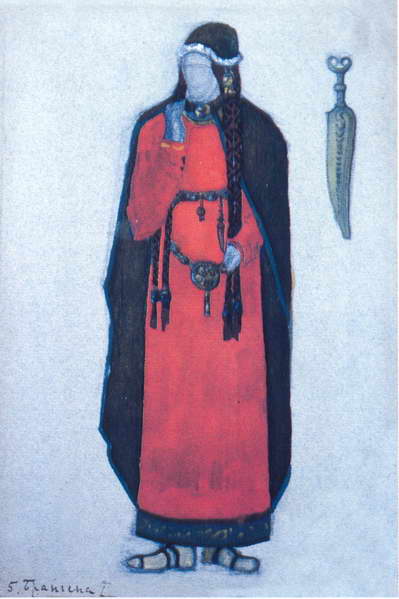
Nicholas Roerich’s "Brangena" presents a striking Art Nouveau woman in red with a knife, juxtaposed against a vintage clock – an enigmatic scene steeped in symbolism and spirit. Explore this captivating artwork by the renowned Russian artist and bring its timeless beauty into your space.

Erkunden Sie die fesselnde Kunst von Nicholas Roerich (1874-1947): Symbolismus, Himalaya-Landschaften und mystische Gemälde. Entwürfe für das Ballett Russes und Verfechter der kulturellen Bewahrung.

Giclée / Kunstdruck

Giclée- oder Leinwanddruck in Museumsqualität mit schneller Produktion und flexiblen Veredelungsoptionen. ( Handgemalte Reproduktion bestellen Zum digitalen Bild wechseln)

Corner sample of the P118B picture frame: formgepresstes Polystyrol, 5 cm wide and 3 cm thick
P118B €10
Corner sample of the P118H picture frame: formgepresstes Polystyrol, 5 cm wide and 3 cm thick
P118H €10
Corner sample of the P118W picture frame: formgepresstes Polystyrol, 5 cm wide and 3 cm thick
P118W €10
Corner sample of the P438Z picture frame: formgepresstes Polystyrol, 5.5 cm wide and 3.5 cm thick
P438Z €10
Corner sample of the P508JH picture frame: formgepresstes Polystyrol, 7 cm wide and 3.5 cm thick
P508JH €12
Corner sample of the P508YH picture frame: formgepresstes Polystyrol, 7 cm wide and 3.5 cm thick
P508YH €12
Corner sample of the P805H picture frame: formgepresstes Polystyrol, 5 cm wide and 3.5 cm thick
P805H €10
Corner sample of the P805Z picture frame: formgepresstes Polystyrol, 5 cm wide and 3.5 cm thick
P805Z €10
Corner sample of the P919BZ picture frame: formgepresstes Polystyrol, 7 cm wide and 3.5 cm thick
P919BZ €10
Corner sample of the P919G picture frame: formgepresstes Polystyrol, 7 cm wide and 3.5 cm thick
P919G €10
Corner sample of the P919XJ picture frame: formgepresstes Polystyrol, 7 cm wide and 3.5 cm thick
P919XJ €10
Corner sample of the P959ZH picture frame: formgepresstes Polystyrol, 5 cm wide and 3 cm thick
P959ZH €10
Corner sample of the P968JZ picture frame: formgepresstes Polystyrol, 6 cm wide and 4 cm thick
P968JZ €12
Corner sample of the W106C picture frame: Massivholz, 5 cm wide and 3 cm thick
W106C €8
Corner sample of the W218G picture frame: Massivholz, 5 cm wide and 3 cm thick
W218G €10
Corner sample of the W218JH picture frame: Massivholz, 5 cm wide and 3 cm thick
W218JH €8
Corner sample of the W218Y picture frame: Massivholz, 5 cm wide and 3 cm thick
W218Y €10
Corner sample of the W307PJ picture frame: Massivholz, 6 cm wide and 3 cm thick
W307PJ €10
Corner sample of the W316G picture frame: Massivholz, 6 cm wide and 3 cm thick
W316G €10
Corner sample of the W316PJ picture frame: Massivholz, 6 cm wide and 3 cm thick
W316PJ €8
Corner sample of the W316Y picture frame: Massivholz, 6 cm wide and 3 cm thick
W316Y €10
Corner sample of the W398PJ picture frame: Massivholz, 5 cm wide and 3 cm thick
W398PJ €8
Corner sample of the W4111J picture frame: Massivholz, 6.5 cm wide and 3.5 cm thick
W4111J €10
Corner sample of the W500HY picture frame: Massivholz, 7 cm wide and 5 cm thick
W500HY €15
Corner sample of the W500JH picture frame: Massivholz, 7 cm wide and 5 cm thick
W500JH €15
Corner sample of the W692G picture frame: Massivholz, 8 cm wide and 4 cm thick
W692G €12
Corner sample of the W849H picture frame: Massivholz, 5 cm wide and 3 cm thick
W849H €8
Corner sample of the W940BG picture frame: Massivholz, 7.5 cm wide and 4.5 cm thick
W940BG €15
Corner sample of the W953PJ picture frame: Massivholz, 6 cm wide and 3.5 cm thick
W953PJ €8

Standardformat
individuell anpassbar
CM
INCH

Wählen Sie aus unseren vordefinierten Formaten, die den ursprünglichen Proportionen des Kunstwerks entsprechen.

Breite
Höhe

Geben Sie die benötigte Breite und Höhe an, damit der Druck perfekt in Ihren Rahmen oder an Ihre Wand passt. Ein Druck kann nur beschnitten, aber niemals größer als das Originalbild angefertigt werden; daher verliert ein Format mit anderen Proportionen einen Teil des Bildes. Wir senden Ihnen ein digitales Mockup zur Freigabe, bevor wir den Druck ausführen. Das auf dieser Seite gezeigte Bild zeigt nicht den tatsächlichen Beschnitt – dies ist nur im Mockup ersichtlich.

Weltweiter Versand () innerhalb von 2 Wochen statt der üblichen 4/5 Wochen. (27 Oktober)

Kostenloser weltweiter Expressversand
Hochwertige Leinenleinwand
Umfassender Versicherungsschutz beim Versand
Zollgebühren-Rückerstattungsgarantie
Garantie für exakte Farbtreue
100 Tage Rückgaberecht (nur bei Mängeln)
100% Geld-zurück-Garantie
Mengenrabatt verfügbar

Gesamtpreis

€ 60

Brangena

Giclée / Kunstdruck

Format der Reproduktion

-

Endpreis

€ 60

Nicholas Roerich's "Brangena": A Portrait of Mystery and Spiritual Seeking

Nicholas Roemerich’s “Brangena,” painted in 1912, is more than just a portrait; it’s an immersive experience, a visual echo of the artist’s lifelong fascination with symbolism, spirituality, and the profound connection between art and human consciousness. This striking image, depicting a woman adorned in crimson and holding a knife, immediately draws the viewer into a realm of enigmatic beauty and quiet contemplation. The painting's vintage aesthetic, firmly rooted in the Art Nouveau movement, lends it an air of timelessness, suggesting that its themes – power, vulnerability, and perhaps even sacrifice – resonate across generations.

Subject and Composition: A Woman at the Crossroads

The central figure is a woman presented with a striking combination of strength and fragility. Her red attire, a color historically associated with passion, royalty, and danger, immediately commands attention. The presence of a knife in her hands – a potent symbol throughout art history – introduces an element of ambiguity. Is she wielding power? Is she defending herself? Or is the knife a tool for transformation, representing a deliberate act of creation or destruction? The addition of a clock on the right side of the canvas adds another layer of complexity. Clocks are universally recognized as symbols of time, mortality, and the relentless march forward. Its placement suggests a confrontation with these concepts, perhaps reflecting the woman’s own contemplation of her role within them.

Artistic Technique and Style: Echoes of Art Nouveau

Roerich's masterful technique is evident in the meticulous rendering of textures – the flowing fabric of the dress, the polished surface of the knife, and the intricate details of the clock. His brushwork is characterized by a smooth, almost ethereal quality, typical of the Art Nouveau style that was gaining prominence at the time. This movement emphasized organic forms, decorative patterns, and a sense of harmony between nature and human design. Roerich’s use of color is particularly noteworthy; the deep reds and muted tones create a dramatic contrast, intensifying the emotional impact of the scene. The overall composition adheres to Art Nouveau principles, prioritizing flowing lines and an elegant, almost dreamlike quality.

Historical Context and Symbolism: Roerich’s Spiritual Journey

"Brangena" was created during a pivotal period in Roerich's life – a time when he was deeply engaged with esoteric philosophies and the search for universal symbols. His work frequently incorporated elements of ancient mythology, religious iconography, and his own personal spiritual beliefs. The title "Brangena," derived from an ancient Siberian legend, suggests a connection to shamanistic traditions and the exploration of altered states of consciousness. This painting can be interpreted as a visual representation of this journey – a quest for knowledge, a confrontation with mortality, and ultimately, a striving towards enlightenment. Roerich believed that art possessed the power to unlock hidden dimensions of reality, and “Brangena” exemplifies this conviction.

Emotional Impact and Collector’s Appeal

“Brangena” possesses an undeniable emotional resonance. Its enigmatic subject matter invites viewers to engage in a personal dialogue with the painting, prompting questions about identity, purpose, and the nature of existence. This work's enduring appeal lies not only in its aesthetic beauty but also in its profound symbolism and Roerich’s deeply held spiritual beliefs. A hand-painted reproduction offers an exceptional opportunity to bring this captivating artwork into your home or office, adding a touch of mystery, sophistication, and intellectual depth to any space. It is a piece that will undoubtedly spark conversation and inspire contemplation for years to come.

Fragen & Antworten

Ist Nikolai Konstantinowitsch Roerich, der Schöpfer von „Brangena“, unter anderen Namen bekannt?

Nikolai Konstantinowitsch Roerich ist auch unter den Namen N. Roerich, Nicholas Roerich bekannt.

Wofür wird eine Reproduktion von "Brangena" von Nikolai Konstantinowitsch Roerich empfohlen?

Eine Reproduktion von "Brangena" von Nikolai Konstantinowitsch Roerich wird für Statement-Piece empfohlen. Dieser Vorschlag ergibt sich aus dem Motiv, der Stimmung und den Farben des Werkes.

Wirken die Farben von "Brangena" eher kräftig oder sanft?

Die Farbsättigung von „Brangena“ ist Ausgewogen. Die Intensität beschreibt, wie kräftig die Farben wirken.


Künstlerbiografie

Nicholas Roerich: Leben, Kunst und Vermächtnis

Frühes Leben und Ausbildung

  • Nikolai Konstantinowitsch Roerich wurde am 9. Oktober 1874 in Sankt Petersburg, Russland, geboren.
  • Sein Vater, ein baltischer Deutscher Notar, und seine Mutter, eine russische Frau, förderten von frühester Kindheit sein Interesse an den Künsten.
  • Roerich studierte sowohl Jura als auch Kunst gleichzeitig und nahm 1893 am St. Petersburger Universität und der Kaiserlichen Akademie der Künste auf.
  • Er erhielt 1897 den Titel „Künstler“ und das Jurastudium im Folgejahr.

Künstlerische Bestrebungen und Einflüsse

  • Roerichs künstlerische Entwicklung wurde maßgeblich von Russischer Symbolismus, einer Bewegung, die Spiritualität und emotionale Tiefe betonte, beeinflusst.
  • Er engagierte sich in der „Weltkunst“-Gesellschaft von Sergei Diaghilew und war von 1910 bis 1916 deren Präsident.
  • Seine frühen Arbeiten zeigten eine Faszination für Archäologie und Bühnenbild, was zu Kooperationen bei Produktionen für die Ballets Russes führte.
  • Er ließ sich auch von apokryphen und mittelalterlichen sektiererischen Schriften wie dem Dovenbuch beeinflussen.

Zusammenarbeit mit den Ballets Russes

  • Roerichs Bühnenbilder für die Ballets Russes wurden hoch gelobt, insbesondere seine Arbeit an Alexander Borodins Fürst Igor (1909) und Igor Strawinskys Das Ritus des Frühlings (1913).
  • Seine Bühnenbilder vereinten historische Forschung mit fantasievoller Kunst und schufen visuell beeindruckende Produktionen.
  • Diese Zusammenarbeit etablierte ihn als eine führende Figur im Theaterdesign im frühen 20. Jahrhundert.

Künstlerische Entwicklung und Themen

  • Roerichs Gemälde entwickelten sich weiter und integrierten zunehmend mystische und spirituelle Themen, die seine wachsende Interesse an der Theosophie und den östlichen Religionen widerspiegelten.
  • Seine Serie Architektonische Studien (1904–1905) demonstrierte sein architektonisches Können und sein Engagement für den Erhalt des kulturellen Erbes.
  • Wiederkehrende Motive in seiner Arbeit sind majestätische Landschaften, antike Städte und religiöse Figuren wie St. Pantaleimon und Kuan Yin.
  • Er stellte oft die Himalaya-Region dar, die für ihn eine tiefe spirituelle Bedeutung hatte.

Wichtige Errungenschaften und Anerkennung

  • Roerich war ein engagierter Verfechter des Schutzes von Kunst und Architektur in Kriegszeiten.
  • Seine Bemühungen führten zur Schaffung des Roerich-Pakt (1935), eines internationalen Vertrags zum Schutz kultureller Objekte, für die er mehrere Nominierungen für den Friedensnobelpreis erhielt.
  • Er reiste weite Teile Zentralasiens ab und führte archäologische Forschungen durch und dokumentierte alte Kulturen.
  • Seine Werke sind in bedeutenden Museumssammlungen auf der ganzen Welt zu sehen, darunter die Staatliche Astrakhan-Gemäldegalerie.

Historische Bedeutung und Vermächtnis

  • Nicholas Roerichs Einfluss auf die russische Kunst und Kultur ist unermesslich.
  • Er schloss die Lücke zwischen künstlerischem Ausdruck und spiritueller Erforschung und beeinflusste Generationen von Künstlern und Denkern.
  • Sein Engagement für den Schutz des kulturellen Erbes ist auch heute noch relevant und unterstreicht die Bedeutung des Schutzes unseres gemeinsamen Erbes.
  • Roerichs Vermächtnis erstreckt sich über seine Gemälde hinaus; er wird als visionärer Künstler, Gelehrter und Humanitär in Erinnerung behalten.
Nikolai Konstantinowitsch Roerich

Nikolai Konstantinowitsch Roerich

1874 - 1947 , Russland

Kurzinfos

  • Beeinflusste Künstler: ['Helena Blavatsky']
  • Beeinflusste Richtungen:
    • Russische Kunst
    • Spirituelle Kunst
  • Bemerkenswerte Werke:
    • St. Pantaleimon der Heiler
    • Kuan Yin
    • Architektonische Studien
    • Ballets Russes (Fürst Igor)
  • Geburtsdatum: 9. Oktober 1874
  • Geburtsort: Sankt Petersburg, Russland
  • Künstlerische Richtung: Symbolismus, Russischer Symbolismus
  • Nationalität: Russisch
  • Sterbedatum: 13. Dezember 1947
  • Vollständiger Name: Nikolai Konstantinowitsch Rerich
Entdecken Sie Kunstwerke, die nach Themen, Stilen und Merkmalen sortiert sind.



































