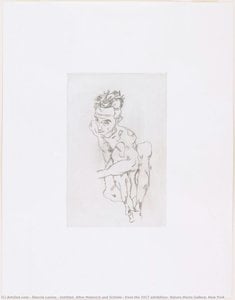
Little Girl’s Drawing by Miguel de Unamuno
This evocative sketch by Miguel de Unamuno captures a fleeting moment of childhood innocence against the backdrop of Basque soil, reflecting the artist's lifelong preoccupation with mortality and existential contemplation. Executed in black and white on aged paper—likely sourced from Bilbao—the drawing embodies Unamuno’s signature style: realism tempered with expressive looseness. The composition centers around two portraits of young girls positioned side by side, their faces rendered with careful observation yet imbued with a palpable sense of emotion. Lines dominate the artwork, defining forms and conveying movement, while tonal variation is achieved through subtle shifts in line weight—a technique characteristic of Unamuno’s spontaneous approach to capturing likeness and feeling.
Style & Technique: A Dialogue Between Observation and Emotion
Unamuno's method prioritizes immediacy over meticulous detail. Unlike academic drawings focused on precise anatomical accuracy, this piece leans towards a more intuitive representation, prioritizing the artist’s emotional response to his subject matter. The loose rendering style—evident in the slightly blurred contours of the girls’ faces—suggests a deliberate rejection of idealized beauty, instead favoring an honest portrayal of youthful vulnerability. Charcoal or pen were employed on textured paper, enhancing the artwork's tactile quality and contributing to its aged aesthetic. This technique aligns with Unamuno’s broader artistic philosophy: embracing imperfection as a pathway to truth and capturing the essence of experience rather than merely replicating it visually.
Historical Context & Symbolism
Created during Unamuno’s formative years—a period marked by profound intellectual engagement and personal loss—the sketch speaks to themes prevalent in his oeuvre. The inclusion of hats hints at social conventions of the time, subtly framing the girls within a specific cultural context. More broadly, however, the image embodies Unamuno's fascination with the human condition, exploring questions of identity, faith, and the confrontation with death. Like many modernist artists grappling with existential anxieties, Unamuno sought to distill complex philosophical ideas into visual form—a challenge he successfully accomplishes through this deceptively simple drawing.
Emotional Impact & Artistic Legacy
The artwork’s subdued palette and understated lighting evoke a sense of nostalgia and intimacy, transporting the viewer back to a bygone era. The sketch's quiet contemplation mirrors Unamuno’s own introspective spirit, inviting reflection on themes of childhood, innocence, and the passage of time. It stands as a testament to Unamuno’s ability to convey profound emotional resonance through deceptively understated visual elements—a hallmark of his enduring artistic legacy.
- Material: Charcoal or Pen
- Size: Unknown
- Date: Unknown
Fragen & Antworten
Für welchen Raum im Zuhause eignet sich eine Reproduktion von "Bild eines Mädchens" besonders gut?
Eine Reproduktion von „Bild eines Mädchens“ passt hervorragend in ein Wohnbereich.
Welche Stimmung würde "Bild eines Mädchens" in einen Raum bringen?
Die Serenität Atmosphäre von "Bild eines Mädchens" von Miguel de Unamuno passt perfekt zu dem empfohlenen Ort: einem Wohnbereich.
Für welchen Ort und welchen Zweck wird "Bild eines Mädchens" empfohlen?
Empfohlene Verwendung (Akzentuierung) und Raum (Wohnbereich) sind die zwei Empfehlungen für "Bild eines Mädchens" von Miguel de Unamuno.



 Vorschau anzeigen
 Zum Druck wechseln
 Versenden
 Teilen
 Details anzeigen
 Leitfaden

 Herunterladen
 Ähnliche Objekte
 Röntgenaufnahme
 Diashow
 Statistiken

 Weiterlesen






































 Die Glasoption ist nur für Größen unter 110 cm verfügbar.