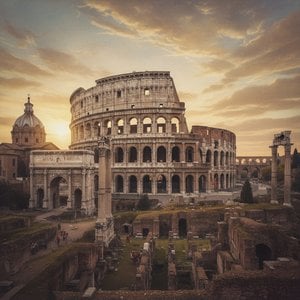
Michelangelo Buonarroti’s Vision for Rome: Palazzo Senatorio
The Piazza Campidoglio, nestled in the heart of Rome, is more than just a historic square; it’s a testament to Michelangelo Buonarroti’s unparalleled ambition and artistic genius. At its center stands
Palazzo Senatorio – a monumental building that embodies the spirit of Renaissance urban planning and Michelangelo’s enduring legacy as an architect. This painting captures not merely a structure but a carefully considered statement about beauty, power, and the harmonious blend of antiquity and innovation. It’s a masterpiece designed to inspire awe and contemplation—a reflection of Michelangelo's profound understanding of human potential and his unwavering dedication to artistic excellence.
Historical Context: Reimagining Roman Grandeur
Michelangelo was commissioned by Pope Julius II to revitalize Piazza Campidoglio, transforming it from a neglected medieval space into a magnificent Renaissance forum. The task wasn’t simply about constructing a building; it was about honoring Rome's imperial past while elevating its cultural future. Recognizing the influence of classical ideals, Michelangelo envisioned a plaza dominated by Marcus Aurelius’ equestrian statue – a symbol of Roman virtue and authority – framed by architectural masterpieces designed to inspire awe and contemplation.
Palazzo Senatorio, alongside
Palazzo dei Conservatori and
Palazzo Nuovo, forms the Capitoline Museums complex – a deliberate effort to showcase Rome’s artistic heritage and intellectual prowess. The project aimed to recapture the grandeur of ancient Rome and establish it as a beacon of humanist thought—a bold undertaking that cemented Michelangelo’s place in art history.
Architectural Significance: A Dialogue Between Eras
The painting skillfully portrays
Palazzo Senatorio as a masterful fusion of Roman and Renaissance styles. The building’s foundations hark back to ancient Rome's monumental architecture, while its façade incorporates classical proportions and decorative elements—a conscious nod to the artistic traditions of antiquity. Notably, the towering clock tower with its ornate steeple is adorned by two clocks – a symbol of time and progress – reflecting Michelangelo’s fascination with mathematical precision and humanist ideals. Furthermore, the statue of Marcus Aurelius at the plaza's center serves as a focal point for contemplation and embodies the virtues championed during the Renaissance. The design prioritized visual harmony, creating a balanced composition that draws the eye upward towards the tower and outward toward the piazza—a testament to Michelangelo’s belief in the transformative power of art.
Artistic Representation: Detail and Harmony
The artist meticulously renders
Palazzo Senatorio with remarkable attention to detail—from the textured stone surfaces to the intricate carvings adorning its walls. The horse statue positioned before the palazzo adds grandeur and symbolizes imperial power. Michelangelo’s design aimed for a profound emotional impact—to inspire awe and convey a sense of timeless beauty. He skillfully utilized perspective and shading techniques to create depth and realism, capturing the essence of Roman architectural splendor. The meticulous craftsmanship speaks volumes about his dedication to artistic perfection and underscores his mastery of sculptural principles applied to architectural form.
Relevance Today: An Enduring Legacy
Today,
Michelangelo Buonarroti: Palazzo Senatorio continues to captivate visitors from around the globe—a testament to Michelangelo’s visionary design and its enduring influence on urban planning. The Capitoline Museums, housing an unparalleled collection of art and artifacts, stand as a beacon of cultural heritage, inviting contemplation and fostering appreciation for the artistic achievements of the Renaissance. For those seeking inspiration or desiring to own a stunning reproduction of this iconic masterpiece, explore
The Museum Piazza Campidoglio (Rome, Italy) at WahooArt.com – where you can acquire hand-painted reproductions crafted with the same precision and artistry as Michelangelo’s original vision.



 In echtem Maßstab anzeigen
 Handgemalte Reproduktion kaufen
 Versenden als Grußkarte
 Teilen
 Details anzeigen
 Leitfaden

 Herunterladen
 Ähnliche Objekte
 Röntgenaufnahme
 Diashow
 Besucherstatistiken


 Mehr anzeigen






































 Die Glasoption ist nur für Größen unter 110 cm verfügbar.