Earth and Green: A Meditation on Color and Silence
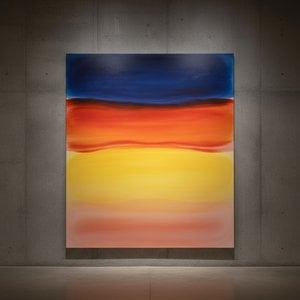
The painting “Earth and Green,” created in 1955 by Mark Rothko, stands as a cornerstone of Color Field Painting—a movement that fundamentally challenged conventional artistic representation. More than just pigment applied to canvas, it’s an invitation into contemplation, a deliberate stripping away of visual clutter to focus solely on the emotive power of color itself. This piece resides within the Museum Ludwig in Cologne, Germany, cementing its place as one of Rothko's most recognizable and celebrated works.
- Artist: Mark Rothko (1903-1970)
- Year Created: 1955
- Medium: Oil on Canvas
- Dimensions: Unknown
Rothko’s artistic journey began in Latvia, shaped by the anxieties of a Jewish family grappling with societal prejudice and political instability. This formative experience instilled within him an acute sensitivity to human suffering—a theme that would permeate his oeuvre throughout his life. His relocation to Portland, Oregon, marked a significant cultural shift, yet it simultaneously fueled his exploration of existential concerns: mortality, trauma, and the quest for meaning in a seemingly indifferent universe. He sought to transcend literal depiction, aiming instead for an experience that bypassed intellect and resonated directly with emotion.
The painting’s aesthetic is strikingly simple—two rectangular blocks of color juxtaposed against a hazy bluish background. The dominant hue is a deep maroon – Rothko meticulously blended pigments to achieve this rich shade, layering thin washes of paint onto the canvas. Subtle variations in tone create an illusion of depth and luminosity, mirroring the way light interacts with surfaces in the natural world. This technique—known as alla prima—allowed for immediate expression without extensive reworking, prioritizing spontaneity and capturing the artist’s intuitive response to the material itself. The green square is equally deliberate; it's a vibrant lime green that contrasts sharply with the maroon, generating a visual tension that invites prolonged observation. Rothko carefully considered the chromatic relationships between colors, recognizing their capacity to evoke profound psychological states.
Beyond its formal qualities, “Earth and Green” carries considerable symbolic weight. Color Field paintings like this one are often interpreted as representations of inner landscapes—the subconscious mind grappling with fundamental questions about existence. The muted hues suggest serenity and contemplation, yet the underlying tension created by the contrasting colors hints at unresolved anxieties. Rothko’s intention wasn't to convey a narrative or represent an external scene; rather, he sought to create a space for viewers to engage in their own emotional journey—a process of confronting oneself through the transformative power of color.
The painting’s enduring appeal lies in its ability to bypass rational thought and tap into primal feelings. It exemplifies Rothko's belief that art could communicate directly with the human spirit, fostering empathy and prompting introspection. Its presence within the Museum Ludwig underscores Cologne’s commitment to showcasing groundbreaking artistic innovations—a testament to Rothko’s legacy as one of the most influential figures in 20th-century abstraction.
Fragen & Antworten
Wo kann ich "Erde und Grün" von Mark Rothko herunterladen?
Das Bild von "Erde und Grün" von Mark Rothko kann auf der Download-Seite des Kunstwerks heruntergeladen werden: ein hochauflösender digitaler Bild-Download.
Welche Stellung nimmt „Erde und Grün“ unter den wiederkehrenden Motiven von Mark Rothko ein?
"Erde und Grün" stellt color field, abstraction, geometric shapes, red color, green color, rothko style, minimalism, emotional expression dar, während die dokumentierten Themen von Mark Rothko expressionism’s emotional depth, existential contemplation, trauma, color as emotive force, central to rothko’s vision, exploring human experience sind. Ein Vergleich der beiden zeigt, wie das Werk mit den üblichen Sujets des Künstlers in Verbindung steht.
Welche Atmosphäre würde eine Reproduktion von "Erde und Grün" von Mark Rothko in einen Raum bringen?
"Erde und Grün" von Mark Rothko besitzt eine Serenität Atmosphäre und wird für ein Wohnbereich empfohlen. Die Stimmung beschreibt das Gefühl, das das Werk in den umgebenden Raum bringt.
Wo kann ich eine digitale Abbildung von "Erde und Grün" von Mark Rothko kaufen?
"Erde und Grün" ist als ein hochauflösender digitaler Bild-Download erhältlich, direkt über diese Seite zu erwerben.
In welchem Raum des Zuhauses lässt sich eine Reproduktion von "Erde und Grün" gut platzieren?
Eine Reproduktion von „Erde und Grün“ passt hervorragend in ein Wohnbereich.
Kann ich "Erde und Grün" als Vollbild-Diashow ansehen?
"Erde und Grün" von Mark Rothko kann als Diashow auf der Diashow-Seite des Kunstwerks betrachtet werden.
Welche Größe sollte ich für den Druck von "Erde und Grün" für mein Zimmer wählen?
Für einen Wohnbereich wird für „Erde und Grün“ ein Druckformat von Großformatig empfohlen.
Welche Farbe sticht in "Erde und Grün" am meisten hervor?
Die dominante Farbe von "Erde und Grün" von Mark Rothko ist Espresso (#422924).



 In echtem Maßstab anzeigen
 Handgemalte Reproduktion kaufen
 Versenden als Grußkarte
 Teilen
 Details anzeigen
 Leitfaden öffnen

 Herunterladen
 Ähnliche Objekte
 Röntgenaufnahme
 Diashow
 Besucherstatistiken
 Mehr anzeigen






































 Die Glasoption ist nur für Größen unter 110 cm verfügbar.