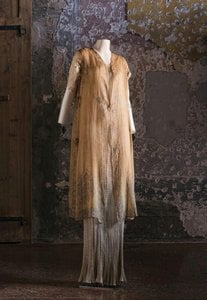
Print sample (1905) von Mariano Fortuny, handgemaltes Ölgemälde-Replikat eines Meisterkünstlers
Vorschau anzeigen In AR ansehen Zum Druck wechseln Zum digitalen Bild wechseln Versenden
Details anzeigen Leitfaden Zu Favoriten hinzufügen Herunterladen Ähnliche Objekte Röntgenaufnahme Diashow Fragen & Antworten Presentation Statistiken

Print sample Handgemalte Ölmalerei-Reproduktion

Abmessungen
49.0 x 33.0 cm

Admire 'Print Sample' by Mariano Fortuny (1905). This vibrant tempera painting showcases a tree with unique circles, reflecting the artist’s innovative spirit and mastery of color & composition.

Mariano Fortuny (1871-1949) war ein spanischer Modeschöpfer & Künstler bekannt für innovative Textilien, Delphos Kleider und beeindruckende Bühnenbilder. Entdecken Sie seinen orientalistischen Einfluss und sein Vermächtnis in der Kunstgeschichte.

Handgefertigte Ölreproduktion

Handgemaltes Ölgemälde auf Leinwand in Ihrer Wunschgröße und mit Rahmen, auf Bestellung von unseren Künstlern angefertigt. ( Zum Druck wechseln Zum digitalen Bild wechseln)

Corner sample of the P118B picture frame: formgepresstes Polystyrol, 5 cm wide and 3 cm thick
P118B €10
Corner sample of the P118H picture frame: formgepresstes Polystyrol, 5 cm wide and 3 cm thick
P118H €10
Corner sample of the P118W picture frame: formgepresstes Polystyrol, 5 cm wide and 3 cm thick
P118W €10
Corner sample of the P438Z picture frame: formgepresstes Polystyrol, 5.5 cm wide and 3.5 cm thick
P438Z €10
Corner sample of the P508JH picture frame: formgepresstes Polystyrol, 7 cm wide and 3.5 cm thick
P508JH €12
Corner sample of the P508YH picture frame: formgepresstes Polystyrol, 7 cm wide and 3.5 cm thick
P508YH €12
Corner sample of the P805H picture frame: formgepresstes Polystyrol, 5 cm wide and 3.5 cm thick
P805H €10
Corner sample of the P805Z picture frame: formgepresstes Polystyrol, 5 cm wide and 3.5 cm thick
P805Z €10
Corner sample of the P919BZ picture frame: formgepresstes Polystyrol, 7 cm wide and 3.5 cm thick
P919BZ €10
Corner sample of the P919G picture frame: formgepresstes Polystyrol, 7 cm wide and 3.5 cm thick
P919G €10
Corner sample of the P919XJ picture frame: formgepresstes Polystyrol, 7 cm wide and 3.5 cm thick
P919XJ €10
Corner sample of the P959ZH picture frame: formgepresstes Polystyrol, 5 cm wide and 3 cm thick
P959ZH €10
Corner sample of the P968JZ picture frame: formgepresstes Polystyrol, 6 cm wide and 4 cm thick
P968JZ €12
Corner sample of the W106C picture frame: Massivholz, 5 cm wide and 3 cm thick
W106C €8
Corner sample of the W218G picture frame: Massivholz, 5 cm wide and 3 cm thick
W218G €10
Corner sample of the W218JH picture frame: Massivholz, 5 cm wide and 3 cm thick
W218JH €8
Corner sample of the W218Y picture frame: Massivholz, 5 cm wide and 3 cm thick
W218Y €10
Corner sample of the W307PJ picture frame: Massivholz, 6 cm wide and 3 cm thick
W307PJ €10
Corner sample of the W316G picture frame: Massivholz, 6 cm wide and 3 cm thick
W316G €10
Corner sample of the W316PJ picture frame: Massivholz, 6 cm wide and 3 cm thick
W316PJ €8
Corner sample of the W316Y picture frame: Massivholz, 6 cm wide and 3 cm thick
W316Y €10
Corner sample of the W398PJ picture frame: Massivholz, 5 cm wide and 3 cm thick
W398PJ €8
Corner sample of the W4111J picture frame: Massivholz, 6.5 cm wide and 3.5 cm thick
W4111J €10
Corner sample of the W500HY picture frame: Massivholz, 7 cm wide and 5 cm thick
W500HY €15
Corner sample of the W500JH picture frame: Massivholz, 7 cm wide and 5 cm thick
W500JH €15
Corner sample of the W692G picture frame: Massivholz, 8 cm wide and 4 cm thick
W692G €12
Corner sample of the W849H picture frame: Massivholz, 5 cm wide and 3 cm thick
W849H €8
Corner sample of the W940BG picture frame: Massivholz, 7.5 cm wide and 4.5 cm thick
W940BG €15
Corner sample of the W953PJ picture frame: Massivholz, 6 cm wide and 3.5 cm thick
W953PJ €8

Standardformat
individuell anpassbar
CM
INCH

Wählen Sie aus unseren vordefinierten Formaten, die den ursprünglichen Proportionen des Kunstwerks entsprechen.

Breite
Höhe

Geben Sie die Breite und die Höhe an, die Sie für Ihren Rahmen oder Ihre Wand benötigen. Da dieses Werk handgemalt ist, kann der Künstler bei einer anderen Form etwas mehr um das Bild herum malen oder etwas abschneiden – Sie entscheiden. Wir senden Ihnen ein digitales Mockup zur Freigabe, bevor mit dem Malen begonnen wird. Das auf dieser Seite gezeigte Bild stellt nicht das tatsächliche Ergebnis dar – dies tut nur das Mockup.

Beispiele für Anpassungsmöglichkeiten: Gesicht durch Kundenfoto ersetzen; Haustier hinzufügen (z. B. Katze durch Hund ersetzen); eine versteckte Nachricht im Hintergrund einfügen; Hintergrundlandschaft oder -elemente ändern.
Nach der Bestellung wird das WahooArt.com-Team dem Kunden Anweisungen per E-Mail zusenden und eine Mockup-Vorschau bereitstellen.

Weltweiter Versand () in nur 3 bis 4 Wochen statt der üblichen 5 Wochen. (5 November). Keine Kompromisse bei der Qualität.

Kostenloser weltweiter Expressversand
Hochwertige Leinenleinwand
Umfassender Versicherungsschutz beim Versand
Zollgebühren-Rückerstattungsgarantie
Garantie für exakte Farbtreue
100 Tage Rückgaberecht (nur bei Mängeln)
100% Geld-zurück-Garantie
Mengenrabatt verfügbar

Gesamtpreis

€ 243

Print sample

Art der Reproduktion

Format der Reproduktion

-

Endpreis

€ 243

Eckdaten

  • Influences: Fortuny
  • Medium: Tempera on paper
  • Artist: Mariano Fortuny
  • Title: Print sample
  • Subject or theme: Nature, Tree

Kunst-Quiz

Jede Frage hat nur eine richtige Antwort.

Frage 1:
What is the primary subject of Mariano Fortuny’s ‘Print sample’?
Frage 2:
In what year was ‘Print sample’ created?
Frage 3:
What medium is used in ‘Print sample’?
Frage 4:
Mariano Fortuny was primarily known for his work in which field before becoming a painter?
Frage 5:
The circular markings on the tree in ‘Print sample’ are most likely intended to represent:

A Whisper of Venice: Mariano Fortuny’s “Print Sample”

Mariano Fortuny’s “Print Sample,” created around 1905 and now meticulously reproduced, offers a captivating glimpse into the mind of a true artistic innovator. More than just a depiction of a solitary tree, this tempera on paper work embodies Fortuny's unique approach to color, light, and the evocative power of suggestion – hallmarks that would define his illustrious career as a painter, designer, and theatrical lighting pioneer. The painting’s deceptively simple composition immediately draws the eye, inviting contemplation over its subtle complexities.

The subject itself—a tree rendered in shades of warm orange—is imbued with an almost dreamlike quality. Three distinct circles punctuate the branches, their placement seemingly random yet contributing to a sense of balanced asymmetry. These aren’t merely decorative elements; they represent Fortuny's fascination with optics and his groundbreaking experiments in reflected light. He meticulously studied how light interacted with different surfaces, a principle he later applied revolutionarily to stage lighting design, creating seamless transitions between scenes within the opulent theaters of his time. The tree itself, bathed in an ethereal glow, feels both ancient and newly born, suggesting a timelessness that transcends its painted form.

Fortuny’s Artistic Alchemy: Technique and Style

Fortuny's style was characterized by a masterful blend of Orientalism, Symbolism, and a distinctly Venetian sensibility. He drew heavily from the rich artistic traditions of the East, particularly Persia and Morocco, incorporating intricate patterns and vibrant color palettes into his work. However, he never simply replicated these influences; instead, he filtered them through his own unique vision, creating something entirely new. “Print Sample” exemplifies this alchemy perfectly. The delicate layering of paint creates a remarkable sense of depth and texture, while the subtle shifts in tone evoke the warmth of sunlight filtering through leaves.

The technique employed is remarkably understated yet profoundly effective. Fortuny’s brushwork is loose and expressive, prioritizing atmosphere over precise detail. He skillfully utilizes glazing – applying thin layers of translucent paint to build up color and luminosity—to achieve a remarkable sense of realism without resorting to photographic accuracy. This approach aligns with his broader philosophy: to capture the *essence* of a subject rather than its literal representation.

A Legacy Forged in Light and Shadow

Born in Reus, Spain, in 1871, Mariano Fortuny’s early life was marked by tragedy – the loss of his father, also a painter, at a young age. This event profoundly shaped his artistic trajectory, leading to a move to Paris where he immersed himself in the world of textiles and design. It was here that he began experimenting with innovative materials and techniques, ultimately pioneering the creation of luxurious fabrics inspired by historical costumes and exotic landscapes.

Fortuny’s contributions extended far beyond painting. He invented the “fortuny cyclorama dome,” a revolutionary stage lighting system that allowed for seamless transitions between scenes in theatrical productions. His treatise, "Eclairage Scenique," outlined his groundbreaking discoveries regarding reflected light, forever changing the landscape of theater design. “Print Sample” stands as a testament to this multifaceted genius – a small but potent example of an artist who seamlessly integrated art, fashion, and technology.

The Enduring Appeal: Symbolism and Emotional Resonance

Beyond its technical brilliance, “Print Sample” resonates with viewers on a deeply emotional level. The solitary tree, bathed in golden light, evokes feelings of tranquility, contemplation, and perhaps even a touch of melancholy. It’s a symbol of resilience, rootedness, and the enduring beauty of nature—themes that have captivated artists for centuries. Fortuny's ability to imbue such a simple subject with such profound meaning is a testament to his artistic vision and his deep understanding of human psychology.

Reproductions of “Print Sample” offer an accessible way to experience the artistry of this remarkable painter. Whether adorning a wall in a contemporary interior or serving as a cherished piece within a collection, this evocative work continues to inspire and delight, reminding us of the power of art to transport us to another time and place.

Fragen & Antworten

Was für ein Kunstwerk ist "Print sample"?

"Print sample" ist ein Werk der Gattung WallArt.

Wie intensiv und gesättigt sind die Farben von "Print sample" von Mariano Fortuny?

Die Farbsättigung von "Print sample" beträgt Muted bei einer Intensität von Monochromatic.

In welcher Ausrichtung liegt "Print sample" von Mariano Fortuny vor?

"Print sample" von Mariano Fortuny hat ein Portrait-Format. Das Format beschreibt die Proportionen der Komposition.


Künstlerbiografie

Frühe Jahre und Inspiration

Mariano Fortuny, ein spanischer Modeschöpfer, wurde am 11. Mai 1871 in Granada, Spanien, geboren. Sein Vater, Mariano Fortuny y Marsal, war ein Maler des Genrebildes, der verstarb, als Mariano erst drei Jahre alt war. Dieses tragische Ereignis führte dazu, dass die Familie nach Paris, Frankreich, zog, wo die Mutter von Mariano ihn mit verschiedensten Textilien und Stoffen vertraut machte, die später seine schöpferische Kraft maßgeblich beeinflussen sollten.

Künstlerische Talente und Erfindungen

Schon in jungen Jahren offenbarte Mariano Fortuny sein außergewöhnliches künstlerisches Talent und bewies meisterhafte Fähigkeiten in der Malerei, Fotografie, Bildhauerei, Architektur, Radierung sowie in der theatralischen Bühnenbeleuchtung. Seine Erfindungen, darunter über zwanzig Patente, die zwischen 1901 und 1934 angemeldet wurden, revolutionierten die Welt des Bühnendesigns grundlegend.
  • Er entwickelte das Fortuny-Cyclorama-Dome, eine halbkuppelförmige Struktur aus Gips oder Stoff, die indirektes Licht nutzte, um einen nahtlosen Übergang zwischen den Szenen zu schaffen.
  • In seiner Abhandlung „Eclairage Scénique“ (1904) beschrieb er seine Entdeckung, wie Licht von verschiedenen Oberflächen reflektiert werden kann, wodurch sich dessen Farbe, Intensität und Eigenschaften verändern lassen.

Bemerkenswerte Beiträge und Kollaborationen

Die Arbeit von Mariano Fortuny erlangte in den 1920er Jahren weltweite Anerkennung. Er arbeitete mit bedeutenden Persönlichkeiten zusammen, darunter:
  • Richard Wagner, ein deutscher Komponist, dessen Opern Mariano dazu inspirierten, ganze Szenen zu malen.
  • Das berühmte Opernhaus La Scala in Mailand, in dem er seine Kuppel installierte, wobei er sie für das größere Theater anpasste und einen Saugventilator erfand, um die straffe Struktur aufrechtzuerhalten.

Vermächtnis und spätes Leben

Mariano Fortuny verstarb am 3. Mai 1949 in Venedig, Italien. Sein Werk inspirierte den französischen Schriftsteller Marcel Proust, und sein Leben fand in Pere Gimferrer's Roman „Fortuny“ Niederschlag. Das Erbe von Mariano beeinflusst die Welt des Bühnendesigns bis heute nachhaltig.

Ausgewählte Gemälde von Mariano Fortuny und anderen Künstlern

Entdecken Sie mehr über Mariano Fortuny und andere Künstler in der umfangreichen Sammlung von WahooArt, die vom 12. bis zum 20. Jahrhundert reicht.
Mariano Fortuny

Mariano Fortuny

1871 - 1949 , Spanien

Kurzinfos

  • Artistic Movement Or Style: Orientalism art
  • Artists Or Movements Influenced By This Artist: ['Marcel Proust']
  • Artists Who Influenced This Artist: ['Richard Wagner']
  • Date Of Birth: 11. Juni 1838
  • Date Of Death: 21. November 1949
  • Full Name: Mariano Fortuny y Marsal
  • Nationality: Spanisch
  • Notable Artworks:
    • Teagown
    • Portrait of Henriette Fortuny
  • Place Of Birth: Granada, Spanien
Entdecken Sie Kunstwerke, die nach Themen, Stilen und Merkmalen sortiert sind.