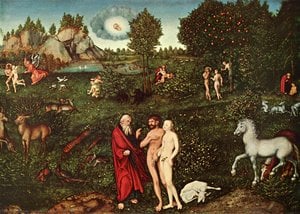
Frühes Leben und Ausbildung
Lucas Cranach der Ältere, ein bedeutender deutscher Renaissance-Maler und Grafiker, wurde vermutlich um den 4. Oktober 1472 in Kronach, Oberfranken, geboren. Sein genauer Geburtstag ist unbekannt. Er erlernte das Zeichnen von seinem Vater, Hans Maler, und vervollkommnete seine Fähigkeiten später unter der Anleitung lokaler süddeutscher Meister.
Karrierehöhepunkte
Lucas Cranach der Ältere fiel Herzog Friedrich III., dem Kurfürsten von Sachsen, auch bekannt als Friedrich der Weise, durch sein Talent auf. 1504 wurde er Hofmaler der sächsischen Kurfürsten in Wittenberg, eine Position, die er den Großteil seiner Karriere innehatte.
- Er war bekannt für seine Porträts deutscher Fürsten und führender Persönlichkeiten der Reformation, darunter Martin Luther.
- Cranach malte auch religiöse Themen, zunächst im katholischen Stil, erkundete später aber neue Wege, um lutherische Anliegen in der Kunst auszudrücken.
- Seine Werkstatt produzierte zahlreiche Werke, darunter Versionen, die von seinem Sohn Lucas Cranach dem Jüngeren und anderen fortgesetzt wurden, auch nach seinem Tod.
Bedeutende Werke und Kooperationen
Zu den bedeutendsten Werken Lucas Cranachs des Älteren gehören:
- Die Wildschutze des Kurfürsten Friedrich III. der Weisen (1529), ein Meisterwerk, das seine Fähigkeit zeigt, die Essenz des nordeuropäischen Renaissancestils einzufangen.
- Selbstbildnis, eine eindrucksvolle Darstellung des Künstlers, die sein Geschick im Einfangen von Licht und Schatten demonstriert.
- Die Verkündigung an Joachim (1516-18), eine Szene voller fröhlicher Stimmung, heute im Szépművészeti Múzeum in Budapest zu sehen.
Entwicklung und Einfluss
Cranachs Stil entwickelte sich im Laufe seiner Karriere weiter. Anfänglich beeinflusst von der Donauschule, entwickelte er einen eigenen, unverwechselbaren Stil, der durch klare Linien, leuchtende Farben und eine gewisse Monumentalität gekennzeichnet ist. Sein Werk spiegelt den Wandel von der spätgotischen Kunst zur Renaissance wider und zeigt gleichzeitig die Auswirkungen der Reformation auf die Kunstwelt. Er war eng mit Martin Luther verbunden und trug dazu bei, dessen Ideen durch seine Grafiken und Gemälde zu verbreiten. Cranachs Werkstatt war eine der bedeutendsten ihrer Zeit und trug maßgeblich zur Verbreitung des Renaissancestils in Deutschland bei.
Vermächtnis und Bedeutung
Lucas Cranach des Älteren hinterließ ein umfangreiches Œuvre, das als eines der wichtigsten Zeugnisse der deutschen Renaissance gilt. Seine Porträts sind nicht nur herausragende künstlerische Leistungen, sondern auch wertvolle historische Dokumente. Er trug maßgeblich zur Etablierung einer eigenständigen deutschen Kunst des 16. Jahrhunderts bei und beeinflusste zahlreiche nachfolgende Künstler. Sein Werk wird bis heute geschätzt und studiert.



 Vorschau anzeigen
 Handgemalte Reproduktion bestellen
 Versenden
 Teilen
 Details anzeigen

 Herunterladen
 Ähnliche Objekte
 Röntgenaufnahme
 Diashow
 Statistiken


 Weiterlesen






































 Die Glasoption ist nur für Größen unter 110 cm verfügbar.