x
Vorschau anzeigenVorschau anzeigen In AR erlebenIn AR erleben Handgemalte Reproduktion bestellen Handgemalte Reproduktion bestellenBild kaufen Bild kaufen VersendenVersenden
Details anzeigenDetails anzeigen Zu Favoriten hinzufügen Zu Favoriten hinzufügen HerunterladenHerunterladen Ähnliche ObjekteÄhnliche Objekte RöntgenaufnahmeRöntgenaufnahme DiashowDiashow

Thomas and Wilhelmine

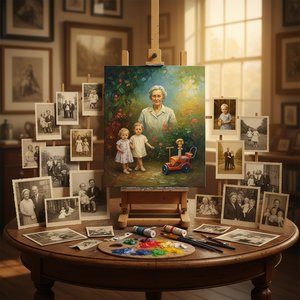
Lovis Corinth's "Thomas and Wilhelmine" (1916) captures two children with poignant realism, reflecting the artist’s journey through Impressionism & Expressionism. Explore this iconic portrait.

Entdecken Sie Lovis Corinth (1858-1925), den deutschen Maler zwischen Impressionismus & Expressionismus! Berühmt für Porträts, Landschaften u. kraftvolle Darstellungen – inkl. 'In der Schlachthofszene'. Sein Vermächtnis als Präsident der Berliner Sezession.

Giclée / Kunstdruck

Giclée- oder Leinwanddruck in Museumsqualität mit schneller Produktion und flexiblen Veredelungsoptionen. (Handgemalte Reproduktion bestellen Handgemalte Reproduktion bestellenBild kaufen Bild kaufen)

P118B $10
P118H $10
P118W $10
P438Z $10
P508JH $12
P508YH $12
P805H $10
P805Z $10
P919BZ $10
P919G $10
P919XJ $10
P959ZH $10
P968JZ $12
W106C $8
W218G $10
W218JH $8
W218Y $10
W307PJ $10
W316G $10
W316PJ $8
W316Y $10
W398PJ $8
W4111J $10
W500HY $15
W500JH $15
W692G $12
W849H $8
W940BG $15
W953PJ $8

Standardformat
individuell anpassbar
CM
INCH

Wählen Sie aus unseren vordefinierten Formaten, die den ursprünglichen Proportionen des Kunstwerks entsprechen.

Breite
Höhe

Sie können Ihre eigenen Maße eingeben, um ein bestimmtes Format oder einen speziellen Platz einzupassen. Wenn das von Ihnen gewählte Format nicht den Proportionen des Originalbildes entspricht, werden wir das Kunstwerk entweder beschneiden oder das Bild mit einem gespiegelten oder einfarbigen Rand erweitern. Ein digitaler Entwurf wird Ihnen zur Genehmigung zugesandt, bevor die Produktion beginnt.
Bitte beachten Sie, dass die Vorschau auf dem Bildschirm nicht den tatsächlichen Zuschnitt oder die Erweiterung widerspiegelt. Nur der Entwurf zeigt die endgültige Komposition präzise an.
Obwohl Sondermaße verfügbar sind, empfehlen wir die Auswahl eines Maßes aus der vordefinierten Liste, um die ursprünglichen Proportionen zu bewahren.

Weltweiter Versand () innerhalb von 2 Wochen statt der üblichen 4/5 Wochen. (1 September)

why_choose_icon
Kostenloser weltweiter Expressversand
why_choose_icon
Hochwertige Leinenleinwand
why_choose_icon
Umfassender Versicherungsschutz beim Versand
why_choose_icon
Zollgebühren-Rückerstattungsgarantie
why_choose_icon
Garantie für exakte Farbtreue
why_choose_icon
60 Tage Rückgaberecht (nur bei Mängeln)
why_choose_icon
100% Geld-zurück-Garantie
why_choose_icon
Mengenrabatt verfügbar

Gesamtpreis

$ 68

reproduction

Thomas and Wilhelmine

Giclée / Kunstdruck

Format der Reproduktion

-

Gesamtpreis

$ 68

Eckdaten

  • Influences:
    • Impressionism
    • Symbolism
  • Artistic style: Vibrant colors, loose brushwork
  • Subject or theme: Family intimacy, childhood
  • Medium: Oil on canvas
  • Dimensions: 165 x 96 cm
  • Title: Thomas and Wilhelmine
  • Year: 1916

Kunst-Quiz

Jede Frage hat nur eine richtige Antwort.

Frage 1:
What artistic movement is Lovis Corinth most closely associated with?
Frage 2:
In the painting 'Thomas and Wilhelmine', what is most evident about the children's relationship?
Frage 3:
What year was the painting 'Thomas and Wilhelmine' created?
Frage 4:
Lovis Corinth suffered a stroke in which year, significantly impacting his artistic style?
Frage 5:
The painting utilizes strong backlighting. What effect does this primarily create?

The Tender Embrace: Lovis Corinth’s “Thomas and Wilhelmine”

Lovis Corinth's "Thomas and Wilhelmine," painted in 1916, isn’t merely a portrait; it’s a poignant distillation of childhood innocence captured within the burgeoning complexities of early 20th-century Europe. The painting depicts two young siblings – Thomas and Wilhelmine – standing side by side, their postures radiating a quiet intimacy that belies the turbulent era in which it was created. Corinth, a master of capturing fleeting moments and intense emotion, eschews traditional formality for a remarkably candid portrayal, inviting us into a private world of familial connection.

The scene unfolds within what appears to be a modest interior – a glimpse of a wooden chair, a partially visible chest of drawers, and a window offering a soft, diffused light. Corinth’s masterful use of chiaroscuro—the dramatic contrast between light and shadow—draws our attention immediately to the children themselves. Their faces, rendered with remarkable sensitivity, hold an expression of gentle curiosity and shared contentment. Wilhelmine, on the left, gazes downwards, her hand instinctively reaching for Thomas's, a gesture that speaks volumes about their bond. Thomas, positioned slightly further back, turns his head towards the viewer, creating a direct connection with the observer – a subtle invitation to share in this quiet moment.

A Painter’s Evolution: Corinth and the Berlin Secession

Understanding “Thomas and Wilhelmine” requires placing it within the context of Lovis Corinth's artistic journey. Initially associated with the more rigid traditions of Munich’s Academy, Corinth quickly gravitated towards the avant-garde circles of Berlin, becoming a prominent figure in the Berlin Secession. This group challenged established norms, embracing bold colors, expressive brushwork, and a focus on depicting the realities of modern life – often with an emotional intensity that resonated deeply with viewers. His early work was influenced by Courbet’s realism, but Corinth swiftly developed his own distinctive style, characterized by vibrant hues, loose brushstrokes, and a profound empathy for his subjects.

The painting's creation coincided with a period of significant personal transformation for Corinth. Following a debilitating stroke in 1911, he experienced a shift in perspective, moving away from the grand narratives of earlier works towards smaller-scale depictions of everyday life and intimate relationships. This change is powerfully evident in “Thomas and Wilhelmine,” where the focus isn’t on elaborate composition or historical grandeur but rather on the simple beauty of childhood connection.

Symbolism of Innocence and Connection

Beyond its immediate depiction, "Thomas and Wilhelmine" carries a rich symbolic weight. The children's youthful faces represent an unspoiled innocence – a fleeting moment before the complexities and challenges of adulthood intrude upon their lives. Their intertwined hands symbolize not only familial love but also a shared vulnerability and mutual support. Corinth’s deliberate choice to depict them in a domestic setting suggests a reverence for the sanctity of family life, particularly during a time marked by social upheaval and uncertainty.

The muted palette—dominated by earthy tones and soft blues—contributes to the painting's overall atmosphere of quiet contemplation. The light filtering through the window acts as a gentle guide, illuminating the children’s faces and highlighting their connection. Corinth masterfully uses this light to create a sense of warmth and intimacy, drawing the viewer into their world.

A Legacy of Emotional Intensity

"Thomas and Wilhelmine" stands as a testament to Lovis Corinth's extraordinary ability to capture the essence of human emotion through his art. It’s a painting that transcends mere representation, offering instead a glimpse into the heart of familial love and the enduring beauty of childhood innocence. Reproductions of this work retain its power to evoke a sense of nostalgia and quiet contemplation, making it a cherished addition to any collection or interior space. Its timeless appeal lies in Corinth's ability to distill complex emotions into a single, unforgettable image – a tender embrace frozen in time.


Über den Künstler

Frühes Leben und Ausbildung

Lovis Corinth, geboren Franz Heinrich Louis am 21. Juli 1858 in Tapiau, Preußen, war ein deutscher Künstler und Schriftsteller, dessen reifes Werk als Maler und Grafiker eine Synthese aus Impressionismus und Expressionismus realisierte. Corinthians frühes Leben war geprägt von seinem Talent zum Zeichnen, das ihn dazu veranlasste, ab 1876 an der Akademie Königsbergs Malerei zu studieren.

Künstlerische Entwicklung

Corinthians künstlerische Entwicklung wurde von mehreren Schlüsselfiguren und Bewegungen beeinflusst:
  • Lovis Corinth's frühe Arbeit war naturalistisch geprägt, was durch seinen Lehrer Otto Günther gefördert wurde.
  • Er studierte unter Ludwig von Löfftz an der Akademie der Bildenden Künste München, die eine sorgfältige Beobachtung von Farben und Werten betonte.
  • Corinth wurde auch von Courbet und der Barbizon-Schule sowie von den Werken Rubes während seiner Zeit in Antwerpen beeinflusst.

Wichtige Werke und Stil

Zu Corinthians bemerkenswertesten Werken gehören:
  • In der Schlachthof-Szene (78 x 89 cm, Staatsgalerie Stuttgart, Deutschland), das seine Verwendung von Öl auf Leinwand zeigt.
  • Selbstbildnis (47 x 53 cm, Kunsthalle Bremen, Deutschland), das sein Können im Zeichnen demonstriert.
  • weibliche Halbnackte mit Hut (283 x 383 cm, Kunstpalast Düsseldorf, Deutschland), das seine Verwendung von Bleistift hervorhebt.

Späteres Leben und Vermächtnis

Corinthians späteres Leben war geprägt von seiner Präsidentschaft der Berliner Sezession von 1915 bis 1925. Er veröffentlichte auch zahlreiche Essays über Kunstgeschichte, darunter "Das Erlernen der Malerei" im Jahr 1908. Corinth starb am 17. Juli 1925 nach einem Schlaganfall im Jahr 1911, der ihn teilweise gelähmt hatte. Wichtige Links:

Bedeutung und Einfluss

Corinth gilt als einer der wichtigsten Künstler des deutschen Modernismus. Seine Werke verbinden impressionistische Elemente mit expressionistischen Tendenzen, was ihm eine einzigartige Position in der Kunstgeschichte einbrachte. Er beeinflusste nachfolgende Generationen von Künstlern und trug maßgeblich zur Entwicklung der modernen Kunst in Deutschland bei. Sein Einfluss ist bis heute spürbar.
Lovis Corinth

Lovis Corinth

1858 - 1925 , Niederlande

Kurzinfos

  • Beeinflusste Künstler:
    • Kirchner
    • Beckmann
    • Baselitz
  • Bemerkenswerte Werke:
    • In der Schlachthof-Szene
    • Selbstbildnis
    • Female Semi-Nude with Hat
  • Einflüsse:
    • Courbet
    • Barbizon Schule
    • Rubens
  • Geburtsdatum: 21. Juli 1858

  • Geburtsort: Tauwade, Niederlande
  • Künstlerische Richtung: Impressionismus & Expressionismus
  • Nationalität: Deutsch
  • Sterbedatum: 17. Juli 1925
  • Vollständiger Name: Lovis Corinth (Franz Heinrich Louis)
Entdecken Sie Kunstwerke, die nach Themen, Stilen und Merkmalen sortiert sind.