In echtem Maßstab anzeigen In AR an der Wand sehen Handgemalte Reproduktion kaufen Zum digitalen Bild wechseln Versenden als Grußkarte
Details anzeigen Leitfaden Zu Favoriten hinzufügen Herunterladen Ähnliche Objekte Röntgenaufnahme Diashow Besucherstatistiken

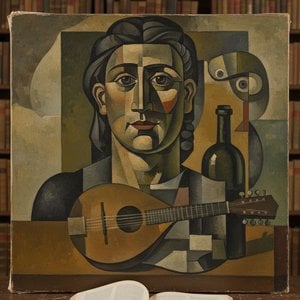
Man in the Cafe

Juan Gris’s ‘Man in the Cafe’ (1912) is a fragmented analytical cubist masterpiece depicting a man in a Parisian cafe, showcasing geometric forms and subtle tonal variations. Explore this iconic work by the Spanish visionary and bring home a piece of art history.

Entdecken Sie Juan Gris (1887-1927), den spanischen Kubismus-Meister! Erforschen Sie seinen geometrischen Stil, synthetische Kubismus & bleibenden Einfluss auf die moderne Kunst. Kunstwerke jetzt entdecken.

Giclée / Kunstdruck

Giclée- oder Leinwanddruck in Museumsqualität mit schneller Produktion und flexiblen Veredelungsoptionen. ( Handgemalte Reproduktion kaufen Zum digitalen Bild wechseln)

P118B $10
P118H $10
P118W $10
P438Z $10
P508JH $12
P508YH $12
P805H $10
P805Z $10
P919BZ $10
P919G $10
P919XJ $10
P959ZH $10
P968JZ $12
W106C $8
W218G $10
W218JH $8
W218Y $10
W307PJ $10
W316G $10
W316PJ $8
W316Y $10
W398PJ $8
W4111J $10
W500HY $15
W500JH $15
W692G $12
W849H $8
W940BG $15
W953PJ $8

Standardformat
individuell anpassbar
CM
INCH

Wählen Sie aus unseren vordefinierten Formaten, die den ursprünglichen Proportionen des Kunstwerks entsprechen.

Breite
Höhe

Sie können Ihre eigenen Maße eingeben, um ein bestimmtes Format oder einen speziellen Platz einzupassen. Wenn das von Ihnen gewählte Format nicht den Proportionen des Originalbildes entspricht, werden wir das Kunstwerk entweder beschneiden oder das Bild mit einem gespiegelten oder einfarbigen Rand erweitern. Ein digitaler Entwurf wird Ihnen zur Genehmigung zugesandt, bevor die Produktion beginnt.
Bitte beachten Sie, dass die Vorschau auf dem Bildschirm nicht den tatsächlichen Zuschnitt oder die Erweiterung widerspiegelt. Nur der Entwurf zeigt die endgültige Komposition präzise an.
Obwohl Sondermaße verfügbar sind, empfehlen wir die Auswahl eines Maßes aus der vordefinierten Liste, um die ursprünglichen Proportionen zu bewahren.

Weltweiter Versand () innerhalb von 2 Wochen statt der üblichen 4/5 Wochen. (22 September)

why_choose_icon
Kostenloser weltweiter Expressversand
why_choose_icon
Hochwertige Leinenleinwand
why_choose_icon
Vollständiger Versicherungsschutz beim Versand
why_choose_icon
Zollgebühren-Rückerstattungsgarantie
why_choose_icon
Garantie für exakte Farbtreue
why_choose_icon
100-tägiges Rückgaberecht (nur bei Mängeln)
why_choose_icon
100% Geld-zurück-Garantie
why_choose_icon
Angebot für Mengenrabatt

Gesamtpreis

$ 68

reproduction

Man in the Cafe

Giclée / Kunstdruck

Format der Reproduktion

-

Gesamtpreis

$ 68

Kurzübersicht

  • Artistic style: Analytical Cubism
  • Movement: Cubism
  • Title: Man in the Café
  • Artist: Juan Gris
  • Dimensions: 128 x 88 cm
  • Subject or theme: Cafe Scene; Portraiture
  • Year: 1912

Kunst-Quiz

Jede Frage hat nur eine richtige Antwort.

Frage 1:
What artistic movement is “Man in the Cafe” primarily associated with?
Frage 2:
Which artist created "Man in the Cafe"?
Frage 3:
What is a key characteristic of Analytical Cubism as exemplified by this painting?
Frage 4:
Where is “Man in the Cafe” currently housed?
Frage 5:
The painting utilizes a subdued color palette. What contributes to this aesthetic?

A Fragmented Portrait: Exploring Juan Gris’s “Man in the Cafe”

Juan Gris’s “Man in the Cafe,” completed in 1912, stands as a cornerstone of Analytical Cubism—a movement that irrevocably altered the landscape of European art. More than just a depiction of a Parisian café scene, it's an intellectual experiment meticulously crafted to dismantle traditional notions of perspective and representation.

  • The Style: Analytical Cubism rejects illusionistic depth, favoring instead geometric forms—cylinders, cones, cubes—that overlap and intersect to create a complex spatial arrangement. This approach wasn’t merely stylistic; it reflected a profound philosophical questioning of how we perceive reality.
  • Technique: Gris employed oil paint on canvas with remarkable precision, applying thin layers of pigment to achieve subtle tonal variations and highlighting the interplay between planes. The artist's meticulous attention to detail underscores his commitment to capturing not just what is seen but also how it feels—a sense of quiet contemplation amidst urban bustle.

Historical Context: Challenging Artistic Conventions

Born José Victoriano González-Pérez in Madrid, Gris’s artistic journey began with an engineering education, demonstrating a methodical mind that would later translate into his groundbreaking visual explorations. Influenced by Pablo Picasso and Georges Braque—the architects of Cubism—Gris sought to push the boundaries of artistic expression during a period marked by significant intellectual ferment.

The movement emerged in Paris around 1907, responding to the burgeoning avant-garde spirit of the era. Artists like Picasso and Braque were actively dismantling established conventions, prioritizing geometric abstraction over realistic depiction—a daring stance that challenged the prevailing aesthetic sensibilities of their time.

Symbolism Within Fragmentation

Despite its apparent simplicity, “Man in the Cafe” is laden with symbolic significance. The obscured face of the man represents anonymity and universality—suggesting that he embodies the human condition itself. The pipe and bottle serve as grounding elements, anchoring the fragmented forms within a recognizable environment.

The muted color palette—dominated by earthy tones—contributes to the painting’s melancholic mood, mirroring the contemplative gaze of the subject. Gris's deliberate use of color reinforces the emotional resonance of the scene, inviting viewers to contemplate themes of isolation and introspection.

Emotional Impact & Legacy

"Man in the Cafe" continues to captivate audiences today with its masterful blend of technique and conceptual innovation. It serves as a testament to Gris’s unwavering belief in the transformative power of art—a conviction that resonates across generations of artists and collectors alike.

Reproductions of this iconic artwork offer an opportunity to experience firsthand the profound aesthetic and intellectual legacy of Analytical Cubism, transporting viewers into the heart of a pivotal moment in artistic history. Its enduring appeal underscores the timeless beauty found within fragmented forms and contemplative observation.


Biografie des Künstlers

Juan Gris: Ein Pionier des Kubismus

  • Geboren: 23. März 1887, Madrid, Spanien
  • Gestorben: 11. Mai 1927

Frühes Leben und künstlerische Entwicklung

José Victoriano González-Pérez, besser bekannt als Juan Gris, wurde in Madrid, Spanien, geboren. Sein frühes Leben umfasste ein Studium der Ingenieurwissenschaften an der School of Arts and Sciences von 1902 bis 1904. Während dieser Zeit trug er Zeichnungen zu lokalen Periodika bei und demonstrierte so eine frühe Begabung für die visuelle Darstellung. Von 1904 bis 1905 studierte Gris Malerei bei José Moreno Carbonero und entwickelte seine künstlerischen Fähigkeiten weiter. Im Jahr 1905 nahm er den Pseudonym Juan Gris an, einen Namen, der mit seinem unverwechselbaren Stil in Verbindung gebracht werden sollte.

Pariser Einflüsse und die Entstehung des Kubismus

Ein entscheidender Moment in Gris’ Karriere kam im Jahr 1906, als er nach Paris zog. Diese Umsiedlung führte ihn in eine lebendige Kunstgemeinschaft, wo er Freundschaften mit einflussreichen Persönlichkeiten wie Henri Matisse, Georges Braque und Fernand Léger schloss. Er wurde tiefgreifend von Pablo Picasso beeinflusst und reichte zunächst humorvolle Illustrationen an Zeitschriften wie *L'Assiette au Beurre*, *Le Rire*, *Le Charivari* und *Le Cri de Paris* ein. Um 1910 begann Gris ernsthaft zu malen und widmete sich der Entwicklung eines persönlichen kubistischen Stils. Er löste sich von der satirischen Illustration hin zu abstrakteren Kompositionen.

Wichtige Werke und künstlerischer Stil

Juan Gris’ künstlerisches Schaffen ist durch mehrere Schlüsselfeatures gekennzeichnet:

  • Klarheit und Ordnung: Seine Arbeit betonte Klarheit und Ordnung, was den Puristenstil beeinflusste, der von Amédée Ozenfant und Charles Edouard Jeanneret (Le Corbusier) vertreten wurde.
  • Geometrische Struktur: Gris’ „Kristallperiode“, wie sie in Werken wie *Stillleben vor einem offenen Fenster* und *Place Ravignan* (1915) gezeigt wird, präsentierte eine starke geometrische Struktur.
  • Synthetischer Kubismus: Nach 1913 nahm Gris den synthetischen Kubismus an und verwendete Techniken wie Papier collé oder Collage ausgiebig. Dies beinhaltete die Einbeziehung von Materialien aus der realen Welt in seine Gemälde, wodurch Textur und Tiefe hinzugefügt wurden.

Bemerkenswerte Werke sind:

  • Gitarre vor dem Meer (1925): Demonstriert seine Einfachheit und sein Festhalten an kubistischen Prinzipien.
  • Hommage à Pablo Picasso (1912): Seine erste Ausstellung im Salon des Indépendants, ein Beweis für seine wachsende Anerkennung in der Kunstwelt.

Vermächtnis und historische Bedeutung

Juan Gris’ Beitrag zum Kubismus ist von großer Bedeutung. Er ging über die frühere analytische Phase der Bewegung hinaus zu einem strukturierteren und synthetischeren Ansatz. Sein Fokus auf Klarheit, geometrische Formen und die Einbeziehung alltäglicher Objekte in seine Kompositionen etablierten ihn als eine führende Figur in der Kunst des 20. Jahrhunderts. Seine Arbeit wird weiterhin für ihre intellektuelle Strenge und ästhetische Schönheit gefeiert und beeinflusst nachfolgende Generationen von Künstlern.

Juan Gris

Juan Gris

1887 - 1927 , Spanien

Eckdaten zum Künstler

  • Beeinflusste Künstler/Bewegungen:
    • Amédée Ozenfant
    • Charles Edouard Jeanneret
  • Bemerkenswerte Werke:
    • Gitarre vor dem Meer
    • Hommage à Pablo Picasso
    • Stillleben vor Fenster
    • Place Ravignan
    • Fruchtkorb mit Zeitung
  • Geburtsdatum: 23. März 1887
  • Geburtsort: Madrid, Spanien
  • Künstlerische Bewegung: Kubismus, Synthetischer Kubismus
  • Künstlerische Einflüsse:
    • Pablo Picasso
    • Georges Braque
    • Henri Matisse
  • Nationalität: Spanisch
  • Sterbedatum: 11. Mai 1927
  • Vollständiger Name: Juan Gris
Entdecken Sie Kunstwerke, die nach Themen, Stilen und Merkmalen sortiert sind.