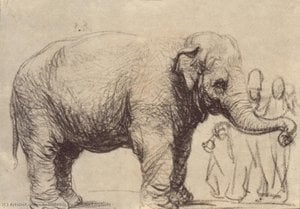
The art world is replete with masterpieces that continue to inspire and awe us. One such remarkable piece is
Circus Elephants, created by the renowned American artist
John Steuart Curry in 1936. This lithograph on paper, measuring 30 x 41 cm, is a testament to Curry's unique style and technique.
Artist Background
John Steuart Curry was a prominent figure in the Regionalist movement, which sought to capture the essence of American life and culture. His works often featured everyday scenes, landscapes, and people, showcasing his ability to find beauty in the mundane.
Circus Elephants is a prime example of this, as it depicts a group of elephants standing in a line, exuding a sense of majesty and wonder.
The Painting's Significance
Circus Elephants is not only a visually striking piece but also holds significant cultural and historical value. The painting is part of the collection at the
Smithsonian American Art Museum, which is dedicated to preserving and showcasing American art from the colonial period to the present. This museum is a treasure trove of artistic masterpieces, including works by other notable artists such as
Balcomb Greene and
Walter Ufer.
- Technique: Curry's use of lithography on paper creates a sense of texture and depth, adding to the overall visual appeal of the piece.
- Composition: The arrangement of the elephants in a line creates a sense of harmony and balance, drawing the viewer's eye through the composition.
- Symbolism: Elephants have long been symbols of strength, wisdom, and good fortune, adding an extra layer of meaning to the painting.
Handmade oil paintings reproductions of
Circus Elephants can be found on https://WahooArt.com, allowing art enthusiasts to own a piece of history. For more information on
John Steuart Curry and his works, visit /art/list/?Filter=john+steuart+curry,john,steuart,curry&.
The captivating world of
John Steuart Curry is a testament to the power of art to inspire and educate us. Through his works, including
Circus Elephants, we gain a glimpse into the past and a deeper understanding of the cultural and historical context in which they were created.
Fragen & Antworten
Ist "Circus Elephants" von John Steuart Curry gemeinfrei?
"Circus Elephants" von John Steuart Curry ist gemeinfrei – das Urheberrecht ist abgelaufen. Dieser Status bestimmt, wie das Bild des Werkes vervielfältigt werden darf.
Wo kann ich eine digitale Abbildung von "Circus Elephants" von John Steuart Curry kaufen?
Ein digitales Bild von "Circus Elephants" von John Steuart Curry kann auf der entsprechenden Digitales Bild-Seite erworben werden: ein hochauflösender digitaler Bild-Download.
Worum geht es in "Circus Elephants"?
"Circus Elephants" von John Steuart Curry zeigt: animals, circus.



 In echtem Maßstab anzeigen
 Handgemalte Reproduktion kaufen
 Versenden als Grußkarte
 Teilen
 Details anzeigen
 Leitfaden öffnen

 Herunterladen
 Ähnliche Objekte
 Röntgenaufnahme
 Diashow
 Besucherstatistiken

 Mehr anzeigen






































 Die Glasoption ist nur für Größen unter 110 cm verfügbar.