A Symphony of Sky and Stone
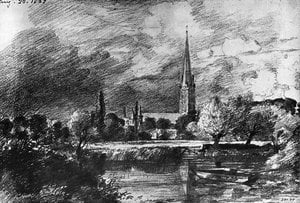
In the vast, sweeping expanse of John Constable’s “Old Sarum,” viewers are invited into a moment where time seems to hold its breath. Completed during the height of his creative powers, this masterpiece transcends mere topographical recording; it is a profound meditation on the ephemeral nature of human endeavor against the enduring majesty of the natural world. As the eye wanders across the canvas, one is immediately struck by the dramatic interplay of light and shadow, a hallmark of the Romantic movement that breathes life into the English landscape. The scene is dominated by a massive, verdant hill, its summit crowned with the skeletal, crumbling remains of ancient structures, creating a poignant juxtaposition between decaying stone and the vibrant, living pulse of the grassy slopes.
Constable’s approach to this work distinguishes him from his predecessors who favored idealized, static representations. While firmly rooted in the Romantic tradition—characterized by an emphasis on emotion and imagination—his technique subtly anticipates the fleeting energy of Impressionism. He employed loose, deliberate brushstrokes, layering colors to capture the atmospheric drama of a day that feels both peaceful and restless. The sky, a central protagonist in this composition, is thick with the scent of impending rain; swirling clouds in shades of slate, pearl, and charcoal drift across the upper half of the work, suggesting a heavy, moisture-laden air that threatens to break into a summer storm. This brooding atmosphere does not merely serve as a backdrop but acts as a psychological force, casting soft, diffused light across the undulating terrain.
The Soul of the English Landscape
At its core, “Old Sarum” presents a sprawling field bathed in a light that feels both intimate and grand. Scattered throughout the composition are the quiet rhythms of rural life: farmers tending to their crops and horses grazing peacefully, grounding the monumental landscape in the beauty of the everyday. The placement of these figures is masterful; for instance, the positioning of the horses on the right side draws the viewer's gaze upward toward the castle, creating a silent visual dialogue between man and nature. This integration of life within the vastness of the Salisbury Plain emphasizes the grandeur of the surroundings while celebrating the humble persistence of agricultural tradition.
For the discerning collector or interior designer, this painting offers an unparalleled emotional depth. It brings a sense of quiet contemplation and historical weight to any curated space, making it an ideal centerpiece for rooms designed for reflection. The artwork’s ability to capture the "fleeting moment"—the subtle shifts in light as it filters through moving clouds—provides a dynamic energy that can transform the atmosphere of a home. Whether viewed as a window into the soul of the English countryside or as a study in atmospheric texture, “Old Sarum” remains a timeless testament to Constable’s unwavering dedication to portraying the natural world with unparalleled honesty and profound emotion.
Fragen & Antworten
Ist "Old Sarum" urheberrechtlich frei?
Was das Urheberrecht betrifft, so ist "Old Sarum" gemeinfrei – das Urheberrecht ist abgelaufen.
In welchem Jahr und welcher Stilrichtung wurde "Old Sarum" geschaffen?
"Old Sarum" entstand im Jahr 1829 innerhalb der Romantic Landscape-Bewegung.
Welches Gefühl wird mit "Old Sarum" assoziiert?
„Old Sarum“ ist mit einem Tranquil Gefühl verbunden. Der emotionale Ton beschreibt den Eindruck, den das Werk vermittelt.



 In echtem Maßstab anzeigen
 Zum Druck wechseln
 Versenden als Grußkarte
 Teilen
 Details anzeigen
 Leitfaden öffnen

 Herunterladen
 Ähnliche Objekte
 Röntgenaufnahme
 Diashow
 Besucherstatistiken

 Mehr anzeigen






































 Die Glasoption ist nur für Größen unter 110 cm verfügbar.