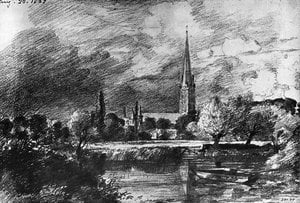
John Constable’s ‘The Grove or Admiral’s House’: A Symphony of Light and Rural Tranquility
John Constable's “The Grove or Admiral’s House,” painted in 1822, isn’t merely a depiction of a landscape; it’s an immersion into the very soul of the English countryside. This remarkable work, measuring a modest 60 x 50 cm, embodies the core tenets of the Romantic movement – a profound reverence for nature and a yearning to capture its fleeting beauty with unparalleled emotional honesty. Constable, born in East Bergholt, Suffolk, possessed an extraordinary ability to translate the subtle shifts of light and atmosphere onto canvas, imbuing his scenes with a palpable sense of life and feeling. The painting’s genesis is deeply intertwined with his family's connection to Dedham Vale, providing him with an intimate understanding of the region’s rhythms and textures that would forever inform his artistic vision.
A Composition Steeped in Romantic Ideals
At first glance, “The Grove or Admiral’s House” presents a seemingly simple scene: a grand but approachable house, distinguished by its vibrant red roof, nestled within a verdant grove. However, beneath this surface lies a carefully constructed composition designed to evoke a specific mood. The placement of the house, partially obscured by trees, creates a sense of mystery and invites the viewer’s eye to wander through the landscape. The two chimneys rising proudly from the structure suggest both grandeur and domestic comfort – a harmonious blend of human presence and natural beauty. Crucially, Constable masterfully employs atmospheric perspective; distant elements fade into softer hues, creating an illusion of depth that draws us further into the scene. The scattered birds in the sky aren’t merely decorative; they contribute to the feeling of lively movement and vitality within the tranquil setting.
Technique and the Language of Light
Constable's technique is characterized by a remarkable sensitivity to light and color. He eschewed the rigid academic conventions of his time, favoring instead a looser, more expressive style that prioritized capturing the *impression* of a scene rather than meticulously rendering every detail. His brushstrokes are visible, adding texture and dynamism to the canvas. Notice how he uses broken color – applying small, distinct strokes of paint side-by-side – to create shimmering effects on the water and foliage. This technique brilliantly simulates the way light interacts with surfaces, lending a remarkable sense of realism and luminosity to the painting. The subtle gradations of tone, from the deep shadows beneath the trees to the bright highlights reflecting off the house’s roof, are executed with exquisite precision.
Symbolism and the Essence of Rural Life
Beyond its aesthetic beauty, “The Grove or Admiral’s House” is rich in symbolic meaning. The grand house itself represents a connection to established order and tradition, yet it's framed by the untamed wilderness of the grove. This juxtaposition speaks to the Romantic fascination with the tension between civilization and nature – a theme prevalent throughout Constable’s oeuvre. The figure standing near the center of the painting is often interpreted as an observer, perhaps contemplating the beauty of the landscape or simply enjoying a moment of respite. It subtly reminds us of our own place within this vast and enduring natural world. The scene evokes a sense of timelessness, suggesting that this particular moment in nature will continue to unfold with unwavering serenity.
A Legacy of Romantic Vision
“The Grove or Admiral’s House” stands as a testament to John Constable's genius and his profound understanding of the English landscape. It is a painting that invites contemplation, offering a glimpse into a world where beauty, tranquility, and the spirit of nature reign supreme. WahooArt offers meticulously crafted reproductions of this iconic work, allowing you to bring its captivating atmosphere into your home or office. Whether you are an art enthusiast, a collector seeking a piece of British heritage, or simply someone who appreciates exquisite artistry, a reproduction of “The Grove or Admiral’s House” is sure to be a treasured addition to any space.
Fragen & Antworten
Wie stark ist der Kontrast in "Der Hain oder Admiralshaus" von John Constable?
Der Kontrastwert von "Der Hain oder Admiralshaus" von John Constable ist Stark kontrastiert.
Welchem Künstler wird "Der Hain oder Admiralshaus" zugeschrieben?
"Der Hain oder Admiralshaus" wird John Constable zugeschrieben.
Welche Leuchtkraft weist "Der Hain oder Admiralshaus" von John Constable auf?
Die für "Der Hain oder Admiralshaus" von John Constable aufgezeichnete Luminanz beträgt Sanfter Schatten.
Unter welchen anderen Namen ist John Constable bekannt?
Weitere unter denen John Constable, Schöpfer von „Der Hain oder Admiralshaus“, bekannt ist, umfassen Johann Konstanze.
Wie kann ich das Bild von "Der Hain oder Admiralshaus" von John Constable herunterladen?
Das Bild von "Der Hain oder Admiralshaus" von John Constable kann auf der Download-Seite des Kunstwerks heruntergeladen werden: ein hochauflösender digitaler Bild-Download.
Wie kann ich eine Reproduktion von "Der Hain oder Admiralshaus" von John Constable in der Vorschau ansehen?
Um eine Reproduktion von "Der Hain oder Admiralshaus" von John Constable in der Vorschau zu sehen, öffnen Sie die Vorschau-Seite des Kunstwerks.
Wo finde ich Statistiken zu "Der Hain oder Admiralshaus" von John Constable?
Für „Der Hain oder Admiralshaus“ existiert eine Statistiken-Seite. Sie zeigt die monatlichen Aufrufe des Kunstwerks sowie der weiteren Werke des Künstlers mit einer Aufschlüsselung nach Land und Sprache an.
Welche Emotion vermittelt das Werk der Romantic Landscape „Der Hain oder Admiralshaus“?
Innerhalb der Romantic Landscape-Strömung ist „Der Hain oder Admiralshaus“ mit einem Gelassen Ton festgehalten.



 In echtem Maßstab anzeigen
 Handgemalte Reproduktion kaufen
 Versenden als Grußkarte
 Teilen
 Details anzeigen
 Leitfaden öffnen

 Herunterladen
 Ähnliche Objekte
 Röntgenaufnahme
 Diashow
 Besucherstatistiken


 Mehr anzeigen






































 Die Glasoption ist nur für Größen unter 110 cm verfügbar.