x
Vorschau anzeigenVorschau anzeigen In AR erlebenIn AR erleben Handgemalte Reproduktion bestellen Handgemalte Reproduktion bestellenBild kaufen Bild kaufen VersendenVersenden
Details anzeigenDetails anzeigen Zu Favoriten hinzufügen Zu Favoriten hinzufügen HerunterladenHerunterladen Ähnliche ObjekteÄhnliche Objekte RöntgenaufnahmeRöntgenaufnahme DiashowDiashow

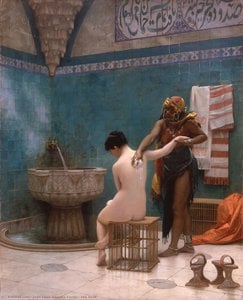
Moorish Bath

Delve into Victorian Orientalism with Jean-Léon Gérôme’s breathtaking *Moorish Bath*, a meticulously crafted Academic masterpiece capturing the opulent serenity of Ottoman bathhouses—a stunning visual journey for art lovers.

Entdecken Sie Jean-Léon Gérôme (1824–1904), französischen Meister des 19. Jh., bekannt für detailreiche historische & orientalistische Szenen! Beeinflusste Sargent & Cassatt.

Giclée / Kunstdruck

Giclée- oder Leinwanddruck in Museumsqualität mit schneller Produktion und flexiblen Veredelungsoptionen. (Handgemalte Reproduktion bestellen Handgemalte Reproduktion bestellenBild kaufen Bild kaufen)

P118B $10
P118H $10
P118W $10
P438Z $10
P508JH $12
P508YH $12
P805H $10
P805Z $10
P919BZ $10
P919G $10
P919XJ $10
P959ZH $10
P968JZ $12
W106C $8
W218G $10
W218JH $8
W218Y $10
W307PJ $10
W316G $10
W316PJ $8
W316Y $10
W398PJ $8
W4111J $10
W500HY $15
W500JH $15
W692G $12
W849H $8
W940BG $15
W953PJ $8

Standardformat
individuell anpassbar
CM
INCH

Wählen Sie aus unseren vordefinierten Formaten, die den ursprünglichen Proportionen des Kunstwerks entsprechen.

Breite
Höhe

Sie können Ihre eigenen Maße eingeben, um ein bestimmtes Format oder einen speziellen Platz einzupassen. Wenn das von Ihnen gewählte Format nicht den Proportionen des Originalbildes entspricht, werden wir das Kunstwerk entweder beschneiden oder das Bild mit einem gespiegelten oder einfarbigen Rand erweitern. Ein digitaler Entwurf wird Ihnen zur Genehmigung zugesandt, bevor die Produktion beginnt.
Bitte beachten Sie, dass die Vorschau auf dem Bildschirm nicht den tatsächlichen Zuschnitt oder die Erweiterung widerspiegelt. Nur der Entwurf zeigt die endgültige Komposition präzise an.
Obwohl Sondermaße verfügbar sind, empfehlen wir die Auswahl eines Maßes aus der vordefinierten Liste, um die ursprünglichen Proportionen zu bewahren.

Weltweiter Versand () innerhalb von 2 Wochen statt der üblichen 4/5 Wochen. (4 September)

why_choose_icon
Kostenloser weltweiter Expressversand
why_choose_icon
Hochwertige Leinenleinwand
why_choose_icon
Umfassender Versicherungsschutz beim Versand
why_choose_icon
Zollgebühren-Rückerstattungsgarantie
why_choose_icon
Garantie für exakte Farbtreue
why_choose_icon
60 Tage Rückgaberecht (nur bei Mängeln)
why_choose_icon
100% Geld-zurück-Garantie
why_choose_icon
Mengenrabatt verfügbar

Gesamtpreis

$ 68

reproduction

Moorish Bath

Giclée / Kunstdruck

Format der Reproduktion

-

Gesamtpreis

$ 68

Eckdaten

  • Artistic style: Orientalist
  • Title: Moorish Bath
  • Artist: Jean Léon Gérôme
  • Location: Museum of Fine Arts Boston
  • Medium: Oil on canvas
  • Notable elements or techniques: Detailed realism, Light and color palette
  • Movement: Academicism

Kunst-Quiz

Jede Frage hat nur eine richtige Antwort.

Frage 1:
What artistic style is Jean-Léon Gérôme’s Moorish Bath primarily characterized by?
Frage 2:
Where was Jean-Leon Gerome's Moorish Bath originally exhibited?
Frage 3:
What inspired Gérôme’s fascination with Orientalist themes?
Frage 4:
The painting depicts a scene within a Moorish bathhouse. What is prominent in the setting?
Frage 5:
What does Gérôme’s use of light and color contribute to in Moorish Bath?

A Glimpse Into the Opulent Orient

In the heart of the nineteenth century, few artists possessed the ability to transport a Parisian salon to the sun-drenched, tile-clad sanctuaries of the Middle East as masterfully as Jean-Léon Gérôme. His 1870 masterpiece, Moorish Bath, serves as more than a mere painting; it is a meticulously crafted window into a world of exotic luxury and quiet intimacy. As a cornerstone of the Orientalist movement, this work captures a profound moment within a Hammam, where the boundaries between reality and romanticized fantasy blur. The scene unfolds with a breathtaking sense of stillness, inviting the viewer to step past the threshold of the everyday and into a space defined by cool shadows, shimmering water, and the rhythmic beauty of ancient rituals.

The composition is anchored by a delicate tension between the figures within the frame. A seated lady, often identified as Circassian, rests amidst the splendor of her surroundings, while an attendant prepares for the ritual of cleansing. This interaction is not merely a depiction of hygiene but a choreographed dance of service and grace. Gér erne’s ability to capture the soft textures of skin against the hard, glazed surfaces of the architecture creates a sensory experience that is almost tactile. For the discerning collector or interior designer, this piece offers an unparalleled depth, providing a focal point that commands attention through its narrative complexity and serene atmosphere.

Mastery of Academic Realism and Light

Technically, Moorish Bath represents the pinnacle of French Academicism. Gérôme was renowned for his photographic precision, a skill honed through rigorous training and fueled by his firsthand observations during travels to North Africa and Egypt. Every element in the painting—from the intricate Arabic calligraphy etched into the blue wall tiles to the subtle reflections dancing upon the surface of the stone basin—is rendered with an almost scientific accuracy. His use of color is particularly evocative; a palette dominated by tranquil blues and earthy tones creates a cooling effect, mirroring the literal temperature of the bathhouse itself.

The artist employs light not just to illuminate, but to sculpt. Light filters into the space as if through high, unseen apertures, catching the glint of gold jewelry and the moisture on the skin, lending the scene a luminous, ethereal quality. This mastery of chiaroscuro—the play between light and shadow—adds a layer of psychological depth to the work. The shadows are not merely dark voids but are filled with the suggestion of heat, humidity, and the heavy, fragrant air of an enclosed sanctuary. Such technical brilliance ensures that a high-quality reproduction of this work retains its ability to transform any room, adding a sense of historical weight and sophisticated texture to a modern interior.

Symbolism and the Legacy of Orientalism

To look upon Moorish Bath is to engage with the complex cultural dialogues of the Victorian era. While Gérôme’s work was deeply rooted in the Orientalist fascination with the "Exotic East," his approach transcends simple caricature. Through his meticulous attention to architectural detail and ethnographic observation, he provides a scholarly, albeit idealized, tribute to Ottoman aesthetics. The bathhouse itself symbolizes a sanctuary of privacy and ritual, a space where the social hierarchies of the era are momentarily suspended in favor of personal rejuvenation.

For those seeking to decorate with art that tells a story, this painting offers a rich tapestry of symbolism. It speaks of the intersection between the domestic and the divine, the private and the public, and the enduring allure of the unknown. Whether placed in a grand library or a contemporary living space, the emotional impact of Gérôme’s work remains potent. It evokes a sense of wanderlust and a deep appreciation for the craftsmanship of a bygone era, making it an essential acquisition for anyone looking to infuse their environment with culture, history, and an everlasting sense of wonder.


Über den Künstler

Frühe Jahre und Ausbildung

Jean-Léon Gérôme, ein renommierter französischer Maler und Bildhauer, wurde am 11. Mai 1824 in Vesoul, Haute-Saône geboren. Seine frühe künstlerische Ausbildung erhielt er von dem lokalen Künstler Claude-Basile Cariage. Im Jahr 1840 zog er nach Paris, um unter Paul Delaroche zu studieren und besuchte später die École des Beaux-Arts.

Aufstieg zum Ruhm

Gérômes Gemälde Die Stierkampf (1846) brachte ihm 1847 eine dritte Auszeichnung beim Pariser Salon ein. Dieses Werk wurde als Inbegriff der Neo-Grec-Bewegung angesehen und katapultierte seine Karriere. Er wurde zu einem der einflussreichsten Lehrer seiner Zeit, wobei Schüler wie Thomas Eakins, John Singer Sargent und Mary Cassatt zu seinen Schützlingen gehörten.

Wichtige Aufträge

Gérôme erhielt den Auftrag, ein großes Wandgemälde mit dem Titel Das Zeitalter des Augustus, die Geburt Christi zu malen. Dieses Werk vereinte die Darstellung der Geburt Christi mit der Huldigung des Augustus durch unterworfene Nationen und sollte Napoleon III. schmeicheln, der es in Auftrag gegeben hatte.

Künstlerischer Stil und Vermächtnis

Gérômes Gemälde zeichneten sich durch seine akribische Detailgenauigkeit, lebendigen Farben und dramatische Beleuchtung aus. Er verwendete oft historische oder mythologische Themen, um Themen wie Macht, Gewalt und Sexualität zu erkunden. Seine orientalistischen Gemälde, wie Haremfrauen füttern Tauben im Innenhof, wurden für ihre exotischen Schauplätze und die erotisierten Darstellungen von Frauen aus dem Nahen Osten hoch geschätzt.

Schlussfolgerung

Jean-Léon Gérômes künstlerisches Vermächtnis ist ein Beweis für seinen innovativen Stil und seine technische Fertigkeit. Als einflussreicher Lehrer und Künstler hat er bleibende Spuren in der Kunstwelt hinterlassen. Seine Werke inspirieren und faszinieren das Publikum bis heute. Wichtige Daten:
  • Mai 1824: Geburt in Vesoul, Haute-Saône
  • 1840: Umzug nach Paris zur Studienzeit bei Paul Delaroche
  • 1846: Malte Die Stierkampf
  • 10. Januar 1904: Tod in Paris
Jean-Léon Gérôme

Jean-Léon Gérôme

1824 - 1904 , Frankreich

Kurzinfos

  • Beeinflusste Künstler:
    • Thomas Eakins
    • John Singer Sargent
    • Mary Cassatt
  • Bemerkenswerte Werke:
    • Der Hahnkampf
    • Öffentliches Gebet in Kairo
    • Harem Frauen füttern Tauben
  • Geburtsdatum: 11. Mai 1824
  • Geburtsort: Vesoul, Frankreich
  • Künstlerische Richtung: Neoklassizismus, Orientalismus
  • Nationalität: Französisch
  • Todatum: 10. Januar 1904
  • Vollständiger Name: Jean-Léon Gérôme
Entdecken Sie Kunstwerke, die nach Themen, Stilen und Merkmalen sortiert sind.