A Symphony of Rococo Elegance
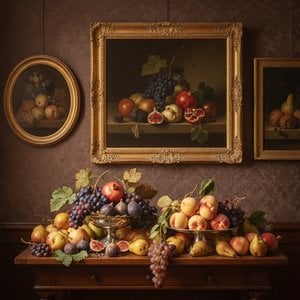
In the heart of the early eighteenth century, amidst the burgeoning splendor of the French Rococo movement, Jean-Baptiste Oudry captured a moment of timeless abundance in his masterpiece, Still Life with Fruit. Painted in 1721, this work is far more than a mere arrangement of perishable delights; it is a sensory experience that invites the viewer into an era of opulent leisure and refined naturalism. As one gazes upon the canvas, the eye is immediately drawn to the meticulous orchestration of textures and light. Apples glisten with a soft, dew-kissed radiance, while pears nestle against velvety foliage, creating a tactile landscape that feels almost within reach. The composition is a masterclass in balance, where the deep crimson of cherries and the luscious, cascading weight of grapes provide a vibrant counterpoint to the subtle, earthy tones of the surrounding elements.
Oudry’s technical prowess is most evident in his use of the glazing technique, a method that allows for the layering of translucent pigments over opaque underlayers. This approach imbues the fruit with an inner luminosity, making the peaches appear soft and sun-ripened and the plums possess a deep, mysterious luster. Every brushstroke serves the purpose of illusion, blurring the line between the painted surface and the physical world. The addition of a small bird perched delicately upon an apple introduces a sudden, charming note of life, breaking the stillness of the arrangement and adding a layer of narrative intrigue that keeps the observer engaged in a continuous dance of discovery.
Historical Splendor and Symbolic Depth
To understand this painting is to understand the soul of Louis XV’s France. During this period, the aristocracy sought art that reflected their elevated status through themes of elegance, asymmetry, and playful ornamentation. Still Life with Fruit embodies this aristocratic appetite for beauty and the celebration of nature's bounty. The arrangement acts as a window into a world of pastoral serenity, where the fleeting moment of perfection is frozen in time. Beyond its surface-level beauty, the artwork carries profound symbolic weight; the abundance of fruit serves as a classic emblem of fertility, prosperity, and the bountiful gifts of the earth, mirroring the perceived stability and wealth of the era.
For the discerning collector or interior designer, this piece offers an unparalleled opportunity to introduce a sense of historical grandeur and sophisticated charm into a contemporary space. The painting’s ability to harmonize vibrant colors with soft, atmospheric light makes it a versatile centerpiece, capable of anchoring a room with its classical dignity while providing a focal point of organic warmth. Whether placed in a sunlit gallery or a moody, formal study, an exquisite reproduction of Oudry’s work brings with it the prestige of the French Rococo, transforming any environment into a sanctuary of artful refinement and enduring grace.



 Vorschau anzeigen
 Handgemalte Reproduktion bestellen
 Versenden
 Teilen
 Details anzeigen

 Herunterladen
 Ähnliche Objekte
 Röntgenaufnahme
 Diashow
 Stats
Stats


 Weiterlesen






































 Die Glasoption ist nur für Größen unter 110 cm verfügbar.