Kostenlose Kunstberatung

x
Gemälde kaufen Gemälde kaufenBild kaufen Bild kaufen VersendenVersenden
DetailsDetails Zu Favoriten hinzufügen Zu Favoriten hinzufügen HerunterladenHerunterladen Ähnliche ObjekteÄhnliche Objekte RöntgenaufnahmeRöntgenaufnahme Diashow anzeigenDiashow anzeigen

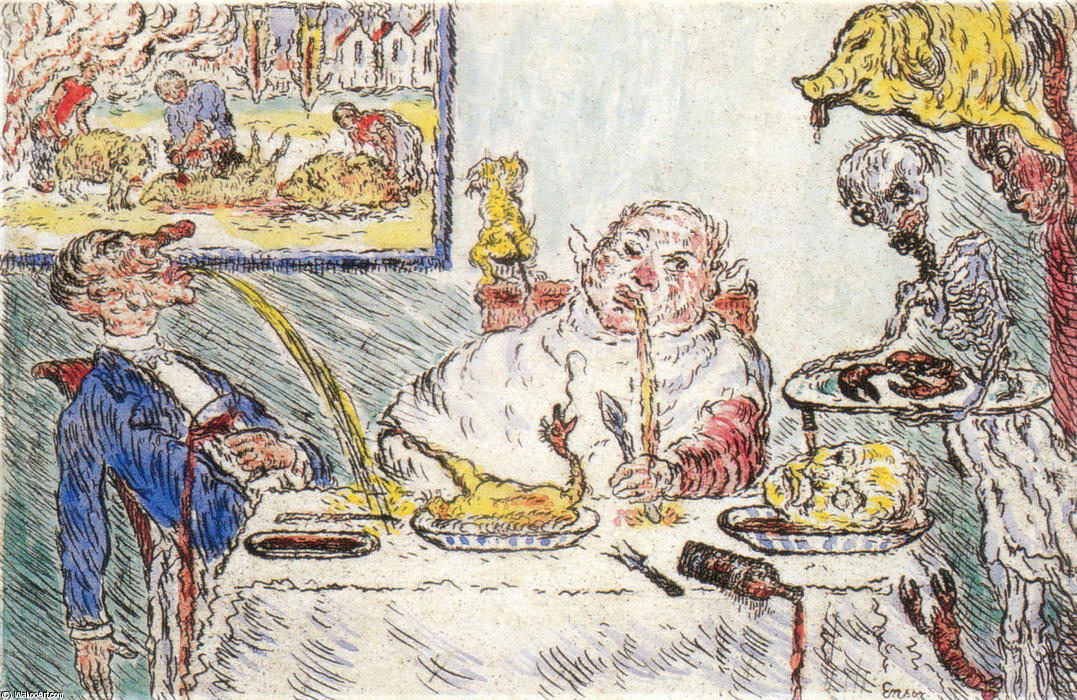
Gluttony

James Ensor's unsettling 'Gluttony,' from The Deadly Sins series (1904), depicts a decadent dining table scene—a masterful exploration of excess and moral decay through stark black and white etching.

Entdecken Sie James Ensor (1860-1949), einen bahnbrechenden belgischen Maler und Grafiker. Erkunden Sie seine verstörenden, traumhaften Szenen von Masken, Karnevalen und Skeletten, die Expressionismus und Surrealismus nachhaltig beeinflussten. #JamesEnsor #Expressionismus #Surrealismus #Bel

Giclée / Kunstdruck

Giclée- oder Leinwanddruck in Museumsqualität mit schneller Produktion und flexiblen Veredelungsoptionen.

P118B $10
P118H $10
P118W $10
P438Z $10
P508JH $12
P508YH $12
P805H $10
P805Z $10
P919BZ $10
P919G $10
P919XJ $10
P959ZH $10
P968JZ $12
W106C $8
W218G $10
W218JH $8
W218Y $10
W307PJ $10
W316G $10
W316PJ $8
W316Y $10
W398PJ $8
W4111J $10
W500HY $15
W500JH $15
W692G $12
W849H $8
W940BG $15
W953PJ $8

Standard
custom
CM
INCH

Wählen Sie aus unseren vordefinierten Größen, die den ursprünglichen Proportionen des Kunstwerks entsprechen.

Breite
Höhe

Sie können Ihre eigenen Maße eingeben, um ein bestimmtes Format oder einen speziellen Platz einzupassen. Wenn das von Ihnen gewählte Format nicht den Proportionen des Originalbildes entspricht, werden wir das Kunstwerk entweder beschneiden oder das Bild mit einem gespiegelten oder einfarbigen Rand erweitern. Ein digitaler Entwurf wird Ihnen zur Genehmigung zugesandt, bevor die Produktion beginnt.
Bitte beachten Sie, dass die Vorschau auf dem Bildschirm nicht den tatsächlichen Zuschnitt oder die Erweiterung widerspiegelt. Nur der Entwurf zeigt die endgültige Komposition präzise an.
Obwohl Sondermaße verfügbar sind, empfehlen wir die Auswahl eines Maßes aus der vordefinierten Liste, um die ursprünglichen Proportionen zu bewahren.

Weltweiter Versand () innerhalb von 2 Wochen statt der üblichen 4/5 Wochen. (2 Juli)

why_choose_icon
Kostenloser weltweiter Expressversand
why_choose_icon
Hochwertige Leinenleinwand
why_choose_icon
Umfassender Versicherungsschutz beim Versand
why_choose_icon
Zollsteuer-Rückerstattungsgarantie
why_choose_icon
Garantie für echte Farbtreue
why_choose_icon
60-Tage-Rückgaberecht (nur bei Mängeln)
why_choose_icon
100% Geld-zurück-Garantie
why_choose_icon
Mengenrabatt verfügbar

Gesamtpreis

-

reproduction

Gluttony

Giclée / Kunstdruck

Größe der Reproduktion

-

Endpreis aller Optionen

-

Eckdaten auf einen Blick

  • Movement: Expressionism
  • Location: MSK Gent
  • Artistic style: Surrealist
  • Subject or theme: Sin, Greed
  • Title: Gluttony
  • Medium: Etching, heightened
  • Artist: James Ensor

Kunst-Quiz

Jede Frage hat nur eine richtige Antwort.

Frage 1:
What is the primary subject matter depicted in James Ensor’s ‘Gluttony’?
Frage 2:
The etching technique employed by James Ensor in ‘Gluttony’ is known for its:
Frage 3:
‘Gluttony’ belongs to Ensor's influential series ‘The Seven Deadly Sins’. What is the overarching purpose of this series?
Frage 4:
According to the image description, what is prominent in the composition?
Frage 5:
James Ensor’s stylistic approach is characterized by:

Beschreibung des Sammlerstücks

James Ensor’s *Gluttony*: A Descent into the Grotesque

James Ensor's Gluttony (circa 1897) is not merely a depiction of a dinner party; it’s a profoundly unsettling exploration of human excess, societal decay, and perhaps most significantly, the anxieties simmering beneath the surface of late Victorian Europe. Painted in stark black and white, the canvas immediately confronts the viewer with a scene of almost unbearable tension. The figures seated around the table – three primary subjects and two indistinct background individuals – are rendered with an unsettling realism that borders on caricature. Their postures, expressions, and the sheer abundance of food on the table contribute to a palpable sense of unease, hinting at a feast not of pleasure but of something far more sinister.

  • Subject Matter: The painting’s subject is straightforward – a group consuming a meal. However, Ensor elevates this commonplace scene into a powerful allegory for moral corruption and the dangers of unchecked indulgence.
  • Style & Technique: Ensor's style aligns with the Symbolist movement, prioritizing emotional expression over strict representational accuracy. His technique employs bold, expressive brushstrokes and a deliberate flattening of perspective, creating a claustrophobic atmosphere that intensifies the psychological impact of the scene. The monochromatic palette further amplifies this effect, stripping away any potential distractions and focusing attention on the figures’ distorted features and the unsettling arrangement of objects.

Historical Context & Ensor's Vision

Created during a period of rapid social change and growing anxieties in Europe – marked by industrialization, urbanization, and burgeoning psychological theories – *Gluttony* reflects these concerns. Ensor was deeply influenced by the Symbolist movement, which sought to express subjective emotions and ideas through symbolic imagery rather than objective representation. His personal background also played a crucial role; his upbringing amidst the vibrant, often unsettling atmosphere of Ostend, a port town known for its carnivals and eccentric characters, undoubtedly shaped his artistic vision. The souvenir shop run by his parents – filled with masks, curiosities, and objects that hinted at hidden meanings – provided him with a rich visual vocabulary that he would later employ to great effect.

Ensor’s rejection of the rigid academic traditions of the Brussels Academy was deliberate. He sought to create art that spoke directly to the subconscious, confronting viewers with uncomfortable truths rather than offering pleasant illusions. This commitment to psychological realism is evident in *Gluttony*, where the figures are not simply eating; they are trapped within a cycle of self-indulgence and moral degradation.

Symbolism & Emotional Impact

The symbolism embedded within *Gluttony* is layered and complex. The abundance of food itself represents excess, waste, and perhaps even a symbolic representation of the sins of mankind. The distorted faces of the figures suggest a loss of identity and an inability to escape their own appetites. The presence of masks – subtly alluded to in the artist’s broader oeuvre – reinforces the theme of disguise and deception. The overall effect is profoundly unsettling, evoking feelings of anxiety, dread, and perhaps even disgust. Ensor masterfully uses composition and technique to create a scene that feels both familiar and deeply disturbing, inviting viewers to confront their own anxieties about morality, consumption, and the darker aspects of human nature.

  • Color Palette: The deliberate use of black and white heightens the dramatic effect and emphasizes the painting's psychological intensity.
  • Composition: The tightly framed composition creates a sense of confinement and intensifies the viewer’s engagement with the scene.

Perfecting Your Collection – A WahooArt Reproduction

WahooArt offers meticulously crafted hand-painted reproductions of James Ensor's *Gluttony*, capturing every nuance of detail and emotional intensity of the original artwork. Our skilled artisans employ traditional techniques, using archival quality materials to ensure that your reproduction will retain its beauty and vibrancy for generations to come. Whether you are a seasoned art collector, an interior designer seeking to create a dramatic focal point, or simply someone captivated by Ensor’s unsettling vision, a WahooArt reproduction of *Gluttony* is the perfect way to bring this iconic masterpiece into your home or workspace.


Biografie des Künstlers

frühes Leben und künstlerische Reise

James Sidney Edward, Baron Ensor, ein prominenter belgischer Maler und Grafiker, wurde am 13. April 1860 in Ostend, Belgien, geboren. Sein frühes Leben war von einem vielfältigen kulturellen Hintergrund geprägt, mit einem englischen Vater, James Frederic Ensor, und einer belgischen Mutter, Maria Catherina Haegheman. Ensor zeigte wenig Interesse an traditionellen akademischen Studien und verließ die Schule mit fünfzehn Jahren, um sich der Kunst zu widmen, zunächst bei lokalen Malern und später am Académie Royale des Beaux-Arts in Brüssel.

Künstlerischer Stil und Themen

Ensor's künstlerischer Stil war durch seine Auseinandersetzung mit dem Unterbewusstsein und traumhaften Bildern gekennzeichnet, der die Expressionismus und Surrealismus maßgeblich beeinflusste. Seine Gemälde zeigten oft bizarre Motive, darunter Karnevale, Masken, Puppenspiel, Skelette und fantastische Allegorien. Bekannte Werke sind Die Schändlichen Masken (1883) und Skelette kämpfen um eine gehängte Person (1891), die seine einzigartige Mischung aus Groteskem und Fantasievollem zeigen.

Anerkennung und Vermächtnis

Trotz anfänglicher Ablehnung gewann Ensor's Werk allmählich Anerkennung und Anklang. Bis 1920 war er das Thema bedeutender Ausstellungen; im Jahr 1929 wurde er zum Baron durch König Albert ernannt, und 1933 erhielt er die Légion d’honneur. Sein Vermächtnis als Pionier der modernen Kunst ist in seinem Einfluss auf nachfolgende künstlerische Bewegungen, einschließlich Expressionismus und Surrealismus, erkennbar.

Wichtige Werke und Ausstellungen

* Die Intrige (90 x 150 cm, Koninklijk Museum voor Schone Kunsten, Antwerpen, Belgien) * Die Qualen des Heiligen Antonius (1887, heute im Besitz der Sammlung des Museum of Modern Art, New York) Ensor's innovativer Stil und sein mutiger Ansatz für die Kunst haben einen unauslöschlichen Eindruck in der Welt der modernen Kunst hinterlassen.

James Ensor

James Ensor

1860 - 1949 , Belgien

Kurzinfos

  • Beeinflusste Künstler:
    • Pieter Bruegel der Ältere
    • Francisco Goya
  • Bemerkenswerte Werke:
    • Die Schmählichen Masken
    • Christus in Brüssel
    • Tribulationen des Heiligen Antonius
  • Geburtsdatum: 1860-04-13
  • Geburtsort: Ostende, Belgien
  • Künstlerische Richtung: Expressionismus, Symbolismus
  • Nationalität: Belgisch
  • Todatum: 1949-11-19
  • Vollständiger Name: James Ensor
  • Von Künstlern Beeinflusst: ['']
Entdecken Sie Kunstwerke, die nach Themen, Stilen und Merkmalen sortiert sind.