In echtem Maßstab anzeigen In AR an der Wand sehen Zum Druck wechseln Zum digitalen Bild wechseln Versenden als Grußkarte

Details anzeigen Leitfaden öffnen Zu Favoriten hinzufügen Herunterladen Ähnliche Objekte Röntgenaufnahme Diashow Besucherstatistiken

Thursday April 17

Discover iosu aramburu, a Peruvian visual artist renowned for exploring modernity, Andean history, and architecture through innovative painting, sculpture, and installation. Dive into his impactful work on Latin American modernism.

Handgefertigte Ölreproduktion

Handgemaltes Ölgemälde auf Leinwand in Ihrer Wunschgröße und mit Rahmen, auf Bestellung von unseren Künstlern angefertigt. ( Zum Druck wechseln Zum digitalen Bild wechseln)

Standardformat
individuell anpassbar
CM
INCH

Wählen Sie aus unseren vordefinierten Formaten, die den ursprünglichen Proportionen des Kunstwerks entsprechen.

Breite
Höhe

Sie können Ihre eigenen Maße eingeben, um einen bestimmten Rahmen oder Platz auszufüllen. Wenn die gewählte Größe nicht den Proportionen des Originalbildes entspricht, werden wir das Kunstwerk entweder beschneiden oder das Gemälde durch zusätzliche, handgemalte Elemente erweitern. Ein digitales Mockup wird Ihnen zur Genehmigung zugesandt, bevor die Produktion beginnt.
Bitte beachten Sie, dass die Bildschirmvorschau nicht die tatsächliche Beschneidung oder Erweiterung widerspiegelt. Nur das Mockup zeigt die endgültige Komposition exakt an.
Obwohl Sondermaße verfügbar sind, empfehlen wir, eine Größe aus der vordefinierten Liste zu wählen, um die ursprünglichen Proportionen beizubehalten.

Beispiele für Anpassungsmöglichkeiten: Gesicht durch Kundenfoto ersetzen; Haustier hinzufügen (z. B. Katze durch Hund ersetzen); eine versteckte Nachricht im Hintergrund einfügen; Hintergrundlandschaft oder -elemente ändern.
Nach der Bestellung wird das WahooArt.com-Team dem Kunden Anweisungen per E-Mail zusenden und eine Mockup-Vorschau bereitstellen.

Weltweiter Versand () in nur 3 bis 4 Wochen statt der üblichen 5 Wochen. (25 September). Keine Kompromisse bei der Qualität.

why_choose_icon
Kostenloser weltweiter Expressversand
why_choose_icon
Hochwertige Leinenleinwand
why_choose_icon
Vollständiger Versicherungsschutz beim Versand
why_choose_icon
Zollgebühren-Rückerstattungsgarantie
why_choose_icon
Garantie für exakte Farbtreue
why_choose_icon
100-tägiges Rückgaberecht (nur bei Mängeln)
why_choose_icon
100% Geld-zurück-Garantie
why_choose_icon
Angebot für Mengenrabatt

Gesamtpreis

$ 272

reproduction

Thursday April 17

Reproduktionsmedium

Format der Reproduktion

-

Gesamtpreis

$ 272


Biografie des Künstlers

A Reimagining of Modernity: The Visionary World of iosu aramburu

iosu aramburu emerges as a compelling voice in contemporary art, a Peruvian visual artist whose work transcends simple categorization. He isn’t merely painting or sculpting; he is excavating and reassembling the fragmented narratives of modernity within the Andean context. Born in Peru, aramburu dedicates his practice to exploring the utopian potentials inherent in early and mid-century modernism as it manifested—and was often reimagined—in Latin America. His research isn’t a nostalgic glance backward but a dynamic interrogation of how these architectural forms, social ideals, and artistic movements took root in a region grappling with its own unique history and identity.

Early Influences and Artistic Development

Aramburu's fascination stems from a deep engagement with the built environment of Peru and the broader Andean region. He doesn’t approach modernism as an imported style but rather as a localized phenomenon, shaped by indigenous traditions, political upheavals, and the specific geographical challenges of the Andes. His early work hinted at this preoccupation, often featuring abstracted landscapes punctuated by geometric forms reminiscent of modernist architecture. These weren't depictions of existing structures so much as echoes—ghosts of ambition and progress embedded within the natural world. This initial phase laid the groundwork for his more ambitious explorations into sculpture and installation, where he began to physically reconstruct fragments of this architectural past. The artist’s development is marked by a shift from representation towards reconstruction, from observing modernity to actively building its potential anew. He seeks not to replicate but to *reactivate* these forms, imbuing them with new meaning for a contemporary audience.

Themes and Symbolism in Aramburu's Work

At the heart of aramburu’s practice lies an investigation into the relationship between architecture, social utopias, and the human imagination. His installations often feature fragmented architectural elements—walls, staircases, windows—arranged in ways that disrupt traditional notions of space and functionality. These disruptions aren't arbitrary; they are deliberate attempts to challenge the perceived stability of modernist ideals. The recurring motif of the staircase, for example, can be interpreted as a symbol of both progress and impasse, representing the aspirations of modernity alongside its inherent limitations. His paintings frequently incorporate bold geometric shapes and vibrant colors, evoking the aesthetic language of early Latin American modernism while simultaneously introducing an element of surrealism. This juxtaposition creates a sense of uncanny familiarity, inviting viewers to question their own assumptions about history and progress. The artist’s work is deeply concerned with memory—the collective memories embedded within architectural structures and the individual experiences shaped by these spaces.

Major Achievements and Historical Significance

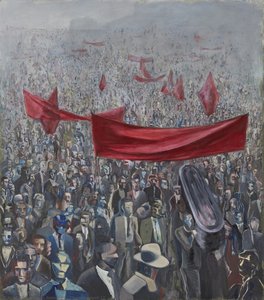
While still developing his career, aramburu has already garnered attention for his innovative approach to sculpture and installation. His piece “Thursday April 17” exemplifies his ability to create immersive environments that challenge viewers’ perceptions of space and history. The work, a fragmented architectural reconstruction, invites contemplation on the utopian ideals of modernism and their often-unfulfilled promises. Aramburu's significance lies in his refusal to treat Latin American modernism as a derivative of European or North American movements. He positions it as a distinct phenomenon—a unique response to specific historical, social, and geographical conditions. By excavating and reassembling the fragments of this past, he offers a powerful critique of colonial legacies and a hopeful vision for a more inclusive future. His work contributes to a broader conversation about the complexities of modernity and the importance of reclaiming marginalized narratives within art history. He is not simply documenting the past; he is actively shaping its future interpretation.

Eckdaten zum Künstler

  • Artistic Movement Or Style: Modernism, Installation
  • Full Name: iosu aramburu
  • Nationality: Peruvian
  • Notable Artworks: ['Thursday April 17']
  • Place Of Birth: Peru