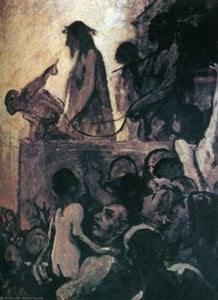
Ein Leben für Kunst und Aktivismus
Honoré-Victorin Daumier, ein französischer Grafiker, Karikaturist, Maler und Bildhauer, hinterließ einen bleibenden Eindruck auf die Kunstszene des 19. Jahrhunderts. Geboren am 26. Februar 1808 in Marseille und gestorben am 10. Februar 1879 in Paris, war Daumiers Leben ein Beweis für sein unermüdliches Engagement, das Wesen der französischen Gesellschaft einzufangen.
Frühes Leben und Einflüsse
Daumiers frühes Leben war geprägt von den literarischen Ambitionen seines Vaters, die die Familie 1814 nach Paris führten. Diese Begegnung mit der pulsierenden Kunstszene der Stadt beeinflusste Daumiers Neigung zur Kunst. Er begann seine Lehre unter Alexandre Lenoir und trat später der Académie Suisse bei.
Künstlerische Laufbahn
Daumiers umfangreiche Karriere umfasste mehrere Medien, darunter Lithografie, Malerei und Bildhauerei. Seine frühen Arbeiten waren durch anonyme Beiträge zu Verlagen gekennzeichnet, die den Stil von Charlet nachahmten und eine lebhafte Begeisterung für die napoleonische Legende zeigten. Nach der Revolution von 1830 wurde Daumiers Kunst offener politisch.
- Le Charivari, eine Comic-Zeitschrift, die von Charles Philipon gegründet wurde, bot Daumier eine Plattform für seine satirische Arbeit, die den Bourgeoisie und der Regierungsinkompetenz zum Ziel war.
- Seine Karikaturen von politischen Figuren und Satiren über gesellschaftliches Verhalten brachten ihm sowohl Anerkennung als auch Kontroversen ein, darunter sechs Monate Haft im Jahr 1832.
Bemerkenswerte Werke und Vermächtnis
- **
Rue Transnonain, 15. April 1834**: Eine ergreifende Lithografie, die das Massaker in der Rue Transnoin darstellt, Teil der Unruhen vom April 1834 in Paris. - **
Les Gens de Justice**: Eine scharfe Satire über den juristischen Beruf, die Daumiers Meisterschaft der Karikatur demonstriert.
**Daumiers Einfluss auf die Kunstgeschichte** Daumiers unerschütterliches Engagement für die Erfassung der Wahrheit der französischen Gesellschaft hat Generationen von Künstlern beeinflusst. Seine Werke sind in verschiedenen Museen und Sammlungen zu finden, darunter auch auf
WahooArt, das einen umfassenden Überblick über seine künstlerische Arbeit bietet.
- Erkunden Sie Daumiers Lithografien und Gemälde auf WahooArt.
- Entdecken Sie mehr über französische Kunstrichtungen, darunter den Realismus, auf Wikipedia.
Schlussfolgerung
Daumiers Leben war ein Beweis für sein unermüdliches Engagement, das Wesen der französischen Gesellschaft einzufangen. Durch seine Kunst inspiriert und provoziert er weiterhin und bietet einen einzigartigen Einblick in Frankreich des 19. Jahrhunderts.
- Das Musée d'Orsay in Paris beherbergt einige von Daumiers restaurierten ungebrannten Tonfiguren.
- Erfahren Sie mehr über Daumiers Leben und Werk auf WahooArt.



 In echtem Maßstab anzeigen
 Handgemalte Reproduktion kaufen
 Versenden als Grußkarte
 Teilen
 Details anzeigen
 Leitfaden

 Herunterladen
 Ähnliche Objekte
 Röntgenaufnahme
 Diashow
 Besucherstatistiken


 Mehr anzeigen






































 Die Glasoption ist nur für Größen unter 110 cm verfügbar.