Vorschau anzeigenVorschau anzeigen In AR erlebenIn AR erleben Handgemalte Reproduktion bestellen Handgemalte Reproduktion bestellenZum digitalen Bild wechseln Zum digitalen Bild wechseln VersendenVersenden
Details anzeigenDetails anzeigen Zu Favoriten hinzufügen Zu Favoriten hinzufügen HerunterladenHerunterladen Ähnliche ObjekteÄhnliche Objekte RöntgenaufnahmeRöntgenaufnahme DiashowDiashow StatistikenStatistiken

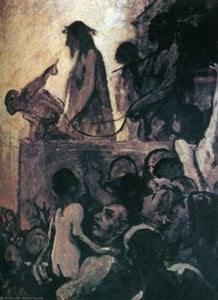
Comedy scene (scene from Molière)

Honore Daumier's 'Comedy Scene (Scene from Moliere)' captures a lively Parisian encounter with masterful draftsmanship and social commentary. Explore the dynamic scene of two men in a black & white painting, reflecting 19th-century French life.

Entdecken Sie Honoré Daumier (1808-1879), französischen Realisten & Satiriker! Seine Lithografien, Gemälde & Skulpturen kritisieren die Gesellschaft des 19. Jh.

Giclée / Kunstdruck

Giclée- oder Leinwanddruck in Museumsqualität mit schneller Produktion und flexiblen Veredelungsoptionen. (Handgemalte Reproduktion bestellen Handgemalte Reproduktion bestellenZum digitalen Bild wechseln Zum digitalen Bild wechseln)

P118B $10
P118H $10
P118W $10
P438Z $10
P508JH $12
P508YH $12
P805H $10
P805Z $10
P919BZ $10
P919G $10
P919XJ $10
P959ZH $10
P968JZ $12
W106C $8
W218G $10
W218JH $8
W218Y $10
W307PJ $10
W316G $10
W316PJ $8
W316Y $10
W398PJ $8
W4111J $10
W500HY $15
W500JH $15
W692G $12
W849H $8
W940BG $15
W953PJ $8

Standardformat
individuell anpassbar
CM
INCH

Wählen Sie aus unseren vordefinierten Formaten, die den ursprünglichen Proportionen des Kunstwerks entsprechen.

Breite
Höhe

Sie können Ihre eigenen Maße eingeben, um ein bestimmtes Format oder einen speziellen Platz einzupassen. Wenn das von Ihnen gewählte Format nicht den Proportionen des Originalbildes entspricht, werden wir das Kunstwerk entweder beschneiden oder das Bild mit einem gespiegelten oder einfarbigen Rand erweitern. Ein digitaler Entwurf wird Ihnen zur Genehmigung zugesandt, bevor die Produktion beginnt.
Bitte beachten Sie, dass die Vorschau auf dem Bildschirm nicht den tatsächlichen Zuschnitt oder die Erweiterung widerspiegelt. Nur der Entwurf zeigt die endgültige Komposition präzise an.
Obwohl Sondermaße verfügbar sind, empfehlen wir die Auswahl eines Maßes aus der vordefinierten Liste, um die ursprünglichen Proportionen zu bewahren.

Weltweiter Versand () innerhalb von 2 Wochen statt der üblichen 4/5 Wochen. (12 September)

why_choose_icon
Kostenloser weltweiter Expressversand
why_choose_icon
Hochwertige Leinenleinwand
why_choose_icon
Umfassender Versicherungsschutz beim Versand
why_choose_icon
Zollgebühren-Rückerstattungsgarantie
why_choose_icon
Garantie für exakte Farbtreue
why_choose_icon
100-Tage-Rückgaberecht (nur bei Mängeln)
why_choose_icon
100% Geld-zurück-Garantie
why_choose_icon
Mengenrabatt verfügbar

Gesamtpreis

$ 68

reproduction

Comedy scene (scene from Molière)

Giclée / Kunstdruck

Format der Reproduktion

-

Gesamtpreis

$ 68

Eckdaten

  • Year: 1862
  • Location: Museum Folkwang, Essen
  • Artist: Honoré Daumier
  • Movement: Realism
  • Artistic style: Caricature
  • Medium: Lithograph
  • Notable elements: Social satire

Kunst-Quiz

Jede Frage hat nur eine richtige Antwort.

Frage 1:
What is the primary subject matter depicted in Honoré Daumier’s ‘Comedy scene (scene from Molière)’?
Frage 2:
In what year was Honoré Daumier’s ‘Comedy scene (scene from Molière)’ created?
Frage 3:
The painting utilizes a predominantly monochrome palette. What artistic technique is most prominently employed to achieve this effect?
Frage 4:
Considering Honoré Daumier’s artistic style and historical context, what is a key theme explored in this artwork?
Frage 5:
Based on the image description, what is the overall composition of the painting?

A Moment of Contention: Honoré Daumier’s “Comedy Scene (Scene from Molière)”

Honoré Daumier's 1862 painting, "Comedy Scene (Scene from Molière)," isn’t merely a depiction of a theatrical moment; it’s a vibrant snapshot of Parisian society grappling with wit, social commentary, and the very nature of performance. The work, rendered in stark black and white – a signature technique for Daumier – immediately draws the viewer into a scene brimming with unspoken tension and subtle gestures. Two men dominate the foreground: one, animatedly gesturing upwards, seemingly addressing an unseen audience; the other, slumped downwards, his gaze fixed on his companion, perhaps lost in thought or responding to the first man’s pronouncements.

Beyond these central figures lies a carefully constructed backdrop of three additional individuals, subtly positioned in the background. Their presence isn't one of active participation but rather serves as a quiet reminder of the broader social context surrounding this private exchange. They are not integrated into the immediate drama, yet their inclusion suggests that this scene unfolds within a larger, more complex world – a world ripe for observation and critique, precisely what Daumier excelled at capturing.

The Artist’s Vision: Realism and Social Satire

Daumier was a pivotal figure in the development of French realism, but his work transcends simple representation. He wasn't interested in idealized beauty or romanticized narratives; instead, he sought to expose the uncomfortable truths of everyday life – particularly the hypocrisy and social inequalities prevalent in 19th-century France. His art became a powerful tool for social commentary, often targeting the aristocracy, the clergy, and the legal system. “Comedy Scene” is no exception, offering a glimpse into a private conversation that hints at underlying tensions and judgments.

The painting’s monochrome palette – predominantly shades of gray and white – contributes significantly to its dramatic effect. This deliberate choice eliminates distractions, forcing the viewer to focus on the figures' expressions and body language. Daumier masterfully employs chiaroscuro—the contrast between light and dark—to sculpt the forms and heighten the sense of drama. The sharp delineation of shadows emphasizes the characters’ postures and gestures, conveying a palpable atmosphere of anticipation and potential conflict.

A Stage Within a Stage: Molière and Parisian Society

The painting's title explicitly references Molière, the renowned French playwright whose comedies satirized societal norms. Daumier wasn’t simply illustrating a scene from one of Molière’s plays; he was capturing the *spirit* of theatrical performance itself – the interplay between performer and audience, the delivery of witty dialogue, and the subtle judgments exchanged during a dramatic moment. The implied setting is likely a Parisian theater, though Daumier deliberately avoids providing specific details, allowing the viewer to project their own interpretations onto the scene.

Furthermore, the painting reflects the vibrant intellectual and artistic life of 19th-century Paris. The Comédie-Française, France’s national theatre, was a central hub for social and political discourse. Daumier's work engages with this dynamic environment, offering a critical perspective on the role of theater in shaping public opinion and exposing societal flaws.

Symbolism and Emotional Resonance

The posture of the two men is particularly revealing. The man gesturing upwards embodies assertiveness and perhaps even arrogance, projecting his thoughts or opinions to an unseen audience. His elevated position suggests a desire for recognition or validation. Conversely, the slumped figure conveys a sense of resignation, doubt, or perhaps quiet disapproval. His downward gaze hints at a critical assessment of the first man’s pronouncements – a subtle challenge to his authority or perspective.

“Comedy Scene” is not a straightforward narrative; it's an invitation to observe and interpret. It evokes a sense of unease, prompting viewers to consider the complexities of human interaction and the often-hidden judgments that shape our perceptions. Daumier’s masterful use of composition, light, and gesture creates a timeless image that continues to resonate with audiences today, reminding us of the enduring power of satire and the importance of critical engagement with the world around us.


Über den Künstler

Ein Leben für Kunst und Aktivismus

Honoré-Victorin Daumier, ein französischer Grafiker, Karikaturist, Maler und Bildhauer, hinterließ einen bleibenden Eindruck auf die Kunstszene des 19. Jahrhunderts. Geboren am 26. Februar 1808 in Marseille und gestorben am 10. Februar 1879 in Paris, war Daumiers Leben ein Beweis für sein unermüdliches Engagement, das Wesen der französischen Gesellschaft einzufangen.

Frühes Leben und Einflüsse

Daumiers frühes Leben war geprägt von den literarischen Ambitionen seines Vaters, die die Familie 1814 nach Paris führten. Diese Begegnung mit der pulsierenden Kunstszene der Stadt beeinflusste Daumiers Neigung zur Kunst. Er begann seine Lehre unter Alexandre Lenoir und trat später der Académie Suisse bei.

Künstlerische Laufbahn

Daumiers umfangreiche Karriere umfasste mehrere Medien, darunter Lithografie, Malerei und Bildhauerei. Seine frühen Arbeiten waren durch anonyme Beiträge zu Verlagen gekennzeichnet, die den Stil von Charlet nachahmten und eine lebhafte Begeisterung für die napoleonische Legende zeigten. Nach der Revolution von 1830 wurde Daumiers Kunst offener politisch.
  • Le Charivari, eine Comic-Zeitschrift, die von Charles Philipon gegründet wurde, bot Daumier eine Plattform für seine satirische Arbeit, die den Bourgeoisie und der Regierungsinkompetenz zum Ziel war.
  • Seine Karikaturen von politischen Figuren und Satiren über gesellschaftliches Verhalten brachten ihm sowohl Anerkennung als auch Kontroversen ein, darunter sechs Monate Haft im Jahr 1832.

Bemerkenswerte Werke und Vermächtnis

- **Rue Transnonain, 15. April 1834**: Eine ergreifende Lithografie, die das Massaker in der Rue Transnoin darstellt, Teil der Unruhen vom April 1834 in Paris. - **Les Gens de Justice**: Eine scharfe Satire über den juristischen Beruf, die Daumiers Meisterschaft der Karikatur demonstriert. **Daumiers Einfluss auf die Kunstgeschichte** Daumiers unerschütterliches Engagement für die Erfassung der Wahrheit der französischen Gesellschaft hat Generationen von Künstlern beeinflusst. Seine Werke sind in verschiedenen Museen und Sammlungen zu finden, darunter auch auf WahooArt, das einen umfassenden Überblick über seine künstlerische Arbeit bietet.
  • Erkunden Sie Daumiers Lithografien und Gemälde auf WahooArt.
  • Entdecken Sie mehr über französische Kunstrichtungen, darunter den Realismus, auf Wikipedia.

Schlussfolgerung

Daumiers Leben war ein Beweis für sein unermüdliches Engagement, das Wesen der französischen Gesellschaft einzufangen. Durch seine Kunst inspiriert und provoziert er weiterhin und bietet einen einzigartigen Einblick in Frankreich des 19. Jahrhunderts.
  • Das Musée d'Orsay in Paris beherbergt einige von Daumiers restaurierten ungebrannten Tonfiguren.
  • Erfahren Sie mehr über Daumiers Leben und Werk auf WahooArt.
Honoré Daumier

Honoré Daumier

1808 - 1879 , Frankreich

Kurzinfos

  • Beeinflusste Künstler:
    • Camille Pissarro
    • Van Gogh
    • Cézanne
  • Bemerkenswerte Werke:
    • Rue Transnonain, 15. April 1834
    • Les Gens de Justice
  • Einflussreiche Künstler:
    • Alexandre Lenoir
    • Charlet
  • Geburtsdatum: 26. Februar 1808
  • Geburtsort: Marseille, Frankreich
  • Künstlerische Richtung: Realismus, Karikatur
  • Nationalität: Französisch
  • Todatum: 10. Februar 1879
  • Vollständiger Name: Honoré Daumier
Entdecken Sie Kunstwerke, die nach Themen, Stilen und Merkmalen sortiert sind.